
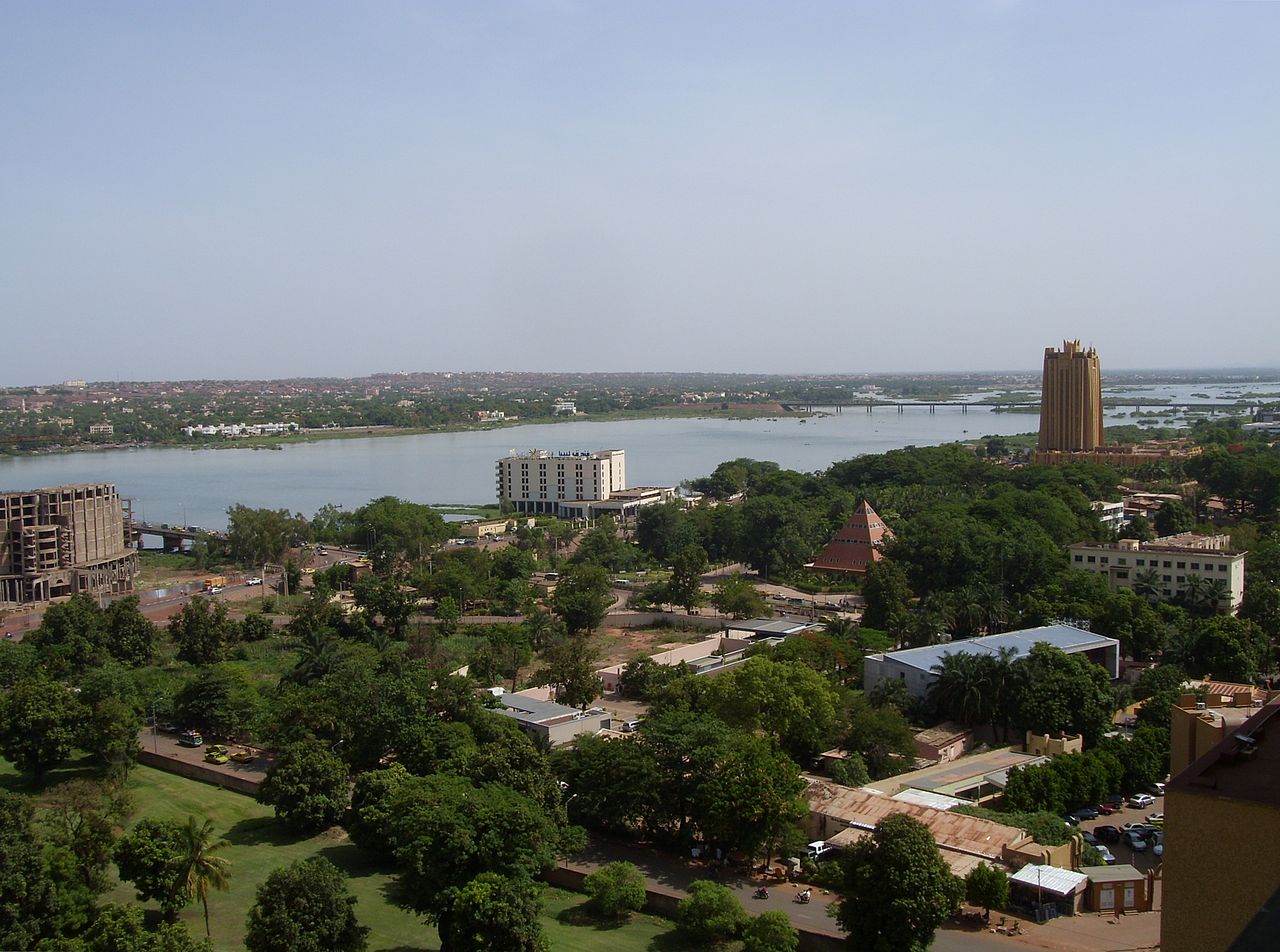
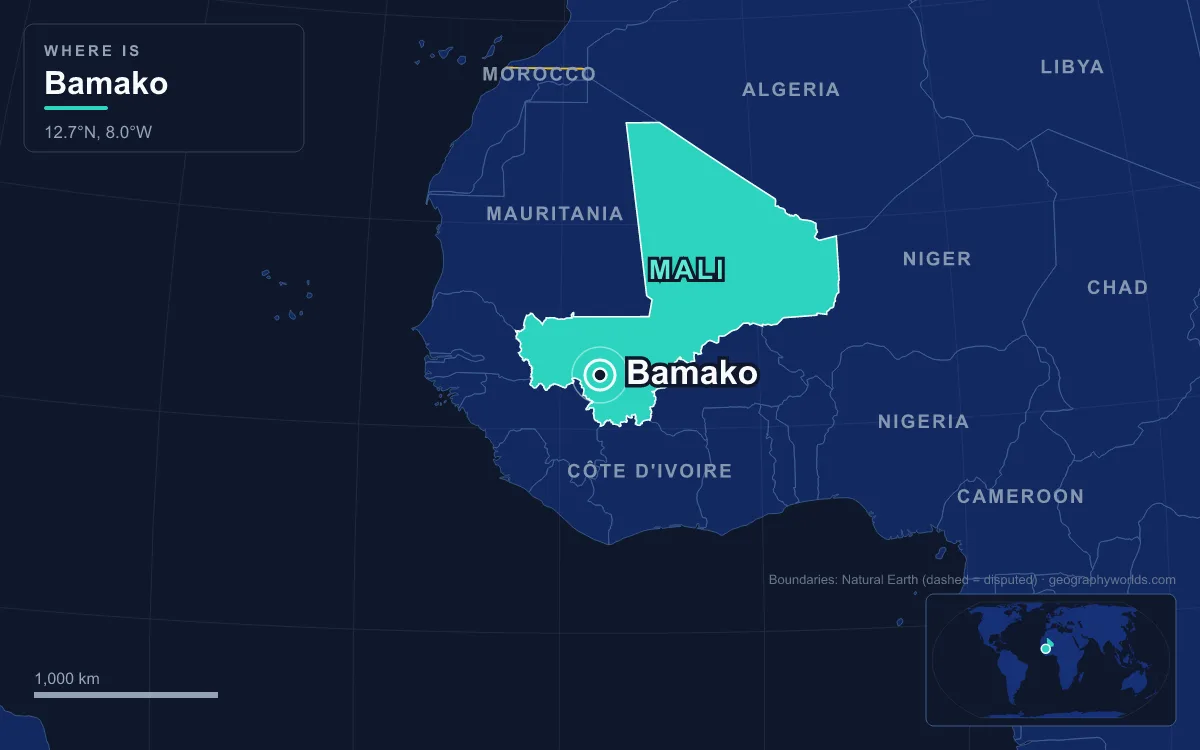
Bamako, whose name means "crocodile river" in Bambara, is the capital and largest city of Mali. It stands on the Niger River in the south-west of the country, near the rapids that divide the upper and middle Niger valleys, and it is run as a separate capital district surrounded on all sides by the Koulikoro Region. The 2022 census counted 4,227,569 people there. When the Scottish explorer Mungo Park passed through in 1806, he estimated the town's population at about 6,000. The story of how it grew so large is a story of the people who came: founding families, traders, soldiers, railway workers, fishermen, musicians and, above all, migrants from the rest of Mali.
The Niaré, Touré and Dravé Families of the 1650 Kafu
People lived along this stretch of the Niger long before there was a town. The floodplain was fertile, and the region sat on trade routes that carried gold, ivory, kola nuts and salt across West Africa and the Sahara. By the 11th century the Ghana Empire controlled the area, and the Mali Empire followed it; our guide to the geography of the Mali Empire traces how far that state reached.
Bamako as a named polity began around 1650, when the Niaré family founded a kafu, a small Mande chiefdom. The founding is sometimes associated with a Soninke man named Bamba Sanogo. Two other families were prominent in the early town: the Touré and the Dravé, mostly clerics and merchants. Bamako later became a client of the Ségou Empire, the Bambara state downriver.
The founders still leave their mark on the map. Niaréla, in today's Commune II, is described as the oldest quarter of the city.

Dyula Traders, Samory's Brother and the French Fort of 1883
In the early 1880s two expanding powers converged on Bamako. From the south came Samory Touré's Wassoulou Empire, which defeated a French force at the Battle of Samaya, outside Kinieran, in February 1882. Some leaders of Bamako's Dyula community, the Muslim Mande merchant community whose trading settlements stretched across West Africa, began approaching the anti-French alliance. From the west came the French, led by Gustave Borgnis-Desbordes, who wanted this strategic point on the Niger for himself. He hurried a column to Bamako and began building a fort there on 1 February 1883.
Samory's brother Kebe Brema tried to draw the French out. In early April 1883 his forces fought two battles at Woyo Wayanko creek near the town. He won the first but was forced to retreat after the second, and Bamako passed under French control.
Railway Workers and Clerks of the Colonial Capital, 1904–1960
The railway turned a garrison into a capital. In 1904 a line was completed from Kayes, in the west, to Bamako, and in 1908 the French made the town the capital of French Sudan. A further line to Dakar on the Atlantic was finished in 1923, putting Bamako at the end of the rail link to the sea. The town began to grow quickly as the seat of the colony. The city had first developed on the north bank of the Niger, and just to its north rises an escarpment, the remains of an extinct volcano, where the Presidential Palace and the main hospital stand today. Nearby Point G hill has caves containing rock paintings, and archaeological evidence shows the area has been settled since the Palaeolithic.
By independence in 1960, estimates put Bamako's population at somewhere between 100,000 and 160,000 people, up from about 8,000 in 1908. The colonial state left institutions that the new country kept. The National Museum began in 1953 as the Sudanese Museum, part of the French research institute IFAN, and became the National Museum of Mali after independence. The library that became the National Library of Mali was founded in 1944 and moved from Koulouba to the Ouolofobougou quarter in 1968. French kept its place as the official language until the constitution approved by referendum in 2023 demoted it to a working language and gave official status to the national languages, Bambara among them.
Bamako's residents also changed the country's politics. In the late 1980s students, trade unionists and lawyers in the city campaigned for multiparty democracy. On 22 March 1991 security forces broke up a large march in central Bamako, and estimates of the dead run as high as 300. Four days later a military coup removed Moussa Traoré, who had ruled for 23 years, and in 1992 the historian Alpha Oumar Konaré became president.
Bozo Fishermen, Rail Band Musicians and Malick Sidibé's Bagadadji Studio
Some of the trades that define Bamako belong to particular peoples. The Bozo are a Mande group known for fishing, sometimes called the "masters of the river". Their name probably comes from the Bambara for "bamboo house". They took possession of the banks of the Niger under the Ghana Empire and founded the cities of Djenné and Mopti. Bozo fishermen still work the river at Bamako, although the 2022 census counted them at only about 1.4 percent of the city's population. Our complete guide to the Niger River follows the waterway they depend on from Guinea to Nigeria.
Markets draw on every group. The traditional commercial centre lies north of the river between Avenue du Fleuve, Rue Baba Diarra and the Boulevard du Peuple, home to the Marché Rose. Commune III, the administrative and commercial heart of the city, holds the two largest markets, the Grand Marché and Dibida.

Music is the trade Bamako is best known for abroad, and it grew out of the Mande griot tradition of praise singers. In 1970 the Ministry of Information and the railway administration sponsored the Rail Band, the house band at the buffet of the Station Hotel. It mixed electric guitars and horns with Mandinka and Bambara singing, the kora and the balafon. Salif Keita, who came to Bamako in 1967 from the village of Djoliba, sang with the Rail Band before joining Les Ambassadeurs du Motel de Bamako in 1973. He and the guitarist Ali Farka Touré won international fame in the 1990s. Later, Amadou Bagayoko, born in Bamako in 1954, and Mariam Doumbia, who had met at Mali's Institute for the Young Blind, became famous as Amadou & Mariam with the album Dimanche à Bamako. Their 2008 album Welcome to Mali was nominated for a Grammy, and they performed together until Bagayoko's death in 2025.
Photography followed the same path. Malick Sidibé, a Fula from Soloba, about 300 kilometres from the capital, was apprenticed to the photographer Gérard Guillat in 1955 and opened his own studio in the Bagadadji quarter in 1962. His black-and-white pictures of young Bamako dancing at parties in the 1960s made him famous far beyond Mali, and in 2007 he received a Golden Lion for Lifetime Achievement at the Venice Biennale, the first photographer and the first African so honoured. Since 1994 the city has hosted the African Photography Encounters, a biennial festival held partly at the National Museum and National Library. The city has even become a subject in its own right: Abderrahmane Sissako's 2006 film Bamako, first shown at Cannes, stages a trial of the World Bank and IMF in the city, with Bamako's everyday life carrying on around the hearings.
Bambara Speakers and Four Million Neighbours in 2022
The biggest group of arrivals came after independence. Census counts show the city more than doubling between 1976 and 1998, and then more than doubling again between 2009 and 2022:
The 2022 census shows how mixed the city has become. The Bambara are the largest group, at about 43 percent. Next come the Fula at 12.5 percent, the Soninke at about 10 percent and the Malinké at about 10 percent, followed by the Dogon, Senufo, Songhai, Bobo and Bwa, and Bozo. The mix of mother tongues is much less even:
Two-thirds of residents have Bambara as their mother tongue, far more than are Bambara by descent. The gap means many residents of Fula, Soninke, Malinké or Dogon origin use Bambara as their main language. Nationally it is spoken by around 80 percent of Malians as a first or second language, and in the capital it is the language that Mali's many peoples share.
Most of the growth now spreads outward. The old centre on the north bank is congested and expensive, and building sprawls across a radius of about 30 kilometres. The largest built-up area now lies on the south bank of the Niger, linked by the Pont des Martyrs, the King Fahd Bridge and a third bridge built with Chinese support in 2011. Commune VI, on the south bank, was already the most populous commune in 2009, with 470,269 people. A new business district is rising in ACI-2000, laid out on the runways of the old airport. The district of Bamako holds about 70 percent of Mali's industrial activity.
Growth has come with strain. Water supply falls short in the hot season from April to June, and the city has also been hit by jihadist violence, including the Radisson Blu hotel siege of November 2015 and attacks on a military training school and the airport on 17 September 2024 that killed at least 77 people. For the wider country around the capital, including its desert north and river cities, see our Mali country guide.
Quick Facts About Bamako
- Country: Mali
- Continent: Africa (West Africa)
- Country population: approximately 25.9 million
- Capital city status: Bamako is the capital of Mali, the seat of national government, and the location of foreign embassies, parliament, and the head of state's official residence.
Frequently Asked Questions
What is the capital of Mali?
The capital of Mali is Bamako. Bamako is the seat of national government, hosts most foreign embassies and consulates, and is typically where the head of state and parliament are located.
What continent is Bamako in?
Bamako, the capital of Mali, is located in Africa, in the West Africa region. As Mali's capital, Bamako serves as the country's primary connection to the broader African political, economic, and cultural sphere.
Why is Bamako the capital of Mali?
Bamako was chosen as the capital of Mali for reasons that typically combine geography, history, and politics. Capital city selections often reflect a desire for centrality (being accessible from across the country), historical importance (being a longstanding seat of government or culture), or neutrality (being acceptable to multiple regions or ethnic groups within the country). The specific reasons for Bamako's designation are detailed in the city's history above.
What is Bamako known for?
As the capital of Mali, Bamako is best known for housing the country's central government institutions — parliament, presidential or royal residences, supreme court, and key ministries. It is also typically a major cultural and economic center within Mali, hosting national museums, embassies, and signature monuments. The introduction and history sections above provide detailed coverage of the city's specific notable institutions and landmarks.
Related Pages
- Mali Country Guide — full geography, climate, economy, and culture overview
- Flag of Mali — meaning, history, and design of Mali's national flag