

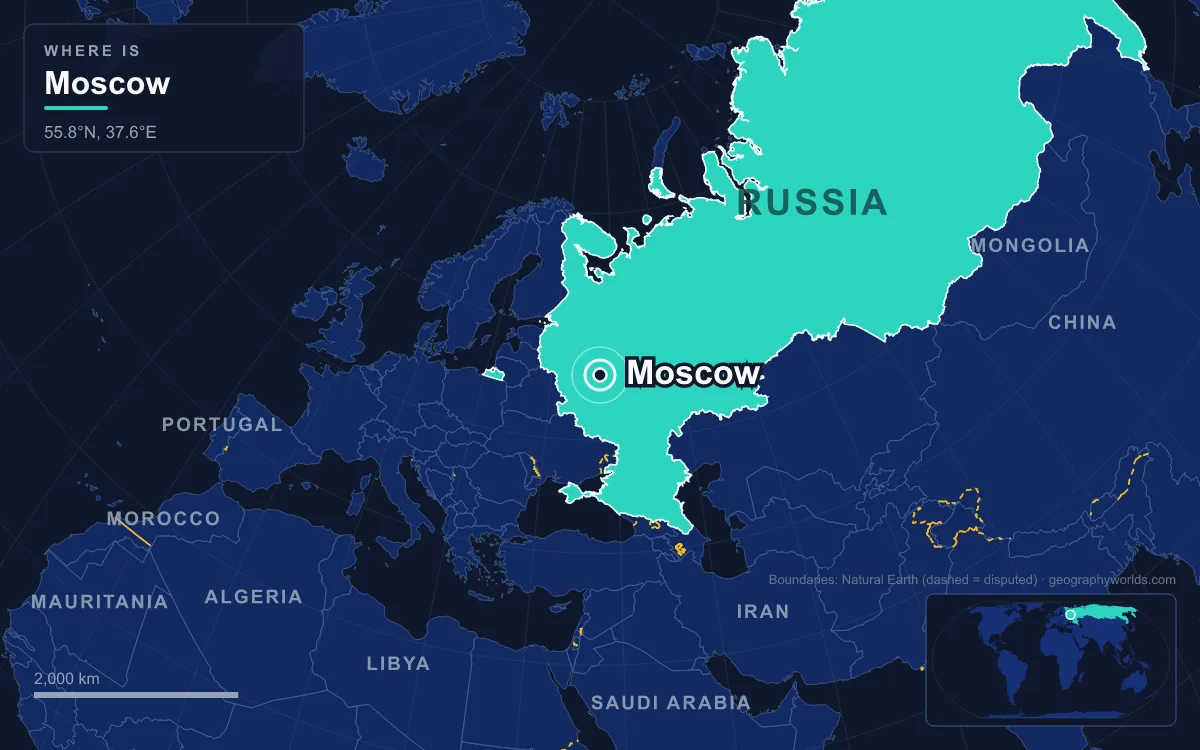
The capital of Russia is Moscow, a federal city on the Moskva River in the west of the country, in Central Russia. The 2021 census counted 13,010,112 people inside the city limits, up from 11,503,501 in 2010, and more than 21.5 million live in the wider metropolitan area, which makes Moscow the most populous city entirely in Europe. Its defining feature sits at the centre: the Kremlin, a walled fortress of palaces and cathedrals that has been the seat of Russian power for most of the last five centuries and is today the workplace of the Russian president. Moscow was the capital until 1712, lost the title to Saint Petersburg for two centuries, and regained it in 1918. Four themes explain what kind of city grew around that fortress: power, faith, trade and the daily routines of 13 million people.
The Kremlin: Ivan III’s Red-Brick Seat of Power
Moscow enters the written record in 1147, when a chronicle names it as the place where Prince Yuri Dolgorukiy met his ally Sviatoslav Olgovich. Dolgorukiy extended the little fort in 1156. The Mongols destroyed it in 1237, and Ivan I Kalita rebuilt it in oak in 1339. The Kremlin that stands today belongs to Grand Prince Ivan III, the ruler who pulled nearly all the Russian principalities under Moscow and whose defeat of the Tatars in 1480 traditionally marks the end of their overlordship. He hired architects from Renaissance Italy. Pietro Antonio Solari designed the new walls and towers, built between 1485 and 1495. They run for 2,235 metres and rise between 5 and 19 metres depending on the ground, and the tallest tower, the Troitskaya, reaches 80 metres. Inside, the Palace of Facets of 1491 is the oldest secular building still standing. The Ivan the Great Bell Tower, built in 1505–1508 and raised to its present 81 metres in 1600, was the tallest structure in the city until the Russian Revolution.
After the Tsardom of Russia was proclaimed in 1547, this fortress was the heart of the state until Peter the Great moved his government to his new Baltic city of Saint Petersburg in 1712. Moscow spent the imperial period as a second city. On 12 March 1918, fearing invasion, Vladimir Lenin moved the capital back and chose the Kremlin Senate as his residence. That building, designed by Matvey Kazakov in the 18th century, is now the president’s main workplace, while the Grand Kremlin Palace by Konstantin Thon serves as the official residence. The Kremlin Museums opened in 1961, and in 1990 the Kremlin and Red Square were among the first Soviet sites inscribed on the UNESCO World Heritage List.
Red Square, running along the Kremlin’s eastern wall, took shape under Ivan III as a marketplace known as Torg, “the Market”, and after the fire of 1571 as Pozhar, “the burnt place”. Its present name did not originally refer to colour: in older Russian krasnaya meant “beautiful”, which is why several other Russian towns also have a Krasnaya ploshchad. Lenin’s Mausoleum has stood against the wall since 1924, and the square held two of the most important parades of the Soviet era. In the October Revolution parade of 1941, troops marched from the square straight to the front line, with the Germans close to the city. At the Victory Parade of 1945, captured Nazi banners were thrown down at the foot of the mausoleum.
Saint Basil’s and the Cathedral of Christ the Saviour: Faith Demolished and Rebuilt
On Red Square stands the building most people picture when they think of Moscow. Its official name is the Cathedral of the Intercession on the Moat, and it was built between 1555 and 1561 on the orders of Ivan the Terrible to celebrate his capture of Kazan and Astrakhan. The design places eight chapels around a ninth, central one, and a tenth was added in 1588 over the grave of Vasily (Basil), a venerated local saint, whose name the whole cathedral now carries. The builders are recorded as Barma and Postnik Yakovlev, though some researchers think the two names refer to a single man. The cathedral was only completed, with its painted colours, in 1683, and the domes took on their present-day colours in 1848.
A few hundred metres southwest of the Kremlin, on the north bank of the Moskva, a second church tells a harsher story. On 25 December 1812, as Napoleon’s army retreated, Tsar Alexander I promised a cathedral to thank Providence for saving Russia. A first design on the Sparrow Hills failed on unstable ground. Nicholas I then commissioned Konstantin Thon, whose Russian Revival plan was approved in 1832, and a site near the Kremlin was chosen in 1837. The Cathedral of Christ the Saviour took more than 40 years to build, and Tchaikovsky’s 1812 Overture had its world premiere in a tent outside the unfinished church in August 1882.
In 1931 the Soviet Politburo had it blown up to make room for a Palace of the Soviets that was meant to house the Supreme Soviet. Work on the palace began in 1937 and stopped in 1941 when Germany invaded; its steel frame was taken down the next year and the palace was never built. In 1958, under Nikita Khrushchev, the flooded foundation pit became the Moskva Pool, for a time the world’s largest open-air swimming pool. After the Soviet collapse, about a million Muscovites gave money for a new cathedral, and it was built on the same site between 1995 and 2000. At 103 metres it is the third-tallest Orthodox church in the world.

Kitay-gorod, GUM and Moscow-City: Five Centuries of Trade
Kitay-gorod, known in the 16th and 17th centuries as the Great Possad, is the old trading quarter east of the square: narrow, densely built streets inside the traces of a wall that has almost entirely gone. In modern Russian Kitay means China, but the quarter’s name probably has older roots. One theory, put forward by the writer Robert Wallace, links kita to woven wicker and reads the name as a fort of wicker baskets filled with earth or rock. Its three main streets, Varvarka, Ilyinka and Nikolskaya, are still lined with banks, shops and storehouses.
The quarter’s great monument to commerce faces the Kremlin across Red Square. The Upper Trading Rows, built between 1890 and 1893 by the architect Alexander Pomerantsev and the engineer Vladimir Shukhov, stretch 242 metres along the square’s eastern side. Shukhov’s steel frame carries a glass roof over the arcades, and in Soviet times the building became GUM, the State Department Store, where the only vendor was the state. It is a shopping centre again, with more than 100 brands in 2021.

Modern money went elsewhere. About 4 kilometres west of Red Square, on the Presnenskaya Embankment of the Moskva, the city government began planning the Moscow International Business Center in 1992 on 60 hectares of old quarries and closed factories. Moscow-City, as everyone calls it, now has more skyscrapers than anywhere else in Europe. Its Federation Tower East is the tallest building in Moscow and the second-tallest in Europe after Saint Petersburg’s Lakhta Center. The towers stand for one of the largest urban economies in the world, and for a city with more resident billionaires than any other in Europe.
The Fires of 1571 and 1812 and the Garden Ring They Left Behind
Moscow has burned down more than once, and its street plan still shows it. Fires wrecked much of the town in 1547. In 1571 the Crimean Tatars captured the city and burned everything except the Kremlin. When they came back in 1591, new walls built by the craftsman Fyodor Kon between 1584 and 1591 held them off. An outer earthen rampart, the Skorodom, was later replaced by the taller Zemlyanoy Val, the “earth rampart”, under the first Romanov tsar.
The best-known fire came in 1812. Napoleon’s army entered Moscow after the Battle of Borodino, on 14 September, and the city burned from 14 to 18 September. About three-quarters of it was destroyed. The military governor, Count Fyodor Rostopchin, is often held responsible for organising the fire so that the French would find nothing to live on, and on 19 October, short of supplies and warned by the first snow, they left. The blaze also cleared the way for new planning. In the 1820s the obsolete Zemlyanoy Val gave way to a ring road between 22 and 43 metres wide, and people along it were given land on condition that they plant gardens. That is the origin of the Garden Ring’s name. Joseph Stalin’s 1935 master plan called for widening it to at least 30 to 40 metres, and Zubovskaya Square, its widest point, had about 18 lanes before a reconstruction of the 2010s.
The rings kept multiplying outward, and the city kept growing past them. On 1 July 2012 Moscow annexed a large wedge of Moscow Oblast to its southwest, and its area more than doubled, from 1,091 to 2,511 square kilometres. The city now even borders Kaluga Oblast.
Daily Life on the Moscow Metro and Through −6 °C Januaries
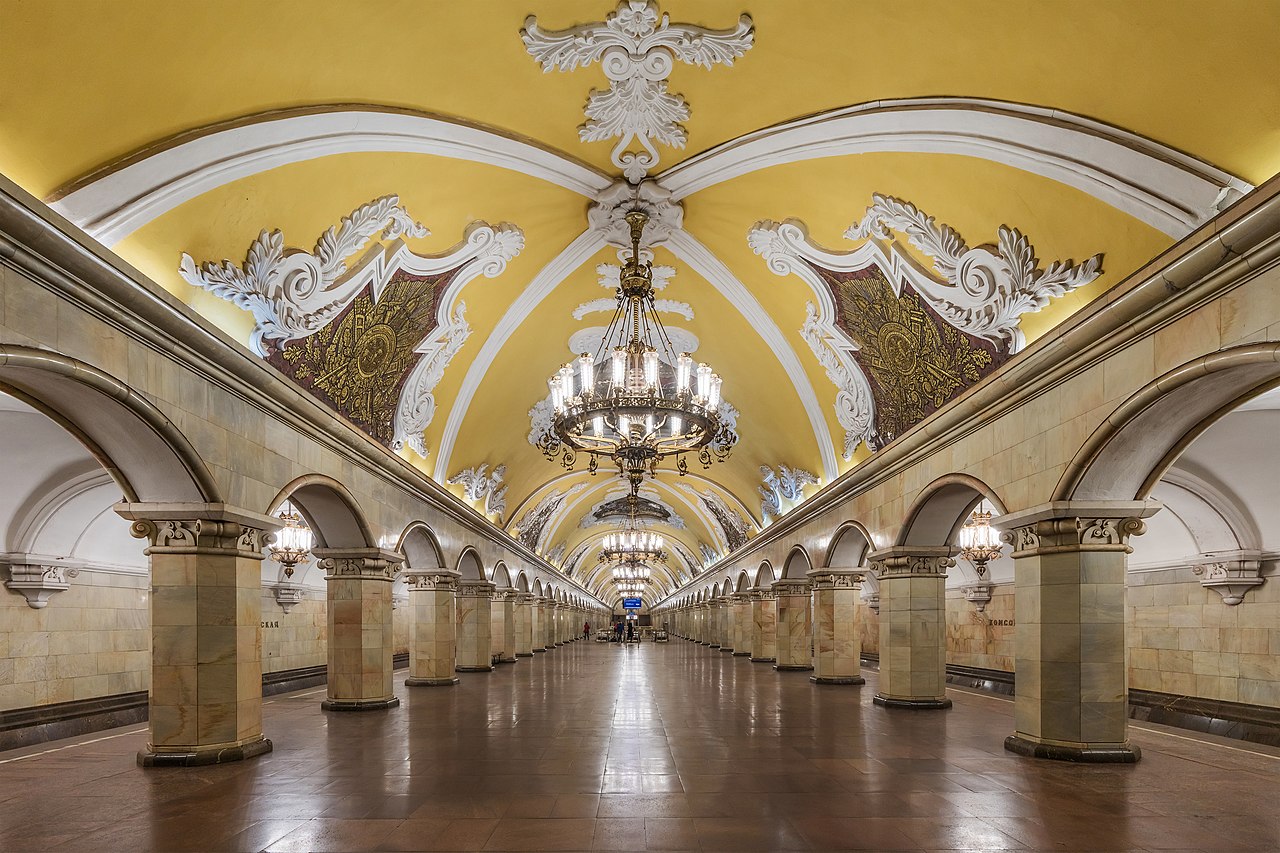
For most Muscovites the city is experienced underground. The Metro opened on 15 May 1935 with a single 11-kilometre line and 13 stations. It was the first underground railway in the Soviet Union, and its lavishly decorated stations have made it a tourist attraction in its own right. By September 2026 it had 309 stations and 541.9 kilometres of route, the longest network in Europe. It is also the only system in the world with three circle lines. In February 2023 Moscow became the first city to run metro trains 80 seconds apart. Its deepest station, Park Pobedy, is 73 metres underground.
Above ground, the weather shapes the year. Moscow is the northernmost and coldest megacity in the world, with a humid continental climate. The 1991–2020 average is −6.2 °C in January and 19.7 °C in July. Snow usually starts falling in mid-October, lies from late November and melts at the end of March, so the ground is white for about five months. The extremes are wide. The lowest temperature on record is −42.1 °C, in January 1940. The highest came on 29 July 2010, when the VVC station reached 38.2 °C and the city centre 39.0 °C. Summer life moves outdoors into a city where more than 40 percent of the land is covered by greenery.
The meeting place of 1147 has become a city spread across 2,511 square kilometres, and the landmarks at the centre have their own stories, told in our guides to the Moscow Kremlin and Saint Basil’s Cathedral. To see how the city reached 13 million, follow the census figures in our breakdown of the population of Moscow.
Quick Facts About Moscow
- Country: Russia
- Continent: Europe (Eastern Europe)
- Country population: approximately 143.4 million
- Capital city status: Moscow is the capital of Russia, the seat of national government, and the location of foreign embassies, parliament, and the head of state's official residence.
Frequently Asked Questions
What is the capital of Russia?
The capital of Russia is Moscow. Moscow is the seat of national government, hosts most foreign embassies and consulates, and is typically where the head of state and parliament are located.
What continent is Moscow in?
Moscow, the capital of Russia, is located in Europe, in the Eastern Europe region. As Russia's capital, Moscow serves as the country's primary connection to the broader Europen political, economic, and cultural sphere.
Why is Moscow the capital of Russia?
Moscow was chosen as the capital of Russia for reasons that typically combine geography, history, and politics. Capital city selections often reflect a desire for centrality (being accessible from across the country), historical importance (being a longstanding seat of government or culture), or neutrality (being acceptable to multiple regions or ethnic groups within the country). The specific reasons for Moscow's designation are detailed in the city's history above.
What is Moscow known for?
As the capital of Russia, Moscow is best known for housing the country's central government institutions — parliament, presidential or royal residences, supreme court, and key ministries. It is also typically a major cultural and economic center within Russia, hosting national museums, embassies, and signature monuments. The introduction and history sections above provide detailed coverage of the city's specific notable institutions and landmarks.
Related Pages
- Russia Country Guide — full geography, climate, economy, and culture overview
- Flag of Russia — meaning, history, and design of Russia's national flag