

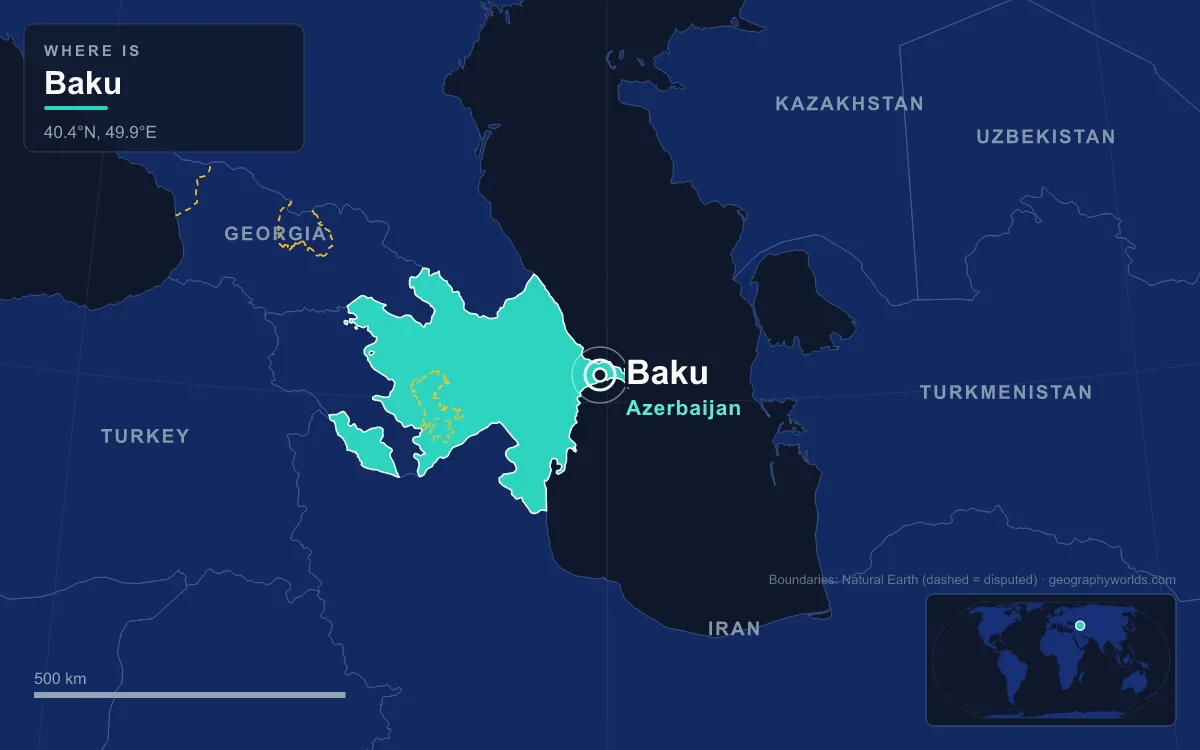
The capital of Azerbaijan is Baku, a city of about 2.34 million people (2024 official estimate) on the southern shore of the Absheron Peninsula, where it curves around the Bay of Baku on the western coast of the Caspian Sea. Baku lies 28 metres below sea level, which makes it the lowest-lying national capital in the world and the largest city anywhere below sea level. It is the largest city on the Caspian and in the Caucasus, roughly a quarter of all Azerbaijanis live in its metropolitan area, and it has been the country’s capital since 1918, first of the short-lived Azerbaijan Democratic Republic, then of Soviet Azerbaijan and, since 1991, of the independent republic. Four threads explain why this windy oil port holds that role: power, faith, trade and the way people live along its seafront.
Power in Baku: From the Shirvanshahs’ Palace to the Heydar Aliyev Center
Baku has been a seat of rulers for more than eight centuries. It belonged to the realm of the Shirvanshahs from the 8th century, and their court moved here from Shamakhi, the old capital of Shirvan, after earthquakes wrecked that city. Between the 12th and 14th centuries the dynasty ringed the town and the surrounding Absheron villages with fortifications: the Maiden Tower, the Ramana Tower, the castles of Nardaran, Mardakan and Shagan, and a castle on an island in the bay. The Maiden Tower, a 12th-century tower in the south-east part of the walled town, is now a museum and appears on Azerbaijani banknotes and official letterheads.
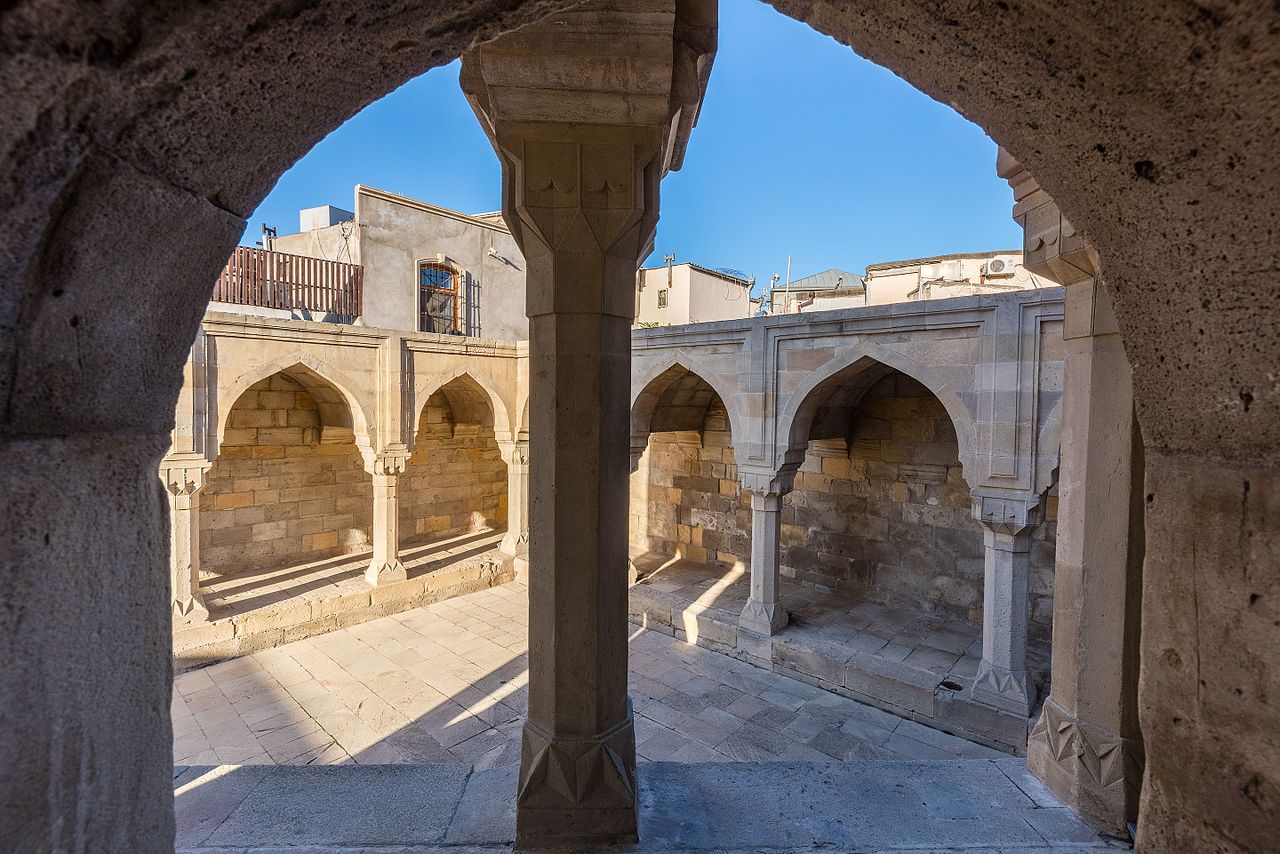
The dynasty’s most complete monument is the Palace of the Shirvanshahs, built in the 15th century inside the Inner City, or Icherisheher. The complex includes the palace itself, the Divanhane pavilion, a family burial vault, the Shah’s mosque and minaret, and the mausoleum of the Sufi scholar Seyid Yahya Bakuvi. No inscription survives on the palace building, so it is dated from inscriptions on the tomb and the minaret, both naming Shirvanshah Khalilullah I. Together with the Maiden Tower and the city walls, it became a UNESCO World Heritage Site in 2000.
Control of the city then passed between empires. Shah Ismail I of the Safavids besieged and took Baku in 1501, and his successor Tahmasp I removed the Shirvanshahs altogether. Peter the Great seized the city in the Russo-Persian War of 1722–1723, only for Russia to hand it back to Iran under the Treaty of Ganja in 1735. It was ceded to Russia by the Treaty of Gulistan in 1813, a transfer the Treaty of Turkmenchay made final in 1828. Under the tsars it became capital of the Baku Governorate after an earthquake at Shamakhi in 1859 ended that city’s claim once more.
Baku’s modern capital status came out of war and bloodshed. In the March Days of 1918, thousands of Azerbaijanis were killed in the city during fighting between the Bolshevik-led Baku Commune and armed Azerbaijani groups. The Azerbaijan Democratic Republic, proclaimed in Tiflis on 28 May 1918, took Baku with Ottoman help on 15 September 1918, and the killings of Armenians that followed became known as the September Days. Baku was then proclaimed the republic’s capital. The Red Army ended that republic on 28 April 1920, and Baku became capital of the Azerbaijan SSR. On 19 and 20 January 1990, Soviet troops sent to suppress the independence movement killed 147 civilians by official Azerbaijani figures, an event remembered as Black January. The Supreme Council adopted a declaration of independence on 18 October 1991. Today the state’s showpiece is the Heydar Aliyev Center, a flowing white building by Zaha Hadid named after the former Soviet party chief and president, which opened in May 2012 and won the Design Museum’s Design of the Year award in 2014.
Faith and Fire at Surakhany and Bibi-Heybat
Religion in Baku has long been bound up with fire. The name of the city is traced to the Old Persian baga, meaning god, and during Sasanian rule it was known as Bagavan. A popular 19th-century explanation read it instead as Bad-kube, “wind-pounded city”, which is why Baku still carries the nickname City of Winds. Natural gas seeping from the Absheron rocks fed flames that burned for centuries, and the Zoroastrian New Year, Novruz, remains the city’s main holiday even though Zoroastrianism itself has died out in Azerbaijan.
The clearest trace of that tradition is the Ateshgah, the “home of fire”, in the suburb of Surakhany. Indian traders who settled in Baku built the pentagonal complex in the 17th and 18th centuries around a central fire altar, with cells for monks along its walls, and it served Hindu, Sikh and Zoroastrian worshippers. It was abandoned in the late 19th century, probably because the Indian community in the area declined. Nearly a century of oil and gas extraction drained the natural flame, which went out in 1969; the fire visitors see today is fed by piped gas. The complex has been a museum since 1975.

Shia Muslims form the largest religious community in Baku, and one of their most revered sites is the Bibi-Heybat Mosque in the coastal village of Bibiheybət, on the edge of the city. It was built in the late 13th century over the tomb of Ukeyma Khanum, whom its inscription names as a daughter of the seventh imam, Musa al-Kadhim. The Bolsheviks demolished it in 1936; the building standing now is a replica completed in the 1990s. The Old City also holds the Juma Mosque, and other notable mosques include the Muhammad Mosque and the Taza Pir Mosque. The constitution defines Azerbaijan as a secular state, and Baku also has Russian Orthodox, Georgian Orthodox, Lutheran and Catholic congregations. After independence seven of its original eleven synagogues were renovated, including the Gilah synagogue of 1896.
Trade and Oil: Nobel Money, Black Town and the Port of Baku
Baku was a trading town long before it was an oil town. Two caravanserais survive inside the walled Old City, and in the early modern period traders came from as far as the Indian subcontinent. Oil was already part of that trade. A 10th-century Arab traveller described white and black oil seeping out of the ground, and by the 15th century lamp oil was drawn from hand-dug wells.
The industrial age began in 1846, when the first oil well was drilled at Bibi-Heybat. In 1872 the Russian authorities began auctioning oil-bearing plots to private investors, and the capital arrived quickly: the Nobel brothers in 1873 and the Rothschilds in 1882. Robert and Ludvig Nobel’s company, Branobel, pioneered pipelines around Baku with the engineer Vladimir Shukhov between 1878 and 1880, and by 1916 it was the largest oil company in Russia. By the early 1880s refineries had clustered near the city in an industrial district called Black Town. By 1900 the city had more than 3,000 wells, and at the start of the 20th century half of the oil sold on world markets came from Baku.
The boom remade the town. Between 1856 and 1910 Baku grew faster than London, Paris, New York or Tokyo, and by 1913 it was the largest city in the Caucasus. Oil also made it a target. Capturing the Baku fields was a main aim of Germany’s Operation Edelweiss in 1942, but the Wehrmacht got no closer than about 530 kilometres. After the war the industry moved offshore. Oil was struck in 1949 at Neft Daşları, the Oil Rocks, about 39 kilometres from the nearest shore, and the settlement built there on trestles and sunken ships is recognised as the world’s first offshore oil platform. It still belongs to the city of Baku.
Oil and gas now arrive from the Azeri-Chirag-Guneshli and Shah Deniz fields through the Sangachal Terminal south of the city, and leave by the Baku–Tbilisi–Ceyhan oil pipeline and by the South Caucasus gas pipeline, which runs for more than 690 kilometres to Turkey. The Port of Baku, founded in 1902, is the largest on the Caspian, with an annual capacity of 15 million tonnes, and is a stop on the Trans-Caspian International Transport Route linking East Asia and Central Asia with Europe. Ferries cross to Turkmenbashi in Turkmenistan, and the Kars–Tbilisi–Baku railway to Turkey opened in 2017. The concentration is extreme: Baku produces about 65% of Azerbaijan’s GDP, and at the end of the first quarter of 2023 it employed 52% of the country’s hired workers.
Daily Life Between the Boulevard and the Khazri Wind
For most residents the centre of Baku life is the seafront. Baku Boulevard, the city’s National Park, was established in 1909 along the Caspian shore, where oil barons had built mansions facing the sea. In 1900 the Municipal Horticultural Commission decided to plant trees and shrubs along the seafront, and because the ground was poor, a decree of the 1880s had already required every ship entering Baku’s harbour from Iran to bring fertile soil with it. The new boulevard of 2012 roughly doubled the promenade to 3.75 kilometres, reaching National Flag Square, and White City Boulevard added another 2 kilometres to the east in 2015. Above it rise the three Flame Towers, completed in 2012, whose LED skins display moving flames after dark. The tallest tower is 182 metres.
The weather shapes the rhythm of the day. Baku has a cold semi-arid climate. The Absheron Peninsula, sheltered by the Caucasus, is the driest part of Azerbaijan, with around 200 millimetres of rain or less a year. The daily mean temperature is 26.4 °C in July and August and 4.3 °C in January and February. Two winds dominate: the cold northern khazri, which can reach 144 km/h and tear off roof tiles, and the warm southern gilavar. In summer the khazri brings welcome relief; in winter it makes a mild coast feel bitterly cold.
Getting around relies on the Baku Metro, opened in November 1967, the suburban railway added in 2019, and the Baku Funicular. The Martyrs’ Lane, once Kirov Park, is dedicated to the dead of Black January and the Nagorno-Karabakh conflict. Chess is a civic passion: Garry Kasparov, Teimour Radjabov and Shahriyar Mammadyarov all come from Baku. Big events have become part of city life too. Baku hosted the Eurovision Song Contest in 2012 and the first European Games in 2015, has run a Formula One street race on a 6.003-kilometre circuit around the Old City since 2016, and hosted the United Nations climate conference in 2024.
A capital below sea level on an inland sea is an unusual thing, and our guide to cities below sea level shows how rare Baku’s position is. The sea itself is covered in our piece on the Caspian Sea, while the Azerbaijan country guide follows the country from the Absheron coast up into the Greater Caucasus.
Quick Facts About Baku
- Country: Azerbaijan
- Continent: Asia (Western Asia)
- Country population: approximately 10.5 million
- Capital city status: Baku is the capital of Azerbaijan, the seat of national government, and the location of foreign embassies, parliament, and the head of state's official residence.
Frequently Asked Questions
What is the capital of Azerbaijan?
The capital of Azerbaijan is Baku. Baku is the seat of national government, hosts most foreign embassies and consulates, and is typically where the head of state and parliament are located.
What continent is Baku in?
Baku, the capital of Azerbaijan, is located in Asia, in the Western Asia region. As Azerbaijan's capital, Baku serves as the country's primary connection to the broader Asian political, economic, and cultural sphere.
Why is Baku the capital of Azerbaijan?
Baku was chosen as the capital of Azerbaijan for reasons that typically combine geography, history, and politics. Capital city selections often reflect a desire for centrality (being accessible from across the country), historical importance (being a longstanding seat of government or culture), or neutrality (being acceptable to multiple regions or ethnic groups within the country). The specific reasons for Baku's designation are detailed in the city's history above.
What is Baku known for?
As the capital of Azerbaijan, Baku is best known for housing the country's central government institutions — parliament, presidential or royal residences, supreme court, and key ministries. It is also typically a major cultural and economic center within Azerbaijan, hosting national museums, embassies, and signature monuments. The introduction and history sections above provide detailed coverage of the city's specific notable institutions and landmarks.
Related Pages
- Azerbaijan Country Guide — full geography, climate, economy, and culture overview
- Flag of Azerbaijan — meaning, history, and design of Azerbaijan's national flag