

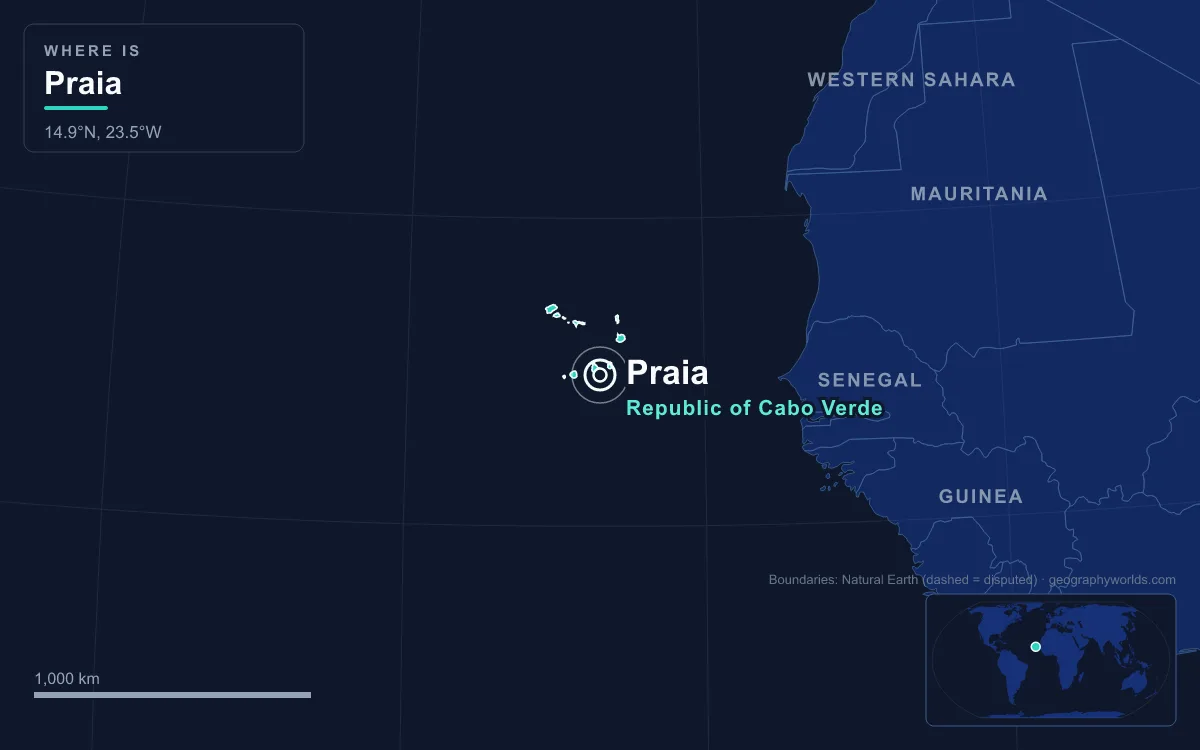
Praia is the capital and largest city of Cape Verde (Cabo Verde), the ten-island Atlantic republic off the coast of West Africa. It lies on the southern coast of Santiago, the country's largest island, and the 2021 census counted 137,868 people in the city. That is about twice as many as Mindelo, the second city. Praia is built on a series of flat volcanic tablelands above a natural harbour. The old centre, known simply as the Plateau, has been the seat of government since 1770. The city is best understood through its people: the settlers and enslaved Africans who formed Cape Verdean Creole on Santiago, the islanders who poured into Praia after independence, and the large diaspora whose money and music still flow back to it.
Settlers, Captives and Traders: From Ribeira Grande to the Plateau, 1462–1858
No one lived on the Cape Verde islands until the Portuguese arrived. The navigator António da Noli, a Genoese in Portuguese service, found Santiago in 1460. In 1462 he settled at Ribeira Grande, about 10 kilometres west of today's Praia, with members of his family and colonists from the Algarve and Alentejo. The settlement had good fresh water from its stream, and it became a key port of call between Portugal, Africa, Brazil and the Caribbean. It was also a hub of the trade in enslaved Africans brought from the nearby mainland coast. Vasco da Gama stopped there in 1497, and Christopher Columbus did the same on his third voyage in 1498.
Cape Verdean society was formed in that port, through the forced meeting of Portuguese settlers and captive Africans. According to the linguist António Carreira, Cape Verdean Creole grew out of a Portuguese pidgin spoken on Santiago from the 15th century onward. Lançados, the traders who settled on the African coast, carried that pidgin to the mainland, where it developed into Guinea-Bissau Creole.

Wealth brought raiders. Francis Drake attacked in 1585 and the French privateer Jacques Cassard in 1712. A village called Praia de Santa Maria is first recorded around 1615 beside a sheltered bay to the east. It had one big advantage over Ribeira Grande: its houses stood on a plateau that was easier to defend. Over time it replaced the old town, which was renamed Cidade Velha ("old city"), and in 1770 it became the capital. Praia's harbour appears in several European records. On 16 April 1781, during the American Revolutionary War, a French squadron under Pierre André de Suffren attacked a British fleet anchored there, even though Portugal was neutral. In 1832 Praia was the first stop of Charles Darwin's voyage on HMS Beagle.
That same year the American diplomat Edmund Roberts estimated that black people made up about "nineteen twentieths" of the town's population. The capital was still small. It had perhaps 1,500 to 2,000 residents in the mid-19th century, and over the course of that century the Plateau was rebuilt on a grid of streets lined with colonial mansions. Praia received the formal rank of city in 1858. By the early 1920s it had about 21,000 people.
Kriolu, Batuque and Funaná: Santiago's Voice in the Capital
The language you hear on Praia's streets is Santiago Creole, the southern (Sotavento) variety of Cape Verdean Creole. Almost every Cape Verdean speaks Creole as a first language. Portuguese is still the only official language, so people switch between the two depending on the setting, with Portuguese used in schools, government offices and courts. A unified spelling system for Creole, known as ALUPEC, was approved on a trial basis in 1998 and formally adopted in 2009. It is still not compulsory, and full official status for Creole has been delayed, partly because there is no agreed standard between the Santiago variety and the northern varieties centred on São Vicente.
Santiago's two home-grown music styles tell the same story of rural culture reaching the capital. Batuque is probably the oldest musical genre in Cape Verde. Women form a circle, called the terreru, that can be set up in a back yard or a public square. They beat out a rhythm by clapping or slapping a cloth, and a lead singer improvises verses that the chorus repeats back. Batuque's rhythm, three beats set over two, makes it the only polyrhythmic genre in the islands. Today it survives only on Santiago.
Funaná, played on the diatonic accordion (gaita) and the scraped iron ferrinho, has a more political history. For a long time it was looked down on as rural, lower-class music, and its performance was at one time banned in the capital, where the more refined morna enjoyed greater prestige. Things changed after independence. In the 1980s the band Bulimundo and its leader Carlos Alberto Martins, known as Catchás, electrified the style and took it to every island. In the interior of Santiago live the Rabelados, a religious community that rejected Catholic Church reforms in the 1940s and withdrew into the mountains around Tarrafal and Santa Cruz to keep their older forms of worship.
After July 1975: The Islands Move Into the Achadas
Resistance to Portuguese rule grew in the 1950s. On 19 September 1956 Amílcar Cabral and five other founders set up, in Bissau, the party that became the PAIGC (African Party for the Independence of Guinea and Cape Verde). Its war was fought on the mainland in Portuguese Guinea, not on the islands. After the 1974 Carnation Revolution in Lisbon, Cape Verde became independent in July 1975, and one of the Plateau's main streets, Avenida Amílcar Cabral, now carries his name.
Independence changed who lived in Praia. Migrants arrived from every island, and the city spread far beyond the Plateau onto the surrounding achadas, a Portuguese word for volcanic plateaus. Neighbourhoods such as Achada de Santo António, Achada Grande, Achadinha and Achada Eugénio Lima filled up. Before 1975 only the Plateau counted as the city proper, and the achadas were treated as outlying suburbs that grew with little planning. Afterwards they were joined into a single city, and new building pushed north. The old centre now holds offices more than homes: the Plateau had only 1,019 residents at the 2010 census. Santiago as a whole had 269,370 people in 2021, more than three times as many as any other island. According to one estimate, the municipality of Praia alone is home to 29 percent of all Cape Verdeans.
Many of the newcomers came to study, because Praia has always been the country's classroom. The Escola Central, now called the Escola Grande, was the first primary school in the archipelago. In 1861 the city also opened the islands' first secondary school, the Liceu Nacional. It failed for lack of support from the Portuguese authorities, and for decades secondary education moved to São Nicolau and later to Mindelo. It returned to Praia only in 1960. By 2016 the city had 12 secondary schools, as well as the public University of Cape Verde and several private institutes, including Jean Piaget University. Neighbourhood loyalties show up in football. Clubs such as Sporting, Boavista, Travadores and Académica, along with smaller sides from Achadinha and Achada Santo António, play in the Santiago South league, and many of them use the Estádio da Várzea.
Most people in the capital make a living from services: government, trade, health, education, hotels and restaurants. The city produces about 39 percent of national GDP, yet in 2014 roughly one in three residents lived below the poverty line. Ferries from Praia harbour, which is managed by the national port authority ENAPOR and was expanded in 2014, connect the city with Maio, Fogo and São Vicente. Share taxis for towns elsewhere on Santiago leave from the Sucupira terminal in the city centre, which opened in May 2018. The weather here is dry by any standard. The 1991–2020 record at the airport averages less than 180 millimetres of rain a year, nearly all of it in August, September and October, and average highs stay between about 27 and 31 °C. Our guide to the best time to visit Cape Verde explains what that means for travellers.

Whalers, Bidons and Brockton: Praia's Families Overseas
Nearly twice as many Cape Verdeans live abroad as at home, close to a million people compared with about 530,000 on the islands. Hardly a family in Praia lacks a relative overseas. The largest overseas community is in the United States, with about 500,000 people. It began with whaling. New Bedford whalers started calling at the islands in the 1790s and signed on local men as crew, and Herman Melville drew on those sailors for Daggoo, one of the harpooners in Moby-Dick. After Portugal abolished slavery throughout its empire in 1869, drought, hunger and economic decline pushed more people to leave. Emigrants shipped home bidons, oil drums packed with food and clothes, from New Bedford and from Providence, Rhode Island, which are still the oldest and largest Cape Verdean communities in the United States.
A second wave began in 1966, after the United States relaxed its immigration law, and continued after independence in 1975. Today Brockton, Massachusetts, has the largest Cape Verdean community of any American city, 18,832 people, while Boston counted 13,605 in 2010. Portugal, France and the Netherlands have sizeable communities too. The migrants' longing for home fills the islands' songs, most famously in Cesária Évora's "Sodade". Praia's ties to the wider Portuguese-speaking world are formal as well. The city joined the Union of Luso-Afro-Americo-Asiatic Capital Cities (UCCLA) in 1985, and the International Institute of the Portuguese Language has its headquarters in the city. To follow the story beyond Santiago, from Mindelo's port to the beaches of Sal, read our Cape Verde island guide.
Quick Facts About Praia
- Country: Cape Verde
- Continent: Africa (West Africa)
- Country population: approximately 530 thousand
- Capital city status: Praia is the capital of Cape Verde, the seat of national government, and the location of foreign embassies, parliament, and the head of state's official residence.
Frequently Asked Questions
What is the capital of Cape Verde?
The capital of Cape Verde is Praia. Praia is the seat of national government, hosts most foreign embassies and consulates, and is typically where the head of state and parliament are located.
What continent is Praia in?
Praia, the capital of Cape Verde, is located in Africa, in the West Africa region. As Cape Verde's capital, Praia serves as the country's primary connection to the broader African political, economic, and cultural sphere.
Why is Praia the capital of Cape Verde?
Praia was chosen as the capital of Cape Verde for reasons that typically combine geography, history, and politics. Capital city selections often reflect a desire for centrality (being accessible from across the country), historical importance (being a longstanding seat of government or culture), or neutrality (being acceptable to multiple regions or ethnic groups within the country). The specific reasons for Praia's designation are detailed in the city's history above.
What is Praia known for?
As the capital of Cape Verde, Praia is best known for housing the country's central government institutions — parliament, presidential or royal residences, supreme court, and key ministries. It is also typically a major cultural and economic center within Cape Verde, hosting national museums, embassies, and signature monuments. The introduction and history sections above provide detailed coverage of the city's specific notable institutions and landmarks.
Related Pages
- Cape Verde Country Guide — full geography, climate, economy, and culture overview
- Flag of Cape Verde — meaning, history, and design of Cape Verde's national flag