

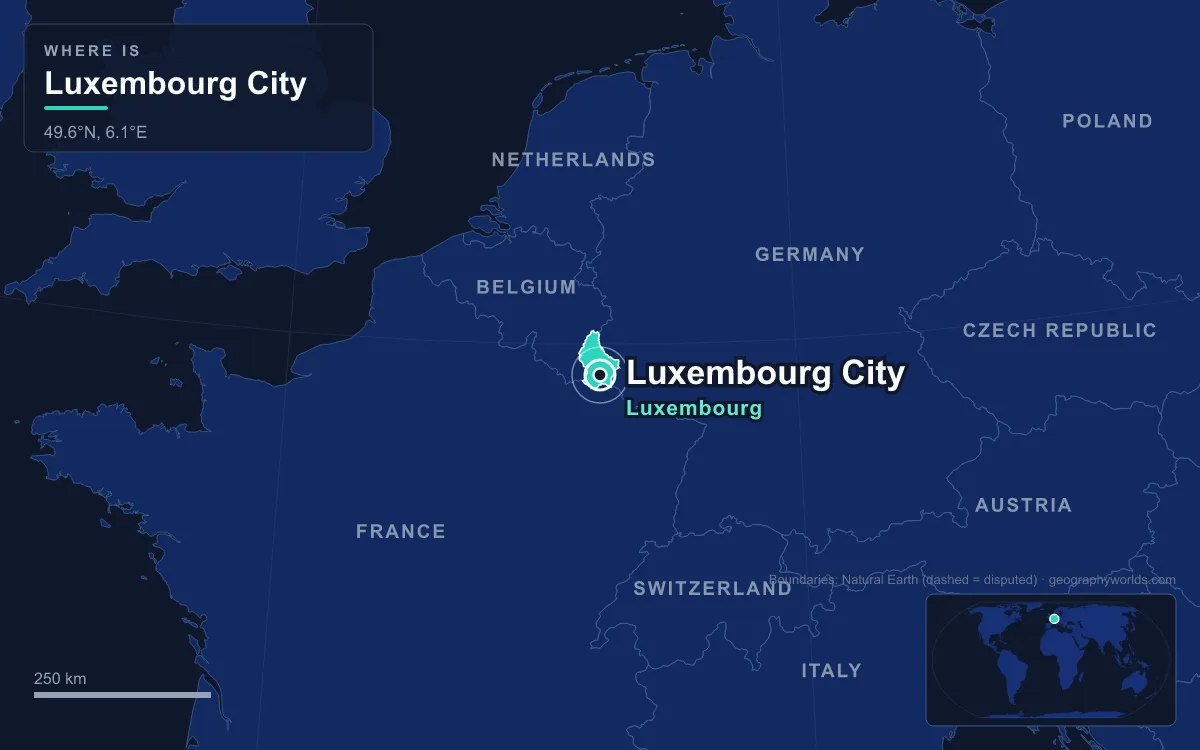
Luxembourg City is the capital of the Grand Duchy of Luxembourg and the country's most populous commune, with 137,696 residents at the end of 2025. It stands in the south of the country where the Alzette and Pétrusse rivers meet, its old town perched on sandstone cliffs above gorges some 70 metres deep, 213 kilometres by road from Brussels and 209 from Cologne. It is small by the standards of European capitals, yet it is one of the four official seats of the European Union and home to the EU's highest court, and more than two-thirds of the people who live in it are foreign citizens. Almost everything about the city is easiest to understand as a contrast: with its rival towns, with the rest of the country, with the people who commute into it, and between its own upper and lower levels.
137,696 Residents Against Esch-sur-Alzette's 37,922
Luxembourg has only one city of any size. The capital's population is more than three times that of the second commune, Esch-sur-Alzette, which had 37,922 people in 2025. Esch lies about 15 kilometres to the south-west on the French border, and it grew for a completely different reason: the discovery of iron ore in the 19th century turned it into one of Luxembourg's main industrial centres, and mining and steel drew workers from across Europe. The other southern steel towns follow at a distance. Differdange, the third-largest, has a little over 30,000 people and still hosts an ArcelorMittal plant; Dudelange, fourth, has about 22,000 and gave the D to the old ARBED steel company.
Measured against the whole country the capital is less dominant than those numbers suggest. The Grand Duchy had 693,916 people in 2026, so the city holds only about one resident in five. Compare that with Podgorica, which holds nearly a third of Montenegro's people. Luxembourg's population is spread across 100 communes, and the industrial south around Esch has its own identity and its own economy.
51 Square Kilometres, or 2% of the Grand Duchy
The commune covers just over 51 square kilometres, about 2% of Luxembourg's 2,586. That makes it only the fourth-largest commune by area. It was once far smaller. Until 1920 the city proper covered just 3.55 square kilometres; in 1920 and 1921 the neighbouring communes of Eich, Hamm, Hollerich and Rollingergrund merged into it, taking its area to 51.52 square kilometres and making it, until 1978, the largest commune in the country.
That area is not densely built. At about 2,600 people per square kilometre, Luxembourg City is thinly populated for a capital, because large parts of it are parkland, forest, protected heritage sites around the old fortress and even farmland within the city limits. The commune is divided into 24 districts, or quartiers, from the historic Ville Haute to the business district of Cloche d'Or in the south.
Ville Haute and the Grund: A Fortress City on Two Levels
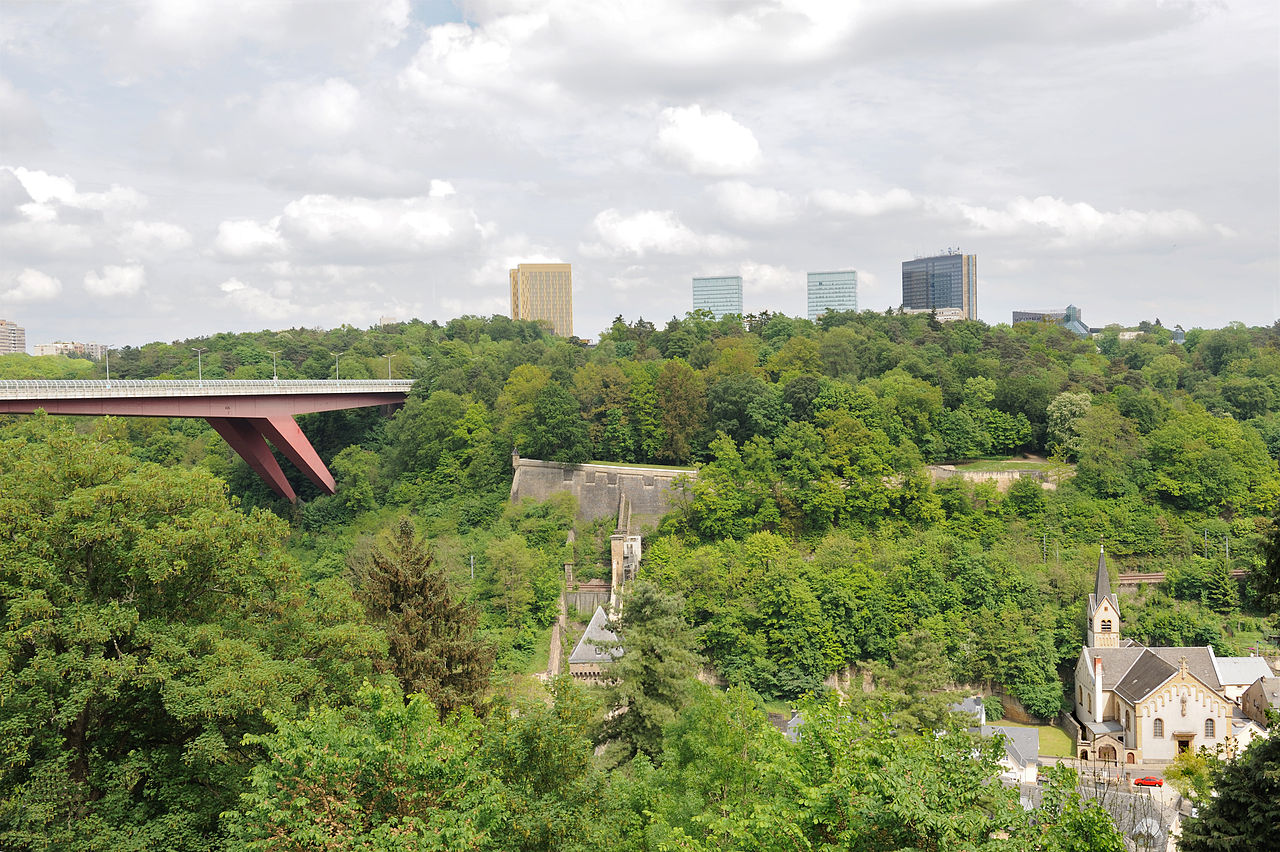
The sharpest contrast in Luxembourg City is vertical. The old centre, the Ville Haute, sits on a rocky salient with sheer drops on two sides into the valleys of the Alzette and Pétrusse. Down in the gorge lie the Grund, Clausen and Pfaffenthal, older riverside quarters of mills, workshops and small houses. Bridges and viaducts stitch the levels together, including the Adolphe Bridge and the Grand Duchess Charlotte Bridge, and since 2016 and 2017 the Pfaffenthal Panoramic Elevator and the Pfaffenthal-Kirchberg funicular have lifted pedestrians out of the valley.
The geography made the city a fortress. In 963 Count Siegfried acquired a small castle, Lucilinburhuc, and began building on the Bock rock above the Alzette. Countess Ermesinde granted the town a charter in 1244. Walls built around 1340 under John the Blind stood until 1867. Burgundians, Spanish, French, Austrians and Prussians took turns holding it. Spain began digging casemates, defensive tunnels in the rock, in 1644 and eventually cut about 23 kilometres of them; the French engineer Vauban enlarged them later in the century. After a seven-month French siege in the 1790s, the French politician Lazare Carnot called Luxembourg "the best fortress in the world, except Gibraltar", which gave it the nickname "Gibraltar of the North".

The 1867 Treaty of London, which settled the Luxembourg Crisis between France and Prussia, ordered the fortress torn down. At that point the city covered 127 hectares while its defences took up 177 hectares, and a building-free zone of almost a kilometre around them had prevented any expansion. Demolition took 16 years, cost 1.5 million gold francs and involved destroying more than 24 kilometres of underground works. The city could finally grow outward, across the Pétrusse to the station district on the Bourbon plateau, connected from 1903 by the Adolphe Bridge. Its upper deck is 153 metres long; a cycle deck was hung beneath it in 2018, and trams have crossed on top since December 2020. What survived of the old defences, together with the historic quarters, was listed by UNESCO in 1994 as "City of Luxembourg: its Old Quarters and Fortifications".
69.5% Foreign: 160 Nationalities in One Commune
Luxembourgers are a minority in their own capital. Foreign nationals make up 69.5% of the city's residents and Luxembourg citizens 30.5%, the highest foreign share of any commune in the country. The population comes from about 160 nationalities. Counted by place of birth rather than passport, 72.7% of residents in 2021 were immigrants: 49.1% born elsewhere in the EU and 23.6% outside it. For the country as a whole, foreigners are just under half the population.
The daytime population is different again. Luxembourg's labour market counts about 445,000 jobs, held by some 120,000 Luxembourgers, 120,000 foreign residents and 205,000 cross-border commuters from France, Belgium and Germany. In other words, more people cross the border each working day to jobs in Luxembourg than live in the capital, and many of them work in the city's banks, offices and EU institutions. Three languages carry this mix: Luxembourgish is the national language, French is the language of legislation, and German is also used in administration.
Kirchberg and the Court of Justice: One of the EU's Four Seats
Across the Alzette gorge from the old town, on the Kirchberg plateau, a second city of glass towers holds most of Luxembourg's European institutions. They include the Court of Justice of the European Union, the European Court of Auditors, the Secretariat of the European Parliament, the European Investment Bank, the European Stability Mechanism and several departments of the European Commission. The Council of the EU meets here each April, June and October.
The European role began early. In 1952 the city became the headquarters of the High Authority of the European Coal and Steel Community, the forerunner of the European Commission, and it hosted some sessions of the European Parliament until 1981. Brussels, Strasbourg and Frankfurt are the other main institutional seats. That concentration, plus banking, explains the country's wealth: the IMF ranked Luxembourg first in the world for GDP per capita in 2024, at about $140,310 in purchasing-power terms. Yet one national institution sits outside the capital. The grand-ducal family, now headed by Grand Duke Guillaume V, lives at Berg Castle in Colmar-Berg, not in the city.
Luxembourg City Weather: 42 Hours of December Sun Against 258 in July
The climate is oceanic, cloudy about two-thirds of the year, with moderate rain spread across every month. Readings are taken at Luxembourg Airport on the Findel plateau, 368 metres above sea level. The 1991–2020 averages give a January daytime high of 3.8 °C and a July high of 23.9 °C. Annual rainfall is 831.5 millimetres, with December the wettest month at 89.4 millimetres and April the driest at 49. The seasonal contrast is starkest in sunshine.
July receives about six times as much sun as December, and the average daytime high climbs by 20 degrees between January and July. January nights at the airport average -1.0 °C, while July nights stay near 14 °C.
Free Trams Since 29 February 2020
The last contrast is between the city's size and its traffic. With so many commuters arriving each working day, Luxembourg City has invested heavily in transport. Its first trams ran from 1875 until 1964, when they were scrapped. A new line opened in December 2017 and was completed in March 2025, running from Luxembourg Airport through Kirchberg, into the old town, over the Adolphe Bridge to the central station and south through Howald to Cloche d'Or. On 29 February 2020 Luxembourg became the first country to make all public transport free nationwide, and buses, trains and trams have carried passengers without tickets ever since. Extensions towards Strassen and Esch-sur-Alzette are planned.
The city also ranks well on comfort. In Mercer's 2019 survey of 231 cities it came first for personal safety and 18th for quality of living. It was the first city to be European Capital of Culture twice, in 1995 and again in 2007, the second time as the centre of a cross-border region taking in parts of Germany, Belgium and France. For the country beyond its capital, see our Luxembourg country guide, the list of the smallest countries by area, and our advice on the best time to visit Luxembourg.
Quick Facts About Luxembourg City
- Country: Luxembourg
- Continent: Europe (Western Europe)
- Country population: approximately 687 thousand
- Capital city status: Luxembourg City is the capital of Luxembourg, the seat of national government, and the location of foreign embassies, parliament, and the head of state's official residence.
Frequently Asked Questions
What is the capital of Luxembourg?
The capital of Luxembourg is Luxembourg City. Luxembourg City is the seat of national government, hosts most foreign embassies and consulates, and is typically where the head of state and parliament are located.
What continent is Luxembourg City in?
Luxembourg City, the capital of Luxembourg, is located in Europe, in the Western Europe region. As Luxembourg's capital, Luxembourg City serves as the country's primary connection to the broader Europen political, economic, and cultural sphere.
Why is Luxembourg City the capital of Luxembourg?
Luxembourg City was chosen as the capital of Luxembourg for reasons that typically combine geography, history, and politics. Capital city selections often reflect a desire for centrality (being accessible from across the country), historical importance (being a longstanding seat of government or culture), or neutrality (being acceptable to multiple regions or ethnic groups within the country). The specific reasons for Luxembourg City's designation are detailed in the city's history above.
What is Luxembourg City known for?
As the capital of Luxembourg, Luxembourg City is best known for housing the country's central government institutions — parliament, presidential or royal residences, supreme court, and key ministries. It is also typically a major cultural and economic center within Luxembourg, hosting national museums, embassies, and signature monuments. The introduction and history sections above provide detailed coverage of the city's specific notable institutions and landmarks.
Related Pages
- Luxembourg Country Guide — full geography, climate, economy, and culture overview
- Flag of Luxembourg — meaning, history, and design of Luxembourg's national flag