
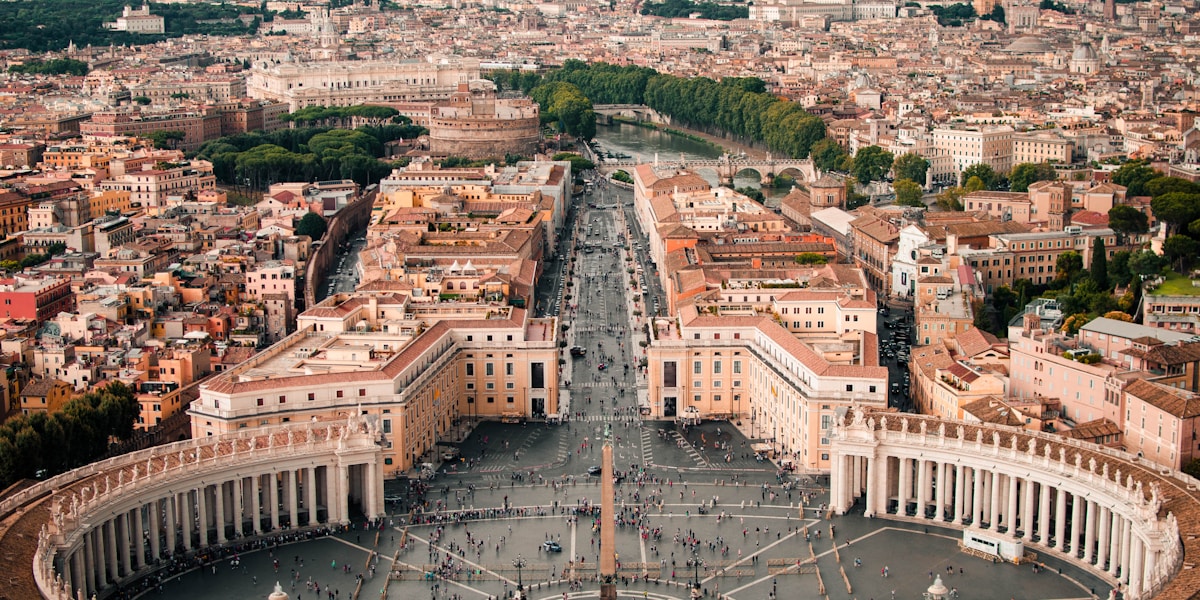
The smallest country in the world is Vatican City, with an area of just 0.44 km² (0.17 square miles). Located entirely within the city of Rome, Italy, Vatican City is the spiritual and administrative center of the Roman Catholic Church and home to approximately 800 people.
Vatican City: The World's Smallest Country
Vatican City — officially the Vatican City State (Stato della Città del Vaticano) — became an independent state on February 11, 1929, through the Lateran Treaty between the Holy See and Italy. Despite its tiny size, the smallest country in the world wields enormous global influence as the headquarters of the Catholic Church, which has over 1.3 billion adherents worldwide.
The entire country could fit inside many golf courses. It is roughly one-eighth the size of New York's Central Park. Yet within its walls lie some of the world's most priceless art and architecture: St. Peter's Basilica (the world's largest church), the Sistine Chapel with Michelangelo's famous ceiling, and the Vatican Museums, which receive over 6 million visitors annually.
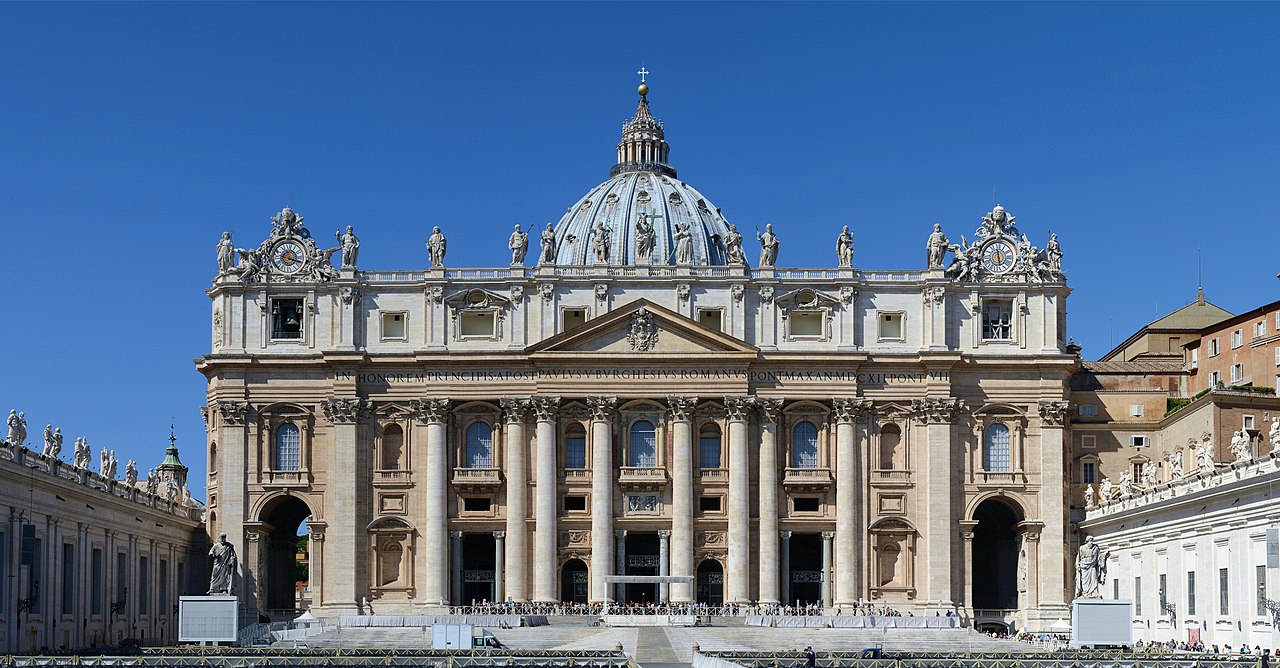
Vatican City Quick Facts
- Area: 0.44 km² (0.17 sq mi)
- Population: ~800
- Head of State: The Pope
- Government: Ecclesiastical elective monarchy (theocracy)
- Currency: Euro (mints its own coins with Vatican designs)
- Languages: Italian (official), Latin (formal)
- Founded: February 11, 1929
- Location: Enclosed within Rome, Italy
Vatican City has no permanent residential population in the traditional sense. Its approximately 800 residents include the Pope, cardinals, members of the Swiss Guard, clergy, and a small number of lay workers. Citizenship is granted based on appointment or employment and is revoked when service ends. The country has no hospitals, no agriculture, and no industry — it is sustained by donations from Catholics worldwide, museum admission fees, and the sale of stamps and publications.
Top 10 Smallest Countries in the World
1. Vatican City — 0.44 km²
- Location: Within Rome, Italy | Population: ~800 | Continent: Europe
The smallest country in the world by both area and population. An independent city-state and the spiritual center of Catholicism.
2. Monaco — 2.02 km²
- Location: French Riviera, bordered by France | Population: ~39,000 | Continent: Europe
Monaco is the most densely populated country in the world (approximately 19,000 people per km²). It is famous for the Monte Carlo Casino, the Monaco Grand Prix, and as a tax haven for the ultra-wealthy. Monaco has no income tax, and nearly one-third of its residents are millionaires.
3. San Marino — 61 km²
- Location: Enclosed within Italy | Population: ~34,000 | Continent: Europe
San Marino claims to be the world's oldest republic, founded in 301 AD. Like Vatican City, it is entirely surrounded by Italy. Despite its tiny size, San Marino has one of the world's highest GDP per capita and more vehicles than people.
4. Liechtenstein — 160 km²
- Location: Between Austria and Switzerland | Population: ~39,000 | Continent: Europe
Liechtenstein is a doubly landlocked country (landlocked and surrounded only by landlocked countries). It is one of the world's wealthiest countries per capita, with a strong financial services sector and low taxes. The country is a constitutional monarchy ruled by the Prince of Liechtenstein.
5. Malta — 316 km²
- Location: Mediterranean Sea, south of Sicily | Population: ~520,000 | Continent: Europe
Malta is an archipelago of three inhabited islands. It has been inhabited for over 7,000 years and contains some of the world's oldest free-standing structures (the Megalithic Temples). Malta is an EU member and uses the Euro.
6. Maldives — 300 km²
- Location: Indian Ocean, southwest of Sri Lanka | Population: ~520,000 | Continent: Asia
The Maldives consists of 1,192 coral islands grouped into 26 atolls, making it the lowest-lying country in the world (average elevation: 1.5 m). Climate change and rising sea levels pose an existential threat — the country could be largely uninhabitable by 2100.
7. Saint Kitts and Nevis — 261 km²
- Location: Caribbean Sea | Population: ~54,000 | Continent: North America
Saint Kitts and Nevis is the smallest country in the Americas and the smallest sovereign state in the Western Hemisphere. It was the last Caribbean island colonized by Europeans and the first to gain independence in the British West Indies (1983).
8. Marshall Islands — 181 km²
- Location: Central Pacific Ocean | Population: ~42,000 | Continent: Oceania
The Marshall Islands consists of 29 coral atolls and 5 islands. Bikini Atoll, part of the chain, was the site of 23 US nuclear weapons tests between 1946 and 1958. The country faces severe threats from rising sea levels.
9. Tuvalu — 26 km²
- Location: Central Pacific Ocean | Population: ~11,000 | Continent: Oceania
Tuvalu is one of the least visited countries in the world and among the most vulnerable to climate change. Its highest point is just 4.6 m above sea level. Tuvalu earns significant revenue from licensing its internet domain (.tv) to television companies.
10. Nauru — 21 km²
- Location: Central Pacific Ocean | Population: ~12,500 | Continent: Oceania
Nauru is the world's smallest island nation and the smallest republic. It briefly had one of the highest per-capita incomes in the world due to phosphate mining, but the deposits are now nearly exhausted. Nauru has no official capital city.
Key Facts About the World's Smallest Countries
- Vatican City (0.44 km²) is over 38 million times smaller than Russia (17.1 million km²).
- Six of the 10 smallest countries are in Europe; three are in the Pacific; one is in Asia.
- Monaco is the most densely populated, while Vatican City has the fewest people.
- Several of the smallest countries are among the wealthiest per capita (Monaco, Liechtenstein, San Marino).
- Multiple Pacific microstates face existential threats from rising sea levels.
Final Thoughts
The smallest country in the world, Vatican City, proves that geographic size has little to do with global influence. From Monaco's glamorous wealth to Tuvalu's existential climate struggle, the world's smallest countries each have compelling stories that far outsize their borders. These microstates remind us that sovereignty comes in all sizes — and that even a country smaller than a city park can shape world history.
Test Your Knowledge!
Think you know your geography? Try our interactive quiz!
Play Geography Games →