
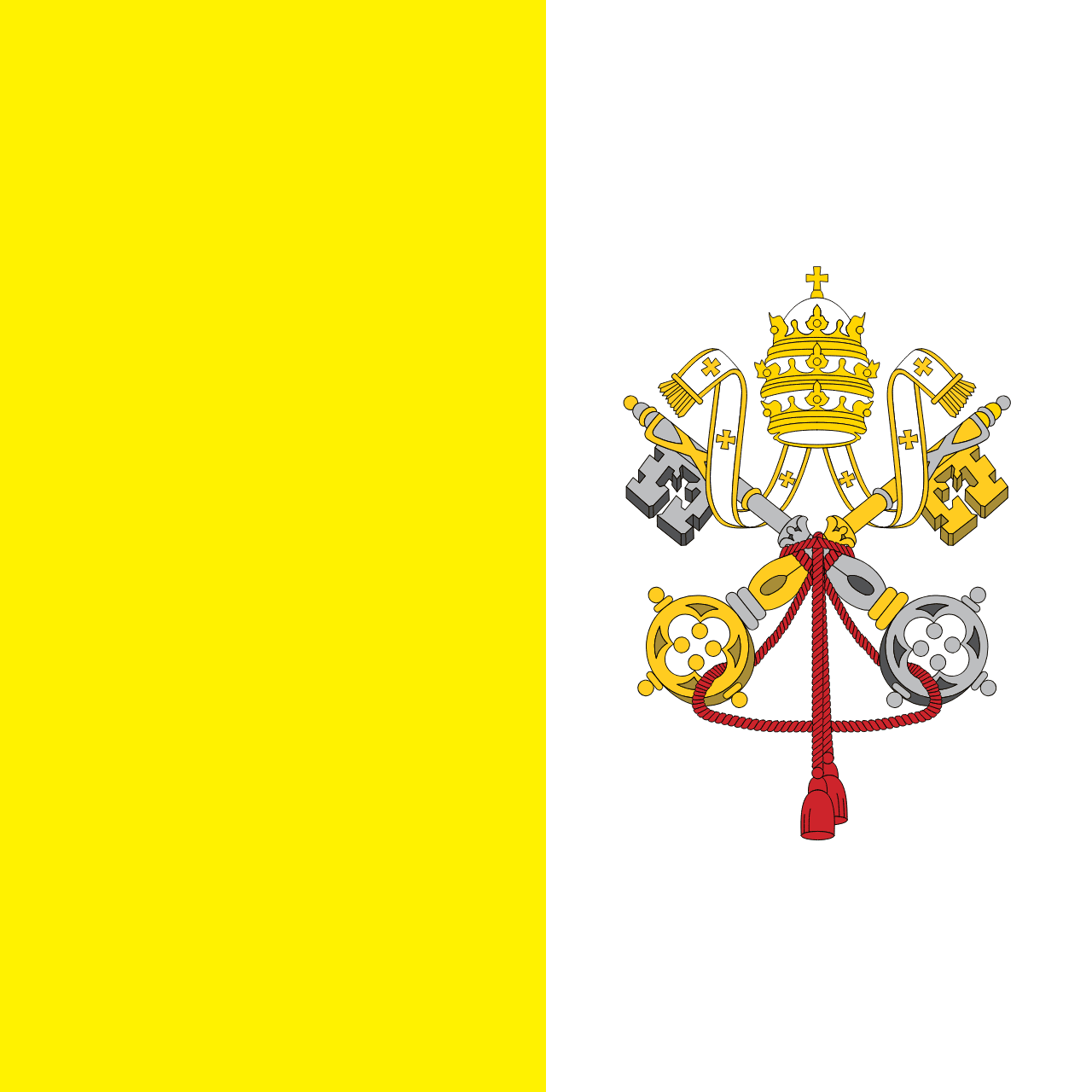
Few flags in the world are as instantly recognizable, or as unusual in shape, as the banner that flies over the smallest sovereign state on Earth. The flag of Vatican City pairs two luminous vertical bands of yellow and white with a compact emblem of crossed keys beneath the papal tiara. It is a flag of contradictions in the best sense: tiny in territory yet vast in symbolic reach, ancient in its imagery yet formally adopted only in the twentieth century. For the hundreds of millions of Catholics around the globe, and for the visitors who crowd St. Peter's Square each year, this golden-and-white standard is the visual shorthand for the seat of the papacy.
What makes the Vatican flag so distinctive is not only its colors but its proportions. Alongside Switzerland, it is one of only two national flags in the world that is perfectly square rather than rectangular. That single design choice sets it apart at a glance, even before the eye registers the keys of Saint Peter at its heart.
A Banner of Yellow and White
The Vatican flag is built from just two colors: yellow and white. These are not decorative selections but the traditional papal colors, a pairing long associated with the office of the pope and the Holy See. The choice carries centuries of ecclesiastical weight, evoking the metals of the keys that appear on the emblem itself.
The yellow band, positioned at the hoist nearest the flagpole, is often understood to represent gold, while the white field beside it suggests silver. Together they echo the colors of the two keys in the coat of arms: one gold and one silver. This deliberate harmony between the field colors and the emblem gives the flag a tightly unified design, where every element reinforces the same theme of spiritual authority entrusted to the Church.
Design and Layout of the Flag
The construction of the flag is elegantly simple to describe but rich in meaning. It is a vertical bicolor, divided into two equal halves running from top to bottom. The yellow half sits closest to the staff; the white half occupies the fly side. Centered on the white portion is the papal coat of arms.
That emblem consists of two crossed keys, one gold and one silver, bound together by a red cord and surmounted by the papal tiara, the three-tiered crown traditionally associated with the popes. The keys cross in a saltire pattern, their bows at the bottom and their wards angled upward, ready to lock and unlock. The placement of the arms only on the white band, rather than spanning the whole flag, keeps the composition balanced and prevents the busy detail of the emblem from competing with the clean division of color.
Because the flag is square, the two color bands are also perfect rectangles of equal width, giving the whole banner a compact, almost heraldic appearance that feels closer to a coat of arms on cloth than to a typical national tricolor.
How the Flag Came to Be
The modern Vatican flag dates to 1929, the year Vatican City came into existence as an independent state. That sovereignty was established through the Lateran Treaty signed between the Holy See and Italy, which resolved decades of tension over the status of the papacy after the unification of Italy had absorbed the former Papal States. With statehood came the need for the formal trappings of a nation, including a flag.
The yellow-and-white design, however, did not appear from nowhere. The papal colors and the crossed-keys emblem had been used by the Holy See well before 1929, drawing on heraldic traditions that stretch back through the history of the Church. When the new microstate adopted its flag, it essentially codified imagery that the world already associated with the pope, giving long-standing symbols a fresh, official standing as the banner of a recognized sovereign entity. Readers curious about the wider story of the territory can explore our vatican city country guide for more on how this remarkable enclave functions.
Compared With Look-Alike Flags
At first glance, a yellow-and-white vertical bicolor might seem easy to confuse with other banners, but the Vatican flag has several features that make it unmistakable once you know what to look for. The most obvious comparison is with Switzerland, the only other square national flag. The two are unrelated in design, Switzerland showing a white cross on red, but they share the rare distinction of breaking from the rectangular norm that nearly every other country follows.
In terms of color, the Vatican stands almost alone. Very few national flags rely on a yellow-and-white palette, partly because white-on-yellow offers low contrast and partly because the combination is so strongly tied to the papacy. The crossed keys and tiara further set the flag apart from any potential imitator; this is heraldry specific to the Holy See and not duplicated by other states. Where many flags use stars, stripes, or crescents that recur across borders, the Vatican's emblem is uniquely its own, instantly tying the cloth to one institution and one office.
Cultural Significance and Identity
For the Vatican, the flag functions on two levels at once. It is the standard of a sovereign state, flown at the borders of the enclave and used in diplomatic settings, and it is simultaneously the banner of a global religious community. When the flag appears, whether atop a building in Rome or carried in a procession on another continent, it signals the presence and authority of the Holy See.
The keys themselves carry deep meaning. They reference the symbolic "keys of the kingdom" entrusted to Saint Peter, regarded as the first pope, and by extension the spiritual authority passed down to his successors. The tiara above them speaks to the dignity of the papal office. In this way the flag is less a statement about a patch of land than a declaration of a continuous spiritual lineage, which is why Catholics far beyond the walls of the city recognize and honor it.
The Flag in Modern Life
Today the Vatican flag is woven into the rhythms of the Church and the daily life of the world's smallest country. It is raised over Vatican buildings, displayed during major liturgical celebrations such as Easter and Christmas, and waved enthusiastically by the crowds who gather to see the pope. During papal travels abroad, the yellow-and-white banner often appears alongside the host nation's own flag, a visible sign of the Holy See's status as a recognized diplomatic actor.
Because Vatican City sits entirely within Rome on the continent of Europe, the flag is a familiar sight to the millions of tourists who pass through St. Peter's Square. It also turns up on stamps, official documents, and souvenirs, ensuring that its compact heraldic design reaches well beyond the few acres it officially represents. For pilgrims, the simple act of seeing the flag flying can carry profound emotional and spiritual resonance.
Interesting Facts at a Glance
- It is one of only two square national flags in the world, the other belonging to Switzerland.
- The yellow and white are the traditional papal colors, echoing gold and silver.
- The crossed keys represent Saint Peter and the authority handed down to the popes.
- The flag was formally adopted in 1929, when Vatican City became an independent state.
- The white half of the flag carries the coat of arms, while the yellow half stays plain.
- The emblem is topped by the three-tiered papal tiara, a crown unique to the papacy.
Frequently Asked Questions
When was the flag of Vatican City adopted?
The flag was adopted in 1929, the same year Vatican City was established as a sovereign state through the Lateran Treaty between the Holy See and Italy. Although the colors and emblem had earlier heraldic roots, 1929 marks when they became the official banner of the new microstate.
What do the colors of the Vatican flag mean?
The yellow and white are the traditional papal colors. They are commonly interpreted as representing gold and silver, mirroring the gold and silver keys of Saint Peter shown in the coat of arms on the white half of the flag.
Who designed the Vatican flag and what is the emblem?
The flag formalized long-standing papal heraldry rather than being the creation of a single named designer. Its central emblem features two crossed keys, one gold and one silver, bound by a cord and topped by the papal tiara, symbolizing the keys entrusted to Saint Peter and the authority of the papacy.
What continent is Vatican City on and how does its flag compare to others?
Vatican City lies within Rome, on the continent of Europe. Its flag is notable for being square, a trait it shares only with Switzerland, and for its rare yellow-and-white palette combined with the unique crossed-keys emblem that distinguishes it from every other national flag.
