
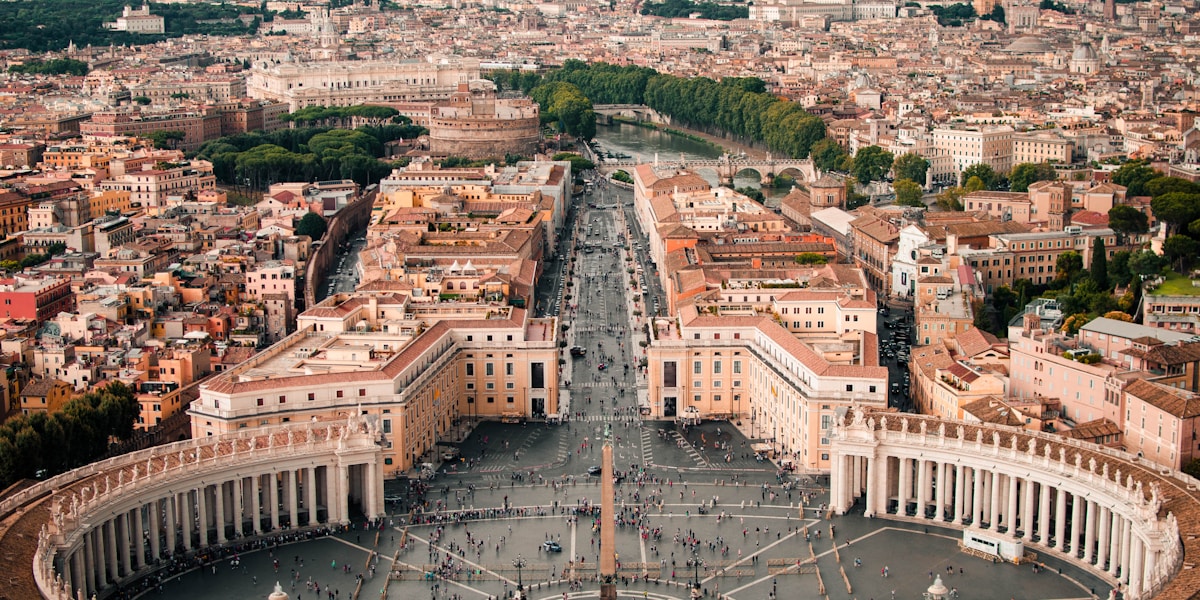
Tucked entirely within the city of Rome, Vatican City is a place where geography and spirituality collapse into a single, astonishing point on the map. It is the smallest sovereign state on Earth, yet it carries an influence felt by more than a billion people across every continent. As the seat of the Pope and the administrative heart of the Roman Catholic Church, this walled enclave punches so far above its physical weight that its name is recognized in nearly every household worldwide. Visitors come not for sprawling landscapes or bustling cities, but to stand beneath Michelangelo's Sistine ceiling, to gaze up at the dome of St. Peter's Basilica, and to feel the weight of centuries of faith, art, and history concentrated into less than half a square kilometer.
Established as an independent state in 1929 through the Lateran Treaty between the Holy See and Italy, Vatican City is a curiosity among nations. It has no countryside, no farmland, and no coastline, yet it functions as a fully recognized sovereign entity with its own diplomatic corps, postal system, and even a small army. For travelers and geography enthusiasts alike, few places offer such a vivid lesson in how size and significance need not go hand in hand.
An Overview of the World's Smallest Nation
Vatican City, officially the Vatican City State, is unique in that it is a theocratic monarchy ruled by the Pope, who serves as head of both church and state. Often referred to simply as The Holy See, the country is governed less like a traditional nation and more like the operational base of a global religious institution. Its roughly 800 residents include clergy, members of the Swiss Guard, and a small number of lay workers and their families. Despite this tiny population, the Vatican manages international relations with dozens of countries and maintains a presence at the United Nations as a permanent observer.
Geography and Landscape
Vatican City occupies just 0.44 square kilometers on the west bank of the Tiber River, a footprint smaller than many municipal parks. It is completely surrounded by Rome, enclosed on nearly every side by medieval and Renaissance walls. The only major opening is at St. Peter's Square, the grand colonnaded piazza designed by Bernini, which spills openly into the surrounding Italian city. The terrain is largely flat, rising gently toward a modest hill in the area of the Vatican Gardens. Those gardens, dotted with fountains, sculptures, and manicured greenery, occupy more than half the entire territory, offering a surprising pocket of calm behind the monumental facades.
There are no rivers, lakes, or natural waterways within the borders, and no agriculture to speak of. Everything within the walls is, in effect, a single urban complex dominated by basilicas, museums, palaces, and administrative buildings. It is geography reduced to its most concentrated and human-made form.
Climate
Because it sits inside Rome, Vatican City shares the Italian capital's Mediterranean climate, marked by hot, dry summers and mild, wet winters. Summer temperatures often climb between 25 and 35 degrees Celsius, while winters remain temperate, generally ranging from 5 to 15 degrees Celsius. Rain falls mostly in autumn and winter, while July and August are reliably dry and sun-baked. This pleasant climate means the Vatican is accessible year-round, though the intense midsummer heat can make long queues for the museums uncomfortable.
History
The Vatican Hill has been significant since ancient Roman times. Nearby stood the Circus of Nero, where tradition holds that the apostle Peter was martyred around 64 CE. In the 4th century, Emperor Constantine ordered the construction of the original St. Peter's Basilica over Peter's tomb, cementing the site as the spiritual anchor of Western Christianity. For more than a millennium, the popes ruled not only the church but vast temporal territories known as the Papal States, which once stretched across much of central Italy.
That worldly power collapsed with the unification of Italy in 1870, when the new Italian kingdom absorbed the papal lands and left the Pope a self-described "prisoner in the Vatican." The resulting standoff, called the "Roman Question," lingered for nearly six decades until the Lateran Treaty of 1929 finally resolved it, creating the compact independent state we know today and guaranteeing the sovereignty of the Holy See. You can see this layered heritage reflected in the flag of vatican city, with its crossed keys and papal tiara.
Culture and Society
The cultural footprint of Vatican City dwarfs its physical size. The Vatican Museums house one of the greatest art collections ever assembled, with masterpieces by Raphael, Caravaggio, and Leonardo da Vinci. The crowning jewel is the Sistine Chapel, whose ceiling Michelangelo painted between 1508 and 1512 in an extraordinary feat of artistic and physical endurance. The Vatican Library, meanwhile, safeguards roughly 80,000 manuscripts and well over a million printed books, including some of the earliest surviving fragments of biblical text.
Society here revolves around the rhythms of the church. Italian is the working language of daily life and administration, while Latin remains the official language of formal documents and liturgy, a living link to the Roman past. Papal ceremonies, from open-air masses in St. Peter's Square to the Easter Urbi et Orbi blessing, can draw hundreds of thousands of pilgrims, transforming the small square into a sea of the faithful from every corner of the globe.
Economy
The Vatican's economy is unlike any other on the planet. It collects no traditional taxes and produces no exports in the conventional sense. Instead, it is sustained by donations from Catholic dioceses worldwide, known as Peter's Pence, alongside revenue from the Vatican Museums, the sale of stamps, coins, and souvenirs, and returns on financial investments. The Institute for the Works of Religion, commonly called the Vatican Bank, manages assets on behalf of Catholic institutions and individuals. The state's finances exist primarily to fund the spiritual and administrative mission of the Holy See rather than to generate national wealth, surrounded as it is by the larger economy of Italy.
Tourism and Travel Tips
For its size, Vatican City may be the most visited place on Earth per square meter. St. Peter's Basilica, the largest church in the world by interior space, anchors any visit, with Michelangelo's soaring dome, Bernini's bronze baldachin, and the heartbreaking beauty of the Pieta. The Vatican Museums lead visitors through dozens of galleries and more than 70,000 works of art before delivering them, almost breathless, into the Sistine Chapel. Some six million people pass through each year.
Practical planning makes an enormous difference here. Book timed entry tickets to the museums online in advance to skip notoriously long lines, and consider an early-morning or late-afternoon slot to avoid the worst crowds. Dress modestly, with shoulders and knees covered, as a strict dress code is enforced for both the basilica and chapel. Climbing the dome of St. Peter's rewards the effort with sweeping views over Rome, though the upper stairs are narrow. The Vatican Gardens require a pre-booked guided tour but offer a serene escape from the throngs. Because the Vatican is seamlessly woven into Rome, many travelers pair it with the wider Italian capital, and those touring the region often continue on to France or other European cultural hubs.
Key Facts
- Official Name: Vatican City State
- Capital: Vatican City
- Continent/Region: Europe (Southern Europe)
- Area: 0.44 km²
- Population: approximately 800
- Currency: Euro (EUR)
- Languages: Italian, Latin
Interesting Facts
- Vatican City is the smallest country in the world at just 0.44 square kilometers, roughly the size of a golf course.
- It maintains its own postal service, pharmacy, radio station, and even a railway station, despite being smaller than most city parks.
- The Swiss Guard, who have protected the Pope since 1506, are widely considered the smallest and oldest standing army in the world.
- The Vatican Library holds around 80,000 manuscripts, among them some of the earliest known copies of the Bible.
- The Vatican often reports the highest crime rate per capita in the world, an oddity driven by pickpocketing among visitors measured against its tiny resident population.
Frequently Asked Questions
What is the capital of Vatican City?
Vatican City is unusual in that the state and its capital are one and the same. The entire country functions as a single city-state, so the capital is simply Vatican City itself.
What languages are spoken in Vatican City?
Italian is the everyday working language used in administration and daily life, while Latin remains the official language for formal church documents and liturgical use, preserving a direct connection to ancient Rome.
When is the best time to visit Vatican City?
Spring (April to June) and autumn (September to October) offer the most comfortable weather and slightly thinner crowds. Summer brings intense heat and the largest tourist volumes, while winter is mild and quieter, ideal for visitors who want to avoid long lines.
What is Vatican City known for?
Vatican City is famous as the spiritual home of the Roman Catholic Church and the residence of the Pope. It is renowned for St. Peter's Basilica, the Sistine Chapel with Michelangelo's frescoes, the vast Vatican Museums, and its status as the smallest independent nation on Earth.