
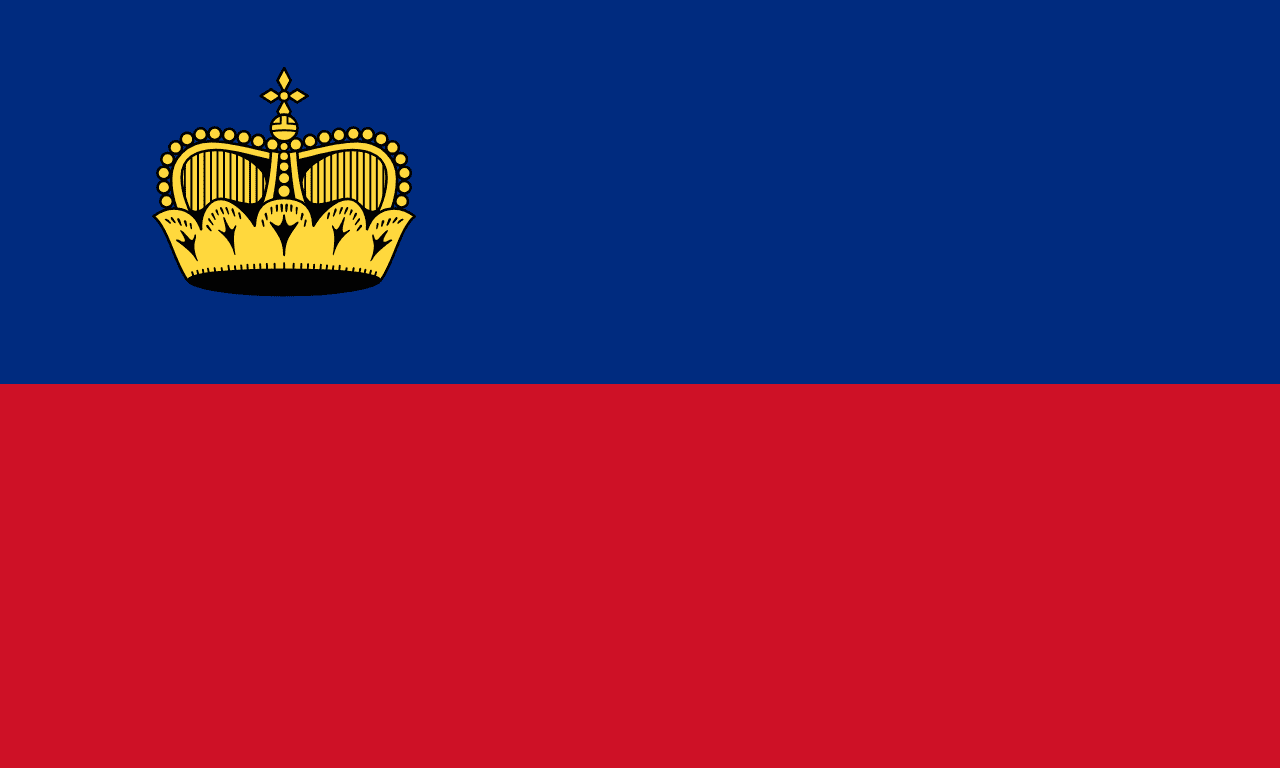
Tucked between Switzerland and Austria in the heart of the Alps, the principality of Liechtenstein is one of the smallest sovereign states on Earth, yet its flag carries one of the most charming origin stories in the world of vexillology. A simple horizontal band of blue over red, topped in the upper hoist by a golden princely crown, the banner manages to feel both humble and regal at once. It speaks of mountain skies and warm hearths, of an ancient ruling house, and famously, of an Olympic mishap that nudged a tiny nation into redesigning its national emblem.
For a country measuring barely 160 square kilometers, Liechtenstein punches far above its weight in flag lore. The current design has flown since 1937, but the colors themselves stretch back much further, woven into the identity of a German-speaking microstate that has guarded its independence with quiet determination. Understanding the flag means understanding the principality itself: small, proud, and unmistakably its own.
The Colors and What They Stand For
The flag of Liechtenstein draws on three colors: blue, red, and gold. Each carries a meaning rooted in the landscape and the people of the principality. The blue upper band represents the sky that arches over the Alpine valleys, a clear and constant presence above the mountains. The red lower band stands for the glow of the hearth fires kindled in the homes of Liechtenstein's people during long evenings, a symbol of warmth, family, and the domestic life that anchors a small nation.
The gold belongs to the crown. As a heraldic color, gold has long signaled sovereignty, dignity, and the dignity of rule. Here it crowns the design quite literally, marking the flag as the banner of a principality rather than a republic. Together, the three colors compress a whole national self-image into a few square meters of cloth: nature above, home below, and monarchy presiding over both.
Reading the Design
At its core the flag is a horizontal bicolor, divided into two equal bands with blue on top and red beneath. This split is clean and balanced, the kind of straightforward composition that many nations have favored for legibility at a distance. What lifts Liechtenstein's flag out of the ordinary is the golden crown set into the canton, the upper section nearest the flagpole.
The crown is a princely crown, depicted in gold and detailed enough to read clearly even when the flag is fluttering. Its placement in the hoist quarter means that whichever way the banner hangs or waves, the emblem of the ruling House of Liechtenstein remains prominent and instantly recognizable. The crown does more than decorate: it identifies. It tells anyone looking that this is not merely a colored field but the flag of a monarchy with a living, reigning prince at its head.
How the Flag Came to Be
The blue-and-red combination had served Liechtenstein since the early nineteenth century, when the principality adopted these colors as it consolidated its national symbols. For more than a hundred years the plain bicolor flew without any additional charge, a simple statement of identity for a state that often went unnoticed on the European map.
The turning point came at the 1936 Summer Olympics in Berlin. Officials and athletes there discovered that Liechtenstein's plain blue-and-red banner was, for all practical purposes, identical to the flag of Haiti, which used the very same horizontal arrangement of those colors. Two unrelated nations on opposite sides of the world had independently arrived at the same design. The realization that the country shared its flag with a Caribbean republic prompted Liechtenstein to act.
In 1937, the principality formally added the golden princely crown to the upper hoist, distinguishing its flag once and for all. The amendment solved the practical problem of confusion while also strengthening the symbolic link between the flag and the monarchy. That 1937 design is the one Liechtenstein continues to fly today, making the modern flag both a product of heraldic tradition and a small monument to an awkward sporting coincidence.
Look-Alikes and What Sets It Apart
The Haiti comparison is the most famous, and for good reason: before 1937 the two flags were so similar that telling them apart at a glance was nearly impossible. Haiti's flag has since evolved with its own coat of arms on a white panel, while Liechtenstein's crown keeps the two firmly distinct. The episode remains one of the most cited examples in the world of why national flags sometimes need a unique charge to avoid duplication.
The blue-over-red horizontal palette also echoes elements seen in other European and regional banners, but few pair the two colors in exactly this order with a monarchical emblem in the canton. The crown is the decisive feature. Many countries use horizontal bicolors and tricolors, yet a golden princely crown set into the hoist is rare enough that, once you know it, the flag of Liechtenstein becomes hard to mistake for any other. Where similar palettes might cause a double-take, the crown delivers an immediate and certain answer.
National Identity and Civic Life
For Liechtensteiners, the flag is inseparable from the institution of the monarchy, which remains central to national life in a way that is unusual among modern European states. The reigning prince is a genuinely active figure in the country's politics and identity, and the crown on the flag is a constant reminder of that relationship. To raise the banner is to affirm both nationhood and the House of Liechtenstein that gives the country its very name.
The flag appears across the principality's civic landscape, from government buildings in the capital, Vaduz, to public celebrations. Liechtenstein's national day in August brings the colors out in force, when residents gather, often within sight of Vaduz Castle, the prince's hilltop residence, to celebrate together. Visitors curious about the wider story of this Alpine state can explore our liechtenstein country guide for context on its geography, governance, and surprising prosperity. In sport, the flag travels with the small but proud delegations Liechtenstein sends to international competitions, including the very Olympic stage where its design story began. The flag also flies in skiing events, where the mountainous principality has historically found some of its greatest athletic success.
Notable Facts at a Glance
- The flag's plain blue-and-red form predates the crown by more than a century, with the colors in use from the early 1800s.
- The golden crown was added in 1937, the design Liechtenstein still uses today.
- The change was prompted by the discovery at the 1936 Berlin Olympics that the flag matched Haiti's.
- Blue represents the sky, red the hearth fires of the people, and gold the princely crown of the ruling house.
- Liechtenstein sits in Europe, landlocked between Switzerland and Austria in the Alps.
- The crown is placed in the upper hoist so it stays visible regardless of how the flag hangs.
Frequently Asked Questions
When was the flag of Liechtenstein adopted?
The current flag was adopted in 1937, when the golden princely crown was added to the upper hoist. The underlying blue-and-red bicolor, however, had been in use since the early nineteenth century, so 1937 marks the date of the design as it appears today rather than the first appearance of the colors.
What do the colors of the Liechtenstein flag mean?
Blue stands for the sky above the Alpine country, red represents the hearth fires of the people in their homes, and gold is the color of the princely crown, symbolizing the monarchy. The three colors together capture nature, domestic life, and sovereign rule in a single, compact design.
Why does the flag have a crown on it?
The crown was added in 1937 after officials realized at the 1936 Berlin Olympics that Liechtenstein's plain blue-and-red flag was identical to Haiti's. Adding the golden princely crown distinguished the two flags and, at the same time, reinforced the connection between the banner and the country's reigning monarchy.
What continent is Liechtenstein on, and which flags resemble its own?
Liechtenstein is located in Europe, a landlocked microstate between Switzerland and Austria. Its closest historical look-alike was the flag of Haiti, which shared the same blue-over-red bicolor before the crown set Liechtenstein's version apart. The princely crown in the hoist is the key feature that distinguishes it from any similarly colored flag.
