

Vaduz is the capital of Liechtenstein, a town of 5,696 people (2019) on the east bank of the Alpine Rhine, where the river forms the border with Switzerland. It is the seat of the Landtag, the government and the courts, yet it is not even the principality’s largest municipality: neighbouring Schaan has more residents. What defines Vaduz is the whitewashed castle on the wooded slope above it, home of the reigning Prince of Liechtenstein, which gave the town its fame and, in a sense, its reason for being a capital at all. The story of how a village of vineyards and farmhouses ended up running a sovereign state is best told era by era.
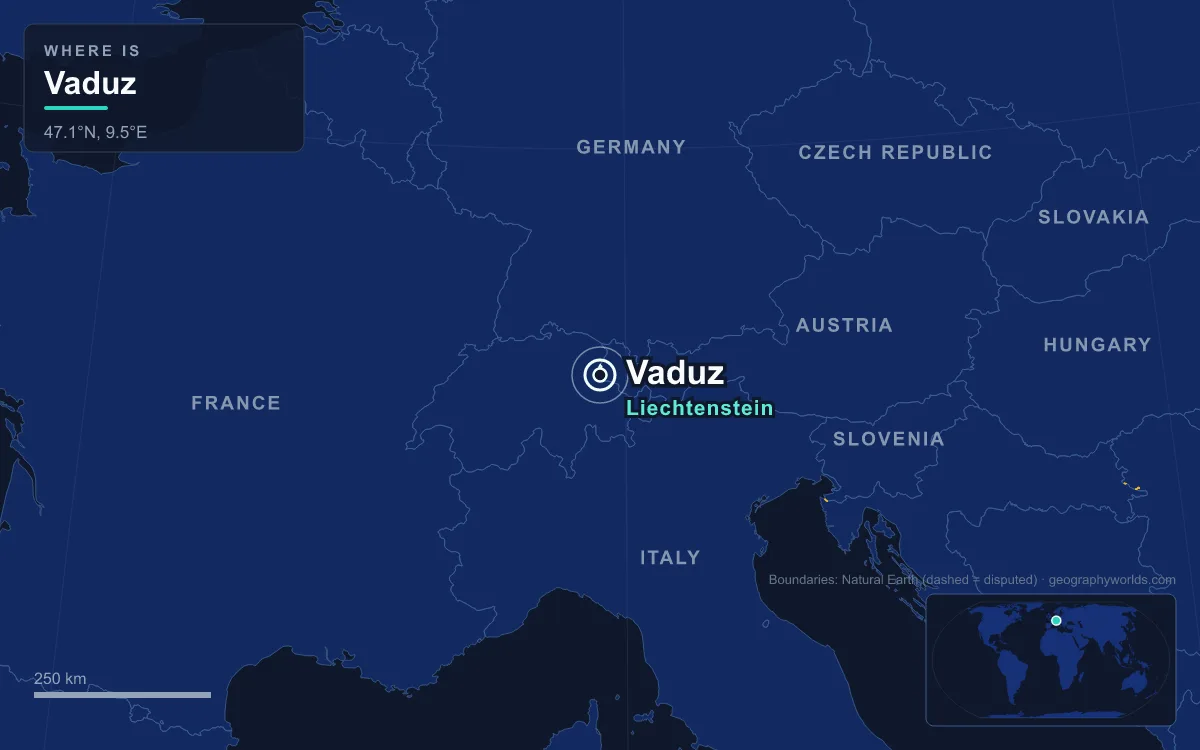
Faduzes on the Rhine: Roman Road to Swabian War (to 1499)
Long before there was a Liechtenstein, the ground Vaduz stands on belonged to the Roman province of Raetia. A Roman road ran north through the valley from the Splügen Pass, keeping to the right bank of the Rhine at the edge of a floodplain that the river regularly drowned. Roman villas have been excavated at Schaanwald and Nendeln, and a late Roman fort survives at Schaan, a reminder that the Alemanni were pressing in from the north.
The town’s name is older than its German-speaking population. It first appears in 12th-century manuscripts as Faduzes, and linguists trace it to a Rhaeto-Romance word for an aqueduct, itself descended from the Latin aquaeductus. Romansh remained the dominant language of the valley until about 1100, after which German gained ground; around 1300 Walser settlers from the Valais arrived and took the high pastures, and the mountain village of Triesenberg above Vaduz still carries traces of their dialect.
The castle above the town is older than any of these written traces of the county. Its keep dates from the 12th century, and the counts of Werdenberg-Sargans are presumed to have built it. The keep stands on a patch of ground just 12 by 13 metres, with walls up to 4 metres thick at the base and an original entrance 11 metres above the courtyard. A County of Vaduz was carved out of the Werdenberg lands in 1342, and in 1396 it gained imperial immediacy, meaning it answered to the Holy Roman Emperor alone. That legal detail would matter enormously three centuries later. In 1434 the Rhine became the line between the Empire and the Swiss cantons, and Liechtenstein’s outer border has not moved since. The early era ended violently: in the Swabian War of 1499 Swiss forces burned the castle and destroyed the whole village.
Hohenems Counts and the Sale of 1712
Vaduz changed hands several times after the fire. When the line of the counts of Vaduz died out with Hartmann IV in 1416, the county passed to the barons of Brandis; in 1507 it was sold to the counts of Sulz, and in 1613 to the counts of Hohenems. Count Kaspar von Hohenems, who ruled from 1613 until his death in 1640, extended the castle’s western side. The century was otherwise grim. Austrian and Swedish troops crossed the valley during the Thirty Years’ War, plague struck, and the witch trials of the period led to more than 100 people being persecuted and executed.
In 1684 Emperor Leopold I stripped Count Ferdinand Karl von Hohenems of his lands and gave them to his brother Jakob Hannibal III, who needed cash to pay his debts. A buyer appeared from far away. The House of Liechtenstein, named after a castle in Lower Austria, held vast estates in Moravia, Bohemia and Austria, but none of them was held directly from the Emperor. Without such land the family could not take a seat in the Imperial Diet. Schellenberg and Vaduz, two small lordships whose only overlord was the Emperor, solved that problem. Prince Johann Adam Andreas bought the Lordship of Schellenberg in 1699 and the County of Vaduz, castle included, in 1712.
A Capital Without Its Prince, 1719–1842
On 23 January 1719 Emperor Charles VI united Vaduz and Schellenberg and raised them to an imperial principality named Liechtenstein, in honour of his servant Anton Florian of Liechtenstein. Vaduz, home of the old count’s castle, became the centre of a state named after a family that lived in Vienna.
That family did not visit. The purchase had been a political manoeuvre, and for more than 120 years no reigning prince set foot in the principality. Vaduz was governed instead by a district office, the Oberamt, whose officials collected taxes and reported developments to Vienna.
Napoleon changed the principality’s status without changing life in Vaduz much. In 1806 Liechtenstein joined the Confederation of the Rhine and became sovereign as the Holy Roman Empire dissolved; in 1815 it joined the German Confederation. Prince Johann I granted a limited constitution in 1818, the same year Prince Alois became the first member of the ruling house to visit. The first visit by a sovereign prince came only in 1842.

Landtag, Railway and Neo-Gothic Church, 1848–1918
Politics finally arrived in Vaduz with the revolutions of 1848. On 22 March that year a people’s committee chose Peter Kaiser, Karl Schädler and Ludwig Grass to lead the movement, and the old district office was abolished. A District Council of 24 elected members met from 7 March 1849, the first democratic body in the country, until Prince Aloys II restored absolute rule on 20 July 1852. Schädler kept pushing, and the constitution ratified on 26 September 1862 created the Landtag, the parliament that still sits in Vaduz. Two years later the municipal law of 1864 gave the town its own mayor and council.
Vaduz also became the stage for Liechtenstein’s only military adventure. In the Austro-Prussian War of 1866 the principality’s 80-man army marched to guard the Stilfser Joch pass, leaving a reserve of 20 men at Vaduz Castle. When the war ended on 22 July, the soldiers marched home to a ceremonial welcome in the town. Local legend insists that 80 left and 81 came home. The army was disbanded on 12 February 1868.
Modern infrastructure largely bypassed the capital. The Feldkirch–Buchs railway opened in 1872, but its nearest stop, Schaan-Vaduz, opened on 24 October that year by agreement with Austria-Hungary and Switzerland, lies in Schaan, 3.5 km from the capital, and attempts to bring the line into Vaduz have failed. The town did get a new church: in 1874 the architect Friedrich von Schmidt built the neo-Gothic parish church of St. Florin on older medieval foundations, dedicating it to Florinus of Remüs, a 9th-century saint of the Vinschgau. In 1890 Governor Friedrich Stellwag von Carion’s idea of a national museum took shape in rooms at the castle, and in 1904 a major restoration of the castle itself began.
Franz Joseph II Moves In, 1919–1989
The First World War ended Liechtenstein’s long orientation towards Vienna. An Entente embargo from 1916 brought food shortages, and in November 1918 a de facto coup forced out the governor, Leopold von Imhof. Liechtenstein then turned to Switzerland: from 1919 Bern represented its interests abroad, the Swiss franc was adopted in 1920 and a customs union followed in 1924. The constitution of 5 October 1921, drafted by Wilhelm Beck, Josef Ospelt and Josef Peer among others, created the mix of monarchy and direct democracy that is governed from Vaduz today.
The decisive event for the capital came in 1938. On 31 March, weeks after Nazi Germany annexed Austria, Prince Franz I named his grandnephew Franz Joseph regent; on 25 July Franz I died and Franz Joseph II succeeded him. The new prince had already extended the castle in the early 1930s, and from 1938 it became the princely family’s primary residence. For the first time in 219 years, Vaduz was a capital with its sovereign living in it. Franz Joseph II reigned until his death in 1989 and is buried in the Princely Crypt beside St. Florin.
Local democracy moved at its own pace. A 1974 revision of the municipal law raised Vaduz’s council to twelve seats with four-year terms and open-list proportional voting. In 1976 Vaduz gave women the vote in municipal matters, eight years before the national referendum of 1 July 1984 made Liechtenstein the last country in Europe to grant women’s suffrage, passing with 51.3% of an all-male electorate. In 1975 a bridge for motor vehicles opened towards Sevelen in Switzerland, alongside the Vaduz–Sevelen footbridge over the Rhine.
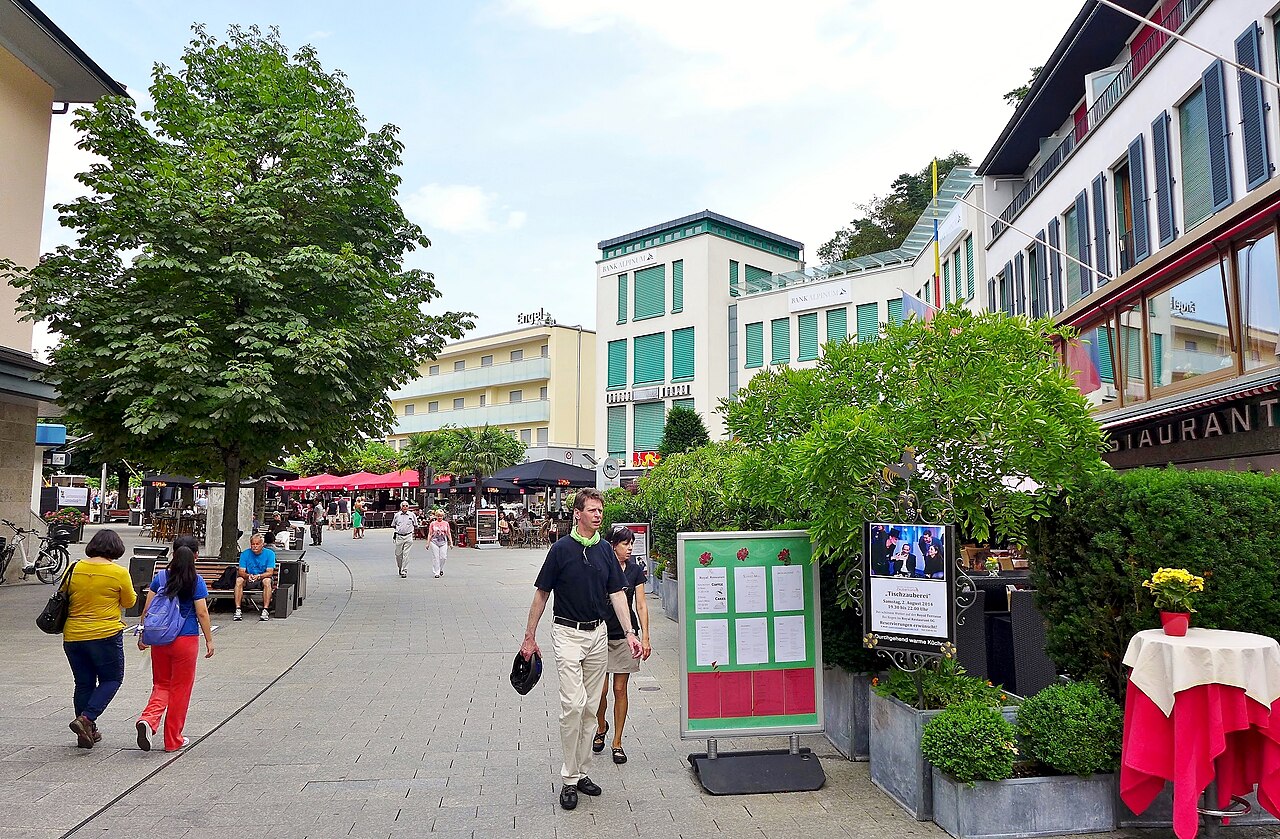
Archdiocese, Kunstmuseum and Finance: Vaduz Since 1990
Hans-Adam II became prince in 1989, and the following decades turned Vaduz into a small international capital. Liechtenstein joined the United Nations on 18 September 1990, the European Free Trade Association in 1991 and the European Economic Area in 1995. On 2 December 1997 Pope John Paul II carved the Archdiocese of Vaduz out of the Swiss Diocese of Chur, and St. Florin was raised to a cathedral; it now hosts national and princely ceremonies.
Culture followed. The Kunstmuseum Liechtenstein, a black box of tinted concrete and basalt by the Swiss architects Meinrad Morger, Heinrich Degelo and Christian Kerez, opened on 12 November 2000 as a millennium gift to the state, and a Hilti Art Foundation building was added beside it in 2015. The Liechtenstein National Museum reopened in expanded form on 28 November 2003 in a building whose core dates to 1438 and which once served as the princely tavern, customs house and seat of government.
The money that pays for all this comes largely from finance. Liechtenstein’s banking and trust sector is centred in Vaduz; the country was long criticised as a tax haven, a reputation that came to a head in the tax affair of 2008 and that the principality has since worked to shed. A 2003 referendum strengthened the prince’s powers, and in 2004 Hans-Adam II handed day-to-day government to his son, Hereditary Prince Alois, who has acted as regent ever since.
Today’s Vaduz is still small enough to feel like a village. Foreign nationals make up 42% of residents, about 67% are Roman Catholic, and the municipality has an oddly fragmented shape, with six exclaves, two of them fully enclosed by other municipalities. The town has the country’s only hospital, the University of Liechtenstein and the main gymnasium, but no airport and no station; most visitors arrive by bus from Buchs, Sevelen or Feldkirch, or fly into Zurich, the nearest major airport, and continue by road.
Because Liechtenstein is wedged between two landlocked countries, Vaduz is one of the few capitals whose citizens must cross two borders to reach a coast, a quirk explored in our guide to doubly landlocked countries. Its patchwork of exclaves is a small-scale version of the puzzles in enclaves and exclaves explained, and the wider principality, from Malbun’s ski slopes to the Unterland villages, is covered in the Liechtenstein country guide.
Quick Facts About Vaduz
- Country: Liechtenstein
- Continent: Europe (Western Europe)
- Country population: approximately 40 thousand
- Capital city status: Vaduz is the capital of Liechtenstein, the seat of national government, and the location of foreign embassies, parliament, and the head of state's official residence.
Frequently Asked Questions
What is the capital of Liechtenstein?
The capital of Liechtenstein is Vaduz. Vaduz is the seat of national government, hosts most foreign embassies and consulates, and is typically where the head of state and parliament are located.
What continent is Vaduz in?
Vaduz, the capital of Liechtenstein, is located in Europe, in the Western Europe region. As Liechtenstein's capital, Vaduz serves as the country's primary connection to the broader Europen political, economic, and cultural sphere.
Why is Vaduz the capital of Liechtenstein?
Vaduz was chosen as the capital of Liechtenstein for reasons that typically combine geography, history, and politics. Capital city selections often reflect a desire for centrality (being accessible from across the country), historical importance (being a longstanding seat of government or culture), or neutrality (being acceptable to multiple regions or ethnic groups within the country). The specific reasons for Vaduz's designation are detailed in the city's history above.
What is Vaduz known for?
As the capital of Liechtenstein, Vaduz is best known for housing the country's central government institutions — parliament, presidential or royal residences, supreme court, and key ministries. It is also typically a major cultural and economic center within Liechtenstein, hosting national museums, embassies, and signature monuments. The introduction and history sections above provide detailed coverage of the city's specific notable institutions and landmarks.
Related Pages
- Liechtenstein Country Guide — full geography, climate, economy, and culture overview
- Flag of Liechtenstein — meaning, history, and design of Liechtenstein's national flag