

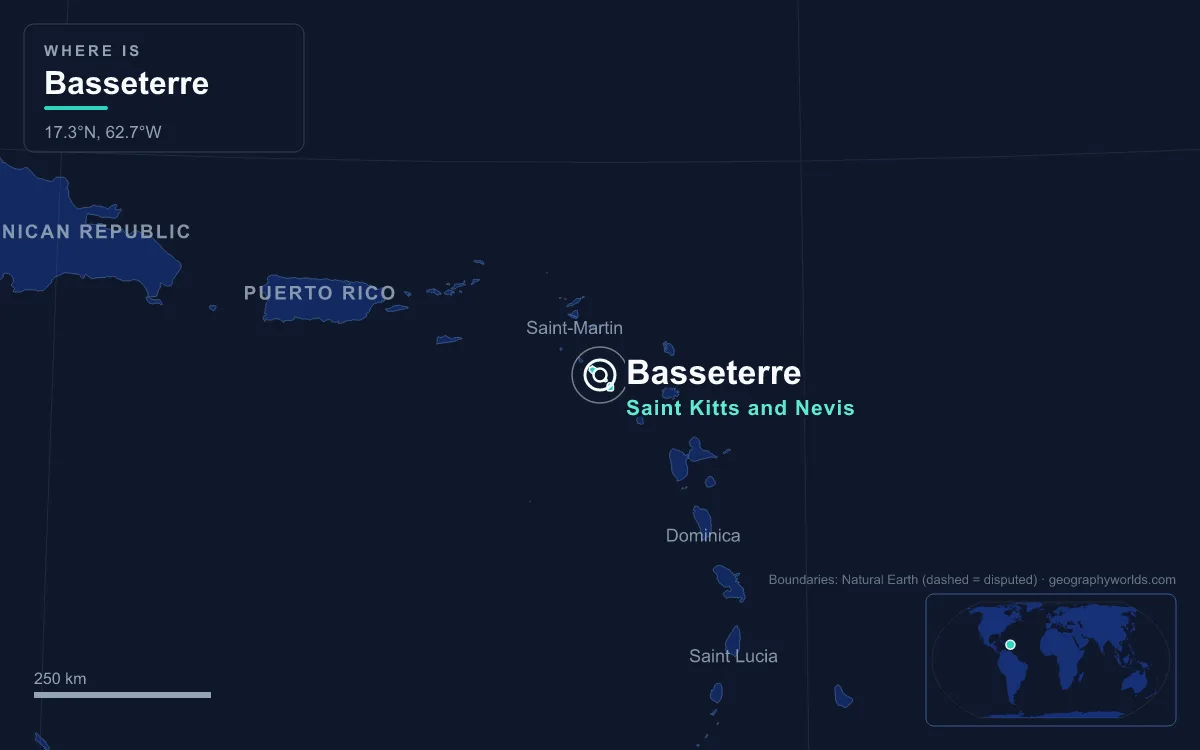
Basseterre is the capital of Saint Kitts and Nevis, a port town of roughly 14,000 people (2018 estimate) on the southwest coast of Saint Kitts, the larger of the federation’s two islands. It became the capital through conquest rather than planning: founded by the French in 1627, it served for a generation as the seat of all France’s Caribbean islands, and the British made it the capital of Saint Kitts in 1727 once they had pushed the French off the island. Today it is the federal capital of the smallest sovereign state in the Western Hemisphere and home to the Eastern Caribbean Central Bank, which issues the currency used by eight island governments.
Old Road Town, Basseterre and an Island Split in Four (1624–1627)
Basseterre was not the first European settlement on Saint Kitts, and for most of its first century it was not the island’s only centre of power. The English arrived first. Thomas Warner landed in early 1624 with about 15 settlers at the place now called Old Road Town, on the west coast, and set about growing tobacco. A year later a French privateer, Pierre Belain d’Esnambuc, arrived with his crew, and rather than fight each other the two groups agreed in 1627 to divide the island into four parts. The English took the middle of the island; the French took the two ends.
The southern French quarter needed a harbour, and d’Esnambuc founded Basseterre in 1627 on the wide bay at the foot of the island’s southern hills. The name means “low land” in French and describes the site well: the town lies on flat ground in the Basseterre Valley, ringed by the Olivees Mountains to the north and the Conaree hills to the east. It also refers to the town’s position on the leeward side of the island, sheltered from the trade winds, where ships could anchor safely. The windward district to the north was called Capesterre for the opposite reason.
The partition made Basseterre the capital of French Saint-Christophe from the start, but it left the island with rival centres just a few kilometres apart and an English colony wedged between the two French zones. That arrangement shaped the next 90 years.
De Poincy’s Port: Capital of the French Antilles (1639–1660)
Basseterre’s first rise came under Phillippe de Longvilliers de Poincy, a Knight of Malta who took charge of the French colony in 1639 and governed it until his death in 1660. Saint Kitts had already served as the springboard for French settlement of Martinique and Guadeloupe, and de Poincy turned Basseterre into a busy port that commanded much of the eastern Caribbean’s trade. From it he took Saint Barthélemy and the French half of Saint Martin in 1648 and sent an expedition to capture Saint Croix in 1650. He made Basseterre the capital of the whole French West Indies colony, and it held that role until 1660.
De Poincy ran the colony from a town hall on what is now Church Street, and from 1642 built a grand residence, the Château de la Montagne, on his estate in the hills. He was so independent that when the French king sent a replacement governor in 1644, de Poincy refused to let him land and eventually shipped him back to France. After his death Basseterre lost that wider role and became, once more, a frontline town on a shared island.
From the Treaty of Utrecht to the Move of 1727
For the rest of the 17th century the two colonies on Saint Kitts fought whenever their home countries did. In 1666 the French overran the English quarter; the Treaty of Breda restored the old borders. In 1689 the French mounted cannon on Brimstone Hill to force the surrender of the English at Fort Charles, and in 1690 an English force under Sir Christopher Codrington landed near Frigate Bay, marched through Basseterre and forced the French garrison to surrender, only for the Treaty of Rijswijk in 1697 to hand their quarters back. The British began turning Brimstone Hill into a fortress in 1690, and it is now a UNESCO World Heritage Site.
The deadlock ended in the War of the Spanish Succession. The French governor surrendered the island to Codrington without a fight in 1702, and the Treaty of Utrecht in 1713 ceded the French part of Saint Kitts to Britain for good. With the whole island under one flag, the British chose the old French capital as their own and made Basseterre the capital of Saint Kitts in 1727.
The reasons were practical. Basseterre had the best anchorage on the island, the widest stretch of flat land for warehouses and streets, and a sheltered bay about 3.2 kilometres long. The British were also about to turn Saint Kitts into a sugar island, and Basseterre was the natural export port. By 1776 Saint Kitts was the richest British colony in the Caribbean per head of population, and the wealth passed through Basseterre’s wharves.
Much of it was built on slavery. The government acquired the central square, then called Pall Mall Square, in 1750, and it quickly became the town’s administrative and commercial centre. It was also where enslaved Africans were sold, on a platform where the fountain now stands, and a basement with barred windows on the south side of the square is thought to have held people before sale. Slavery was abolished across the British colonies on 1 August 1834, when 19,780 people on Saint Kitts were freed.

Rebuilt After the Great Fire of 1867: The Circus and Pall Mall Square
Being the capital did not protect Basseterre from disaster. The town has been hit repeatedly by fires, earthquakes, floods, riots and hurricanes, and its low site brings its own risk: the College and Westbourne ghauts, stream beds that are dry most of the year, run through downtown and even serve as streets, and the College ghaut has flooded the town many times. The worst blow was the Great Fire of 1867, which destroyed most of the centre. Most of the buildings standing in Basseterre today date from after that fire.
The rebuilding gave the capital its present form: a small grid with four main streets running west to east (Bay Road, Liverpool Row, Central Street and Cayon Street), crossed by Fort Street and Bank Street, where most shops and banks are found. St George’s Anglican Church shows how often the town has had to start over. French Jesuits built a church called Notre Dame on the site in 1670; English soldiers burned it in 1706; it was rebuilt and renamed St George’s in 1710, wrecked by the earthquake of 1842, replaced by a new church consecrated in 1859, gutted in 1867 and restored in 1869.
The post-fire town gained a new centre at The Circus, a roundabout modelled on London’s Piccadilly Circus. At its middle stands the Berkeley Memorial of 1883, a four-faced clock tower and drinking fountain made by George Smith and Co. of Glasgow and dedicated to Thomas Berkeley Hardtman Berkeley. The old Pall Mall Square, with the Catholic co-cathedral, the courthouse and most of the older buildings, remained the second centre, and on independence it was renamed Independence Square.

Capital of a Two-Island Federation: Nevis, Anguilla and the ECCB
Basseterre’s modern role began when the British merged separate colonies. Nevis, just 3 kilometres across the channel called the Narrows, had its own capital, Charlestown, which replaced the earlier capital at Jamestown after an earthquake and sea surge destroyed it in the late 17th century. In 1883 the governments of Saint Kitts, Nevis and Anguilla were combined under a single assembly, and Basseterre became the capital of all three islands. Of the assembly’s ten seats, Nevis had two and Anguilla one.
The union was never comfortable. After the islands became an associated state of Britain in 1967, Anguilla expelled the federation’s police and declared independence the same year. Britain took over direct rule of the island in 1971, and Anguilla was formally separated from Saint Kitts and Nevis in December 1980. Nevis stayed, but its politicians complained for decades that the island was neglected by its larger neighbour. The ferry route between the two capitals also brought the country’s worst modern disaster: on 1 August 1970 the overloaded government ferry Christena, built for 155 passengers but carrying about 320, sank in the Narrows on its way from Basseterre to Charlestown, killing 233 people.
When Saint Kitts and Nevis became independent on 19 September 1983, the constitution named Basseterre the federal capital but gave Nevis its own administration in Charlestown and the right to secede. Nevis nearly used it. In a referendum on 10 August 1998, about 62 percent of voters backed independence, short of the two-thirds majority required. The federal government therefore still sits in Basseterre, while the offices of the Nevis Island Administration remain in Charlestown.
The capital’s weight in the country is clear from the population figures. About three-quarters of the federation’s people live on Saint Kitts, and Basseterre is several times larger than any other town.
Independence year also brought a regional role. The Eastern Caribbean Central Bank was set up in 1983 with its headquarters in Basseterre. It issues the Eastern Caribbean dollar for Anguilla, Antigua and Barbuda, Dominica, Grenada, Montserrat, Saint Kitts and Nevis, Saint Lucia and Saint Vincent and the Grenadines, and supervises their banks. The Eastern Caribbean Securities Exchange is based in the city too, which gives a town of about 14,000 people a financial role far larger than its size.
The economy around the capital has changed as well. The sugar industry, which had shaped Basseterre since the 1640s, closed in 2005 after years of heavy losses, and the state turned to tourism. Port Zante, built on about 15 acres of land reclaimed from the bay in 1995, now takes large cruise ships in the middle of the waterfront, while a separate deep-water harbour at the east end of the bay handles cargo. In 2007 the Warner Park stadium hosted Cricket World Cup matches, making Saint Kitts and Nevis the smallest country ever to host a World Cup event. The federation covers just 261 square kilometres, which puts it near the bottom of our list of the smallest countries by area, and our Saint Kitts and Nevis country guide follows the story beyond the capital to Brimstone Hill, the Narrows and Nevis Peak.
Quick Facts About Basseterre
- Country: Saint Kitts And Nevis
- Continent: North America (Caribbean)
- Country population: approximately 47 thousand
- Capital city status: Basseterre is the capital of Saint Kitts And Nevis, the seat of national government, and the location of foreign embassies, parliament, and the head of state's official residence.
Frequently Asked Questions
What is the capital of Saint Kitts And Nevis?
The capital of Saint Kitts And Nevis is Basseterre. Basseterre is the seat of national government, hosts most foreign embassies and consulates, and is typically where the head of state and parliament are located.
What continent is Basseterre in?
Basseterre, the capital of Saint Kitts And Nevis, is located in North America, in the Caribbean region. As Saint Kitts And Nevis's capital, Basseterre serves as the country's primary connection to the broader North American political, economic, and cultural sphere.
Why is Basseterre the capital of Saint Kitts And Nevis?
Basseterre was chosen as the capital of Saint Kitts And Nevis for reasons that typically combine geography, history, and politics. Capital city selections often reflect a desire for centrality (being accessible from across the country), historical importance (being a longstanding seat of government or culture), or neutrality (being acceptable to multiple regions or ethnic groups within the country). The specific reasons for Basseterre's designation are detailed in the city's history above.
What is Basseterre known for?
As the capital of Saint Kitts And Nevis, Basseterre is best known for housing the country's central government institutions — parliament, presidential or royal residences, supreme court, and key ministries. It is also typically a major cultural and economic center within Saint Kitts And Nevis, hosting national museums, embassies, and signature monuments. The introduction and history sections above provide detailed coverage of the city's specific notable institutions and landmarks.
Related Pages
- Saint Kitts and Nevis Country Guide — full geography, climate, economy, and culture overview
- Flag of Saint Kitts and Nevis — meaning, history, and design of Saint Kitts and Nevis's national flag