

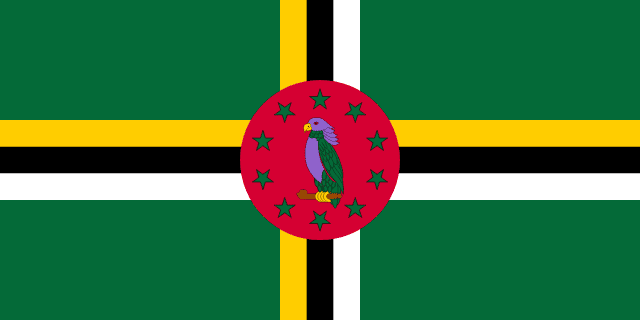
Among the hundreds of national flags flying around the world, the flag of the Commonwealth of Dominica stands out for one quietly remarkable reason: it is the only national flag that uses the color purple. That splash of violet sits at the very heart of the design, on the breast of a parrot found nowhere else on Earth. The result is a banner that feels less like a generic tricolor and more like a portrait of a single, specific island. This Caribbean nation packed its lush forests, its faith, its national bird, and its layered history into one busy, beautiful rectangle.
To understand the flag of Dominica is to understand the island itself: green to the horizon, deeply religious in its roots, and fiercely proud of the rare creatures that live in its rainforests. Let's unpack what each element means, how the design came together, and why this flag refuses to look like anyone else's.
A Field of Forest Green
The dominant impression of the flag is green. A rich green field fills the background, and that choice is not decorative whim. Dominica is one of the most thickly forested islands in the Caribbean, a place where steep volcanic slopes are blanketed in rainforest and threaded with rivers and waterfalls. The green of the flag stands directly for that vegetation, the verdant landscape that defines the island's character and its nickname as the "Nature Isle" of the Caribbean.
Set against that green is a centered cross, and around the central emblem sit the other colors that give the flag its unusual six-color palette. Few national flags juggle so many hues at once, and that abundance is intentional. Where many flags strip themselves down to two or three bold blocks, Dominica's chooses richness, mirroring the biological richness of the island it represents.
The Cross, the Colors, and What They Stand For
Running across the green field is a cross made of three thin stripes laid side by side. The cross is a statement of faith: it represents Christianity and the belief in God that runs deep through Dominican society. Rather than rendering that cross in a single color, the designers split it into three bands, and each band carries its own meaning tied to the people and resources of the island.
The three colors of the cross are yellow, black, and white. Together they speak to the land and its people. Yellow evokes sunshine and the agricultural wealth of the island, the citrus and bananas grown on its slopes, as well as honoring the Kalinago (Carib) people, the indigenous inhabitants. Black recalls the rich volcanic soil and the African heritage of much of the population. White stands for the clarity of the rivers and waterfalls and for purity. The arrangement of these stripes in a single cross neatly bundles faith, ancestry, and environment into one symbol.
The Sisserou Parrot at the Center
The true showpiece of the flag is the red disc at its center, on which perches the Sisserou parrot. This bird, also called the imperial amazon, is endemic to Dominica, meaning it lives in the wild nowhere else in the world. It is the national bird, and so prominent is it in the national imagination that it also appears on the country's coat of arms.
The parrot is depicted with the green and purple plumage that the real bird wears, and that purple breast is the source of the flag's most famous claim to fame. By placing the bird on a red circle, the designers gave it a vivid backdrop. The red disc itself is generally understood to represent social justice, while the ring of ten green stars circling the parrot stands for the country's ten parishes, with green again reinforcing hope and the island's natural bounty. The parrot is not merely a mascot; it is a stand-in for everything fragile and irreplaceable about Dominica's wilderness.
How the Flag Took Its Present Shape
Dominica adopted its flag in 1978, the year the island gained independence from the United Kingdom. From the start, the design featured the green field, the tricolor cross, and the Sisserou parrot on a central disc, an ambitious and distinctive composition for a brand-new nation.
What followed was a period of fine-tuning. The flag was modified more than once in its first dozen years as small details were adjusted, including the orientation in which the parrot faces and refinements to the surrounding stars and shading. The version flown today has been in place since 1990, and it represents the settled, definitive form of a design that was essentially right from the beginning but needed a little polishing. For anyone curious about the island behind the banner, the dominica country guide goes deeper into the geography and culture the flag celebrates.
How It Compares to Other Caribbean Flags
Set Dominica's flag beside its neighbors and the differences leap out. Many Caribbean flags lean on combinations of blue, yellow, and black or favor simple geometric bands and triangles. Dominica instead opted for a centered emblem on a green field, a layout that has more in common with flags that feature a coat of arms or a central device than with the clean stripes of, say, the flags of the wider region.
The green ground also sets it apart. Relatively few national flags use green as their main field, and fewer still combine it with a parrot, a cross, and a ring of stars. But the single feature no other national flag can match is the purple. Numerous flags share reds, greens, yellows, and blues, and look-alikes are common across the globe. Purple, by contrast, is famously absent from almost every national banner, partly because the dye was historically rare and expensive. Dominica's willingness to put it front and center on the parrot's breast makes the flag instantly identifiable and guarantees it a permanent place in flag trivia.
National Identity and Everyday Pride
For Dominicans, the flag is woven through public life. It flies over government buildings, schools, and sporting events, and it appears in force each year around Independence Day in early November, when celebrations of Creole culture, music, and dress fill the streets. The Sisserou parrot at its center doubles as a symbol of national conservation pride; the bird is endangered, and protecting it has become a point of patriotic purpose.
Because the flag is so visually tied to the island's environment, it functions as a constant reminder of what makes Dominica distinctive in a region of beach-and-sun destinations. The Nature Isle wears its rainforest, its rivers, its faith, and its rarest bird on its sleeve, every time the flag is raised.
Quick Facts Worth Knowing
- Only purple: Dominica's is the sole national flag in the world that includes the color purple, thanks to the Sisserou parrot's plumage.
- An endemic centerpiece: The imperial amazon parrot at the center exists in the wild only on Dominica.
- Ten stars, ten parishes: The green stars ringing the parrot represent the island's ten administrative parishes.
- Six colors: Green, yellow, black, white, red, and purple all appear, making it one of the more colorful national flags.
- A bird on two emblems: The Sisserou parrot appears on both the flag and the national coat of arms.
- Settled since 1990: First flown in 1978, the design reached its current form after a few revisions in 1990.
Frequently Asked Questions
When was the flag of Dominica adopted?
Dominica first adopted its national flag in 1978, the year it became independent from the United Kingdom. The design was modified several times over the following years, and the version flown today has been in use since 1990.
What do the colors of the Dominican flag mean?
The green field represents the island's lush vegetation. The cross stands for Christianity, with its three stripes, yellow, black, and white, symbolizing sunshine and the Kalinago people, the rich volcanic soil and African heritage, and the clear rivers and purity respectively. The red disc signifies social justice, and the green stars represent the ten parishes.
Why is the flag of Dominica famous for purple?
The Sisserou parrot at the center of the flag has purple plumage on its breast, and because purple appears nowhere on any other country's national flag, Dominica holds the unique distinction of being the only nation whose flag includes the color purple.
What continent is Dominica on, and how does its flag compare to similar ones?
Dominica is a Caribbean island nation, geographically part of North America. While it shares colors like green, yellow, and red with many flags, its centered parrot emblem on a green field, ringed by stars and crossed by a tricolor cross, makes it visually distinct from the simpler striped designs common across the region, and the purple ensures it has no true look-alike anywhere.