
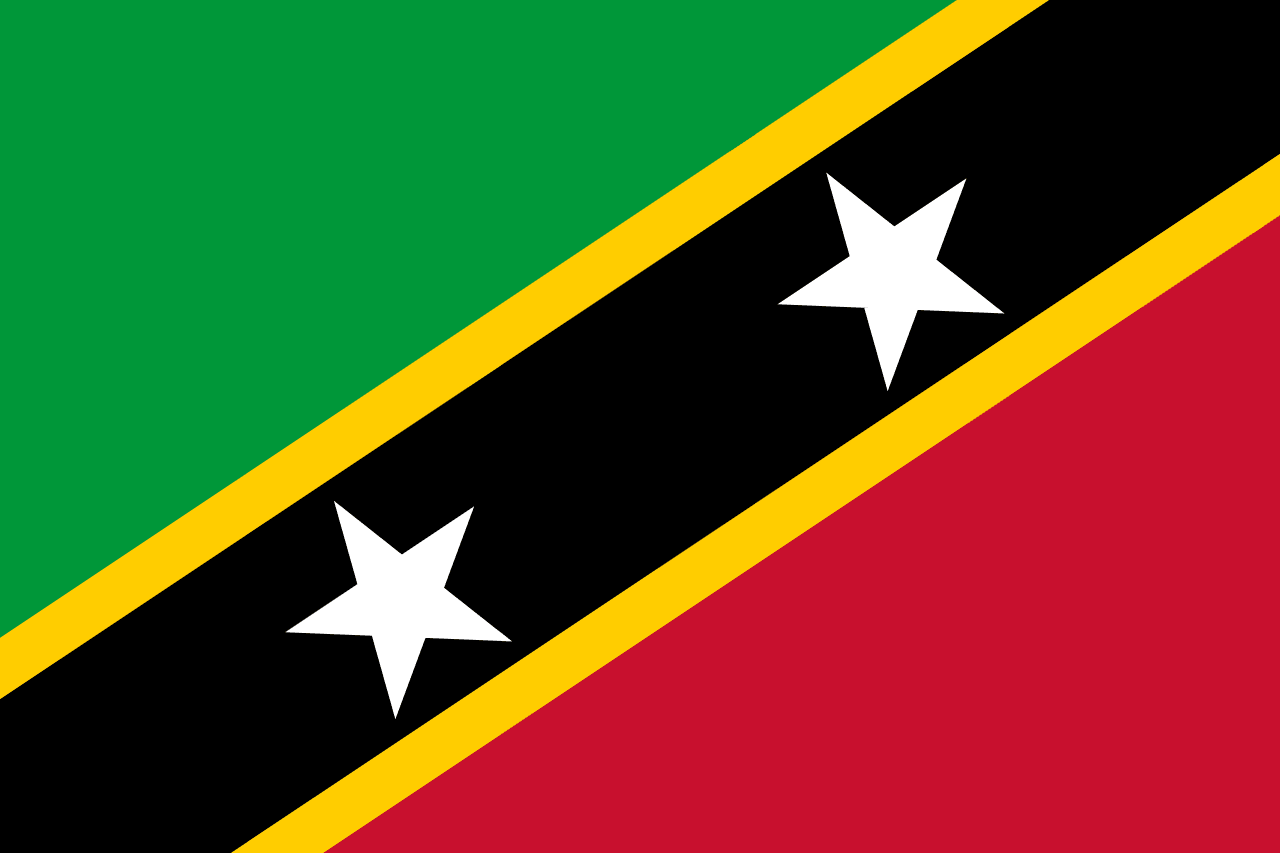
Slung diagonally across a Caribbean banner, two crisp white stars cut through bands of green, black, red, and yellow. This is the flag of Saint Kitts and Nevis, the twin-island federation that holds the title of smallest sovereign nation in the Americas, both by land area and population. The design is bold and unmistakable, and unlike many flags that arrive after decades of debate, this one is forever fused to a single moment: the night the islands stepped out from under British rule and became their own country. Few national emblems pack so much meaning into so little space.
What makes this flag worth a closer look is how deliberately every element was chosen. There is no filler here, no leftover heraldry inherited from a colonial coat of arms. Instead, the colors and the two stars speak directly to who the people of these islands are, where they come from, and the struggle that brought them to nationhood. Let's unpack the design piece by piece.
A Diagonal That Breaks the Rules
Most national flags rely on horizontal or vertical stripes, the comfortable grid of tricolors and bicolors that fills atlases worldwide. Saint Kitts and Nevis goes its own way. The defining feature is a broad black band edged in yellow that runs diagonally from the lower hoist (the bottom corner nearest the flagpole) up to the upper fly (the top corner farthest from the pole). That single diagonal sweep gives the flag a sense of motion and ambition, as if it is rising toward something.
Above and below that central stripe sit two triangles of solid color. The upper triangle, near the hoist, is green. The lower triangle, near the fly, is red. Set into the black diagonal band are two five-pointed white stars, arranged so that one sits above the other along the line of the stripe. The geometry is clean and balanced, and the diagonal layout instantly distinguishes this banner from almost every other flag in the region.
What the Colors Mean
The palette of green, red, black, yellow, and white is not decorative shorthand. Each hue carries an explicit message about the land and its people.
- Green stands for the fertility of the islands, the lush volcanic soil and tropical growth that have long shaped life in the Caribbean.
- Red represents the struggle of the people against slavery and colonialism, the hard road traveled toward freedom and self-determination.
- Black honors the African heritage of the population, a direct acknowledgment of the ancestry of most Kittitians and Nevisians.
- Yellow, used for the slim borders around the diagonal band, evokes the year-round sunshine that bathes the islands.
- White, the color of the two stars, signals hope and the promise of a new future.
The two stars do more than complete the composition. They stand for the two islands themselves, Saint Kitts and Nevis, twin partners in a single federation. Their placement together on the black band quietly insists that these are two distinct places bound into one nation.
Born at the Stroke of Independence
The flag was adopted in 1983, the very year Saint Kitts and Nevis gained full independence from Britain. For centuries the islands had been a prized colonial possession; Saint Kitts in particular earned the nickname "the Mother Colony of the West Indies" because it served as a base from which other Caribbean territories were settled by Europeans. Sugar plantations worked by enslaved Africans defined the colonial economy, a history that the flag's black and red bands address head-on.
When the moment of nationhood finally arrived, the islands wanted a symbol that owed nothing to the empire they were leaving behind. The chosen design was the product of a national competition, a common path for new states eager to involve their citizens in shaping the emblem they would carry forward. The result has flown unchanged since the day of independence, making it one of the more youthful national flags in the world and one of the few whose birthday coincides exactly with the country's own. Readers who want the fuller story of the islands can explore our saint kitts and nevis country guide.
How It Compares to Its Caribbean Neighbors
The green-red-black-yellow combination places Saint Kitts and Nevis squarely within a family of flags that draw on Pan-African colors, a palette echoed across the African diaspora and seen on banners from the continent to the Caribbean. At a glance it shares a kinship with flags like that of nearby Dominica, which also leans on green and a central cross of colors, and with other Eastern Caribbean states that emerged from British rule around the same era.
Yet a few features keep it from being mistaken for any of them. The diagonal black band is the giveaway. While diagonal stripes appear elsewhere, the specific arrangement here, a thick black diagonal bordered in yellow and carrying two white stars, is unique. Compare it to Trinidad and Tobago, which also uses a diagonal black band edged in white but contains no stars and uses a red field. The two-star motif, meanwhile, reads very differently from single-star flags like those of Liberia or Somalia. The doubling is the whole point: it is a federation of two, and the flag never lets you forget it.
A Banner Woven Into National Life
For a young nation, the flag has become a genuine emblem of pride rather than a bureaucratic formality. It appears every September during Independence Day celebrations, when the streets of Basseterre, the capital, fill with color, music, and the diagonal banner waving from buildings and balconies. It flies over government offices, schools, and embassies, and it travels with the federation's athletes to regional and international competitions, where small island nations punch far above their weight in sprinting and cricket.
Because the design is so legible and so distinctive, it lends itself easily to merchandise, sports kit, and tourism branding. Visitors arriving on the islands encounter the colors almost immediately, and locals wear them with evident affection. The flag manages the rare trick of being both instantly recognizable and rich with layered meaning, a combination that helps it function as a true shorthand for national identity.
Quick Facts Worth Knowing
- Saint Kitts and Nevis is the smallest country in the Americas in both area and population, so its flag represents one of the world's tiniest sovereign states.
- The flag and the nation share a birth year: 1983, the year of independence from Britain.
- The two white stars are widely read as symbols of hope as well as the two islands of the federation.
- The country sits in the Caribbean, part of the North American continent's surrounding island chain, within the Lesser Antilles.
- Saint Kitts is officially named Saint Christopher, and the formal name of the country is the Federation of Saint Christopher and Nevis.
- The diagonal layout makes it one of relatively few national flags built around a slanted central band rather than upright stripes.
Frequently Asked Questions
When was the flag of Saint Kitts and Nevis adopted?
The flag was adopted in 1983, the same year Saint Kitts and Nevis became independent from the United Kingdom. It has flown unchanged since, making its history as old as the nation itself.
What do the colors and stars on the flag mean?
Green represents the fertility of the islands, red the people's struggle against colonialism and slavery, black their African heritage, yellow the abundant sunshine, and white hope. The two white stars stand for the two islands, Saint Kitts and Nevis, that together form the federation.
Who designed the flag?
The flag emerged from a national design competition held around the time of independence, a process meant to involve citizens in choosing their new symbol. The winning entry became the official flag in 1983 and has represented the country ever since.
What continent is Saint Kitts and Nevis on?
Saint Kitts and Nevis lies in the Caribbean Sea within the Lesser Antilles, the island arc associated with North America. As the smallest nation in the Americas, it occupies a tiny but proud place on the map of the Western Hemisphere.