

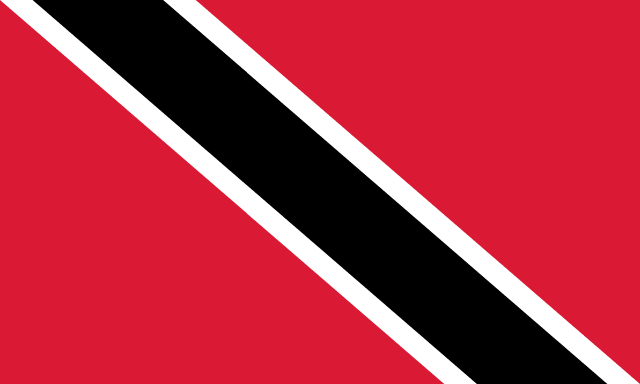
Few national flags manage to feel both bold and elegant at once, but the banner of Trinidad and Tobago pulls it off with a single, confident gesture. A vivid red field is crossed by a black diagonal band edged in crisp white, slicing from the upper hoist toward the lower fly. The effect is dynamic rather than static, suggesting movement and forward energy. Adopted in 1962, the year this twin-island nation gained its independence, the flag distills an entire archipelagic identity into three colors and one decisive stroke. It is a design that reads instantly at a distance yet rewards a closer look, and it has become one of the most recognizable symbols anywhere in the Caribbean.
A Country Carried on a Diagonal
Trinidad and Tobago sits at the southern edge of the Caribbean, just off the coast of Venezuela, and although the islands lie geographically close to South America, the country is counted as part of North America for continental purposes, like its Caribbean neighbors. That maritime, near-equatorial setting matters to the flag, because every element of the design speaks to the relationship between land, sea, and the people who live between them. The flag's proportions are wide and rectangular, the kind of canvas that lets a single diagonal stripe do enormous visual work without crowding it.
What makes the banner feel alive is precisely that off-center stripe. Rather than dividing the flag into neat horizontal bands the way so many national flags do, the black-and-white diagonal cuts across the red, giving the whole composition a sense of motion. It is the visual equivalent of a country in stride, and it reflects the islands' famous reputation for rhythm, celebration, and outward-looking confidence.
Reading the Three Colors
The flag's palette is deliberately small, and each color carries explicit meaning. Red dominates the field and stands for vitality, the warmth of the sun, and the energy and friendliness of the people. White, which borders the central band, represents purity, equality, and the surrounding sea that defines an island nation. Black, the heart of the diagonal, signals strength, unity, and the dedication and steadfastness of the population.
There is a poetic shorthand often attached to this trio: the colors are said to evoke the three elements that shape the islands' character. Red is fire and the sun overhead, white is the encircling water, and black is the earth itself. Read together, the flag becomes a compact portrait of place, hope, and human resolve, with the sun's vigor, the sea's clarity, and the land's enduring strength all held in a single frame.
How the Design Came Together
The flag was created in the run-up to independence, when Trinidad and Tobago was preparing to step out from under British colonial rule. Rather than emerging from a single celebrated artist, the design was the product of a committee charged with choosing national symbols for the new state. That collaborative origin is fitting for a country built on a remarkable mix of African, Indian, European, Chinese, Indigenous, and Middle Eastern heritage; the flag was meant to belong to everyone at once rather than to any single group or tradition.
When the banner was raised in 1962, it replaced the colonial ensign that had flown previously, and it has remained unchanged ever since. That stability is itself meaningful. While some young nations revised their flags repeatedly in the decades after independence, Trinidad and Tobago settled on a design at the very start that needed no later correction, a sign that the symbolism resonated immediately and durably.
How It Compares to Other Flags
The red, white, and black color scheme appears on a number of flags around the world, but Trinidad and Tobago's use of it is distinctive. Many flags that share this palette, such as several in the Middle East, arrange the colors in horizontal stripes or pan-Arab layouts. The diagonal construction here sets the banner apart almost instantly.
Within the Caribbean, the flag is unusual for its restraint. Several neighboring nations favor blue and yellow to evoke sea and sand, or pack their flags with multiple symbols and emblems. Trinidad and Tobago instead chose a single graphic move and trusted it. The closest visual cousins are other flags that use a bold off-axis stripe, but the specific combination of a red field with a white-fimbriated black diagonal is essentially unique. Where some look-alike palettes can blur together on a crowded flagpole, this one never quite does, because the angle of the stripe is doing the identifying work that color alone cannot.
A Symbol of a Mixed and Modern Nation
For a republic as culturally layered as this one, the flag functions as common ground. Trinidad and Tobago is the birthplace of steelpan music, calypso, soca, and one of the largest Carnival celebrations in the hemisphere, and the red, white, and black turn up everywhere during festival season, from costumes to face paint to the bunting strung across streets. The banner has become shorthand for a particular kind of joyful, plural national identity.
The flag also carries weight in quieter civic settings. It flies over government buildings, schools, and embassies, and it appears on official documents and uniforms. Citizens display it during Independence Day on the last day of August and on Republic Day later in the year, when the country marks its 1976 transition to a republic. For anyone curious about the broader story of the islands behind the symbol, the trinidad and tobago country guide offers a fuller picture of the nation's geography, culture, and history.
The Flag in Sport and Public Life
Nowhere does the flag feel more electric than in sport. Trinidad and Tobago has a passionate following for cricket and football, and the red, white, and black are a fixture in the stands whenever the national teams play. When the country's footballers reached the World Cup for the first time, the diagonal stripe was waved by fans across the globe, and the flag's clean graphic identity translated beautifully to television and merchandise alike.
Beyond the stadium, the colors anchor a wide range of national branding, from the livery of state institutions to the look of major cultural events. Because the design is so simple and so strong, it scales effortlessly, working as well on a tiny lapel pin as on a stadium-sized banner. That versatility is part of why the flag has aged so gracefully over more than six decades.
Interesting Facts About the Flag
- The flag was adopted in 1962, the same year Trinidad and Tobago became independent from Britain.
- Its design came from an official committee rather than a single named designer.
- The three colors are popularly linked to fire and sun (red), water and sea (white), and earth and strength (black).
- The white edging around the black stripe is a heraldic device called fimbriation, used to separate the two dark and bright tones cleanly.
- The diagonal orientation makes the flag unusually dynamic compared with the horizontal-stripe layouts common elsewhere.
- The flag has never been redesigned since independence, surviving unchanged through the country's shift to a republic in 1976.
Frequently Asked Questions
When was the flag of Trinidad and Tobago adopted?
The flag was adopted in 1962, the year Trinidad and Tobago gained independence from the United Kingdom. It has remained unchanged ever since, including through the country's transition to a republic in 1976.
What do the colors of the flag mean?
Red represents vitality, the warmth of the sun, and the energy of the people; white stands for purity, equality, and the surrounding sea; and black symbolizes strength, unity, and dedication. Together they are often described as fire, water, and earth.
Who designed the flag of Trinidad and Tobago?
The flag was created by an official committee assembled to choose national symbols ahead of independence, rather than by a single celebrated designer. Its collaborative origin reflects the country's diverse population.
What continent is Trinidad and Tobago on?
Trinidad and Tobago lies in the southern Caribbean, just off the northern coast of South America, but it is grouped with North America for continental purposes, as are most Caribbean nations. Its island setting strongly informs the flag's sea symbolism.