
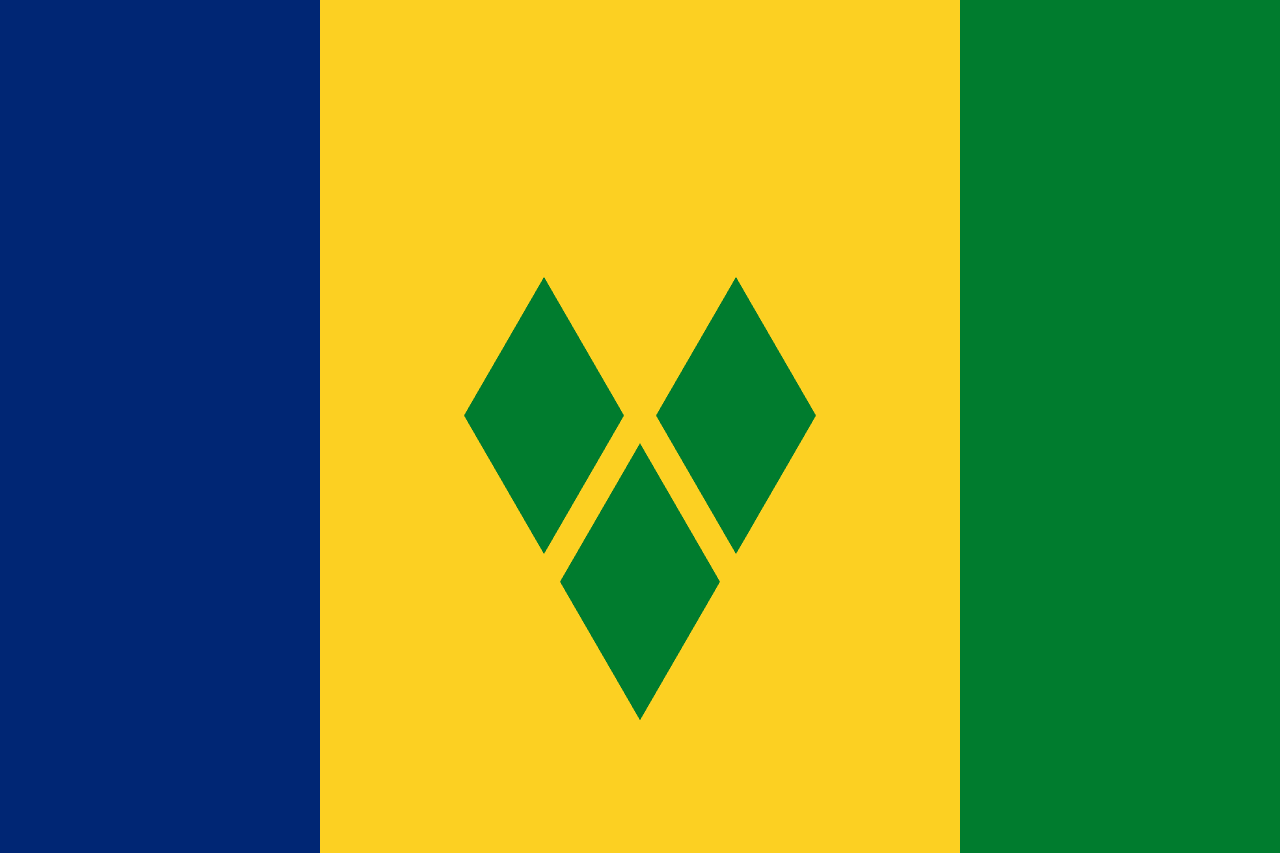
Few flags in the Caribbean wear their nickname so openly as the banner of Saint Vincent and the Grenadines. Locals call it "the Gems," and a single glance explains why: three vivid green diamonds sit clustered at the center of a bold blue, gold, and green field. It is a flag that manages to be both instantly recognizable and quietly clever, packing a national geography lesson into a few geometric shapes. For a young nation strung across a single mountainous island and a scatter of smaller ones, the diamonds say something the words of an anthem cannot.
This flag is relatively modern by world standards, having taken its current form in 1985. Yet it speaks to centuries of identity, color symbolism, and a deliberate effort to look like nowhere else. Below, we take it apart panel by panel, trace how it got here, and see how it stacks up against the crowded family of Caribbean tricolors it shares the region with.
A Vertical Triband Built Around Diamonds
The design is, at its core, a vertical triband: three upright bands running side by side. The outer bands are blue and green, and the wider central band is gold. That gold panel is not left plain. Resting at the heart of the flag are three green diamonds, arranged in a loose V formation, often described as forming the shape of a letter that echoes the country's own name.
The proportions matter to the overall effect. The central gold stripe is broader than the flanking blue and green stripes, which gives the diamonds a generous yellow canvas to float against. The diamonds themselves are not stacked in a neat column but set in a diagonal, almost scattered, pattern, two below and one above, suggesting gemstones laid out for inspection rather than soldiers in a row. The result is dynamic and a little playful, which suits a flag whose own people gave it a jeweler's nickname.
What the Colors and Diamonds Mean
Each element of the design carries a specific reading, and together they map the nation onto cloth. The blue stands for the sky and the sea that surround and define an island state, where the horizon is rarely out of view. The gold at the center represents the warm sun that pours over the islands and, by extension, the warmth of the people themselves. The green evokes the lush vegetation that blankets Saint Vincent's volcanic slopes and the smaller Grenadine islands.
The three green diamonds are the signature flourish. They represent the gems of the Antilles, casting the islands as jewels set in the Caribbean Sea. It is a poetic conceit, but a practical one too: the diamond motif gives the flag a unique fingerprint in a region where blue, gold, and green appear again and again. The fact that the diamonds suggest the "V" of Vincent only deepens the wordplay. This visual identity is woven through the broader story told in the saint vincent and the grenadines country guide, which sets the symbolism against the islands' geography and culture.
How the Flag Evolved After Independence
The current banner is the third flag the country has flown since gaining independence. Saint Vincent and the Grenadines became fully independent in 1979, and like many new nations, it spent its early years refining how it wished to present itself to the world. The flags adopted in that first stretch experimented with arrangements and emblems before the nation settled on the clean, confident design seen today.
By 1985 the current version was hoisted, trading earlier complexity for the bold simplicity of the triband and its trio of diamonds. The streamlining is telling. A flag that is easy to draw, easy to recognize at a distance, and easy to explain to a child tends to endure, and the Gems has done exactly that. The progression from a more intricate post-independence design to the spare modern one mirrors a wider 20th-century trend: emerging nations gradually favoring strong color blocks and a single memorable symbol over busy heraldic detail.
How It Compares to Other Caribbean Flags
The Caribbean is full of flags that lean on warm and natural palettes, so a quick comparison shows what makes this one stand apart. Blue-and-gold combinations turn up across the region, and green is a natural choice for islands draped in rainforest. Where many neighbors reach for stars, suns, or coats of arms as their central device, Saint Vincent and the Grenadines reaches for geometry.
That choice is the key differentiator. Diamonds as a primary flag emblem are genuinely rare worldwide, and within the Caribbean they are essentially unique to this flag. A vertical triband is itself less common in the region than the horizontal kind, adding another point of distinction. So while a passing tourist might lump several island banners together as "blue and yellow flags," anyone who knows the Gems can pick it out in an instant. The diamonds do the heavy lifting that a star or crest does on other flags, but with a silhouette no neighbor shares.
The Flag in National Life
For Vincentians, the flag is a fixture of public and ceremonial life. It flies over government buildings, schools, and harbors, and it appears each year on Independence Day, the late-October celebration when national pride is at its loudest. Sporting fans wave it at regional cricket matches and athletics meets, where the blue-gold-green is unmistakable in the stands, and it is a natural feature of the regattas that the Grenadine islands are famous for.
The nickname "the Gems" has become part of how citizens talk about themselves, a shorthand that turns the flag into a friendly emblem rather than a stiff official symbol. That informal affection is a kind of success most flags never achieve. When a population gives its banner a pet name, the design has crossed from mere identification into genuine identity, and the diamonds have clearly done that work for these islands.
Quick Facts About the Gems
- Adopted: 1985, the third flag flown since independence in 1979.
- Layout: a vertical triband of blue, gold, and green, with the gold center band widest.
- Central emblem: three green diamonds arranged in a V-like cluster.
- Nickname: "the Gems," a direct nod to the diamond motif.
- Color meanings: blue for sky and sea, gold for the sun, green for vegetation.
- Diamond meaning: the islands as the gems of the Antilles.
- Continent: North America, within the Caribbean region.
Frequently Asked Questions
When was the flag of Saint Vincent and the Grenadines adopted?
The current flag was adopted in 1985. It is the third national flag the country has used since becoming independent in 1979, replacing earlier post-independence designs with the streamlined blue, gold, and green triband seen today.
What do the colors and diamonds on the flag mean?
Blue represents the sky and the surrounding sea, gold stands for the warm sun and the warmth of the people, and green symbolizes the islands' rich vegetation. The three green diamonds represent the gems of the Antilles, portraying the islands themselves as jewels in the Caribbean.
Why is the flag nicknamed "the Gems"?
The nickname comes directly from the three green diamonds arranged across the gold central band. Because diamonds are precious stones and the design casts the islands as gems of the Antilles, Vincentians affectionately call their flag "the Gems."
What continent is Saint Vincent and the Grenadines on, and how does its flag compare to neighbors?
The country lies in North America, in the Caribbean portion of the region. While blue, gold, and green appear on several Caribbean flags, Saint Vincent and the Grenadines is distinguished by its vertical triband and its rare diamond emblem, a central device no neighboring flag shares.