
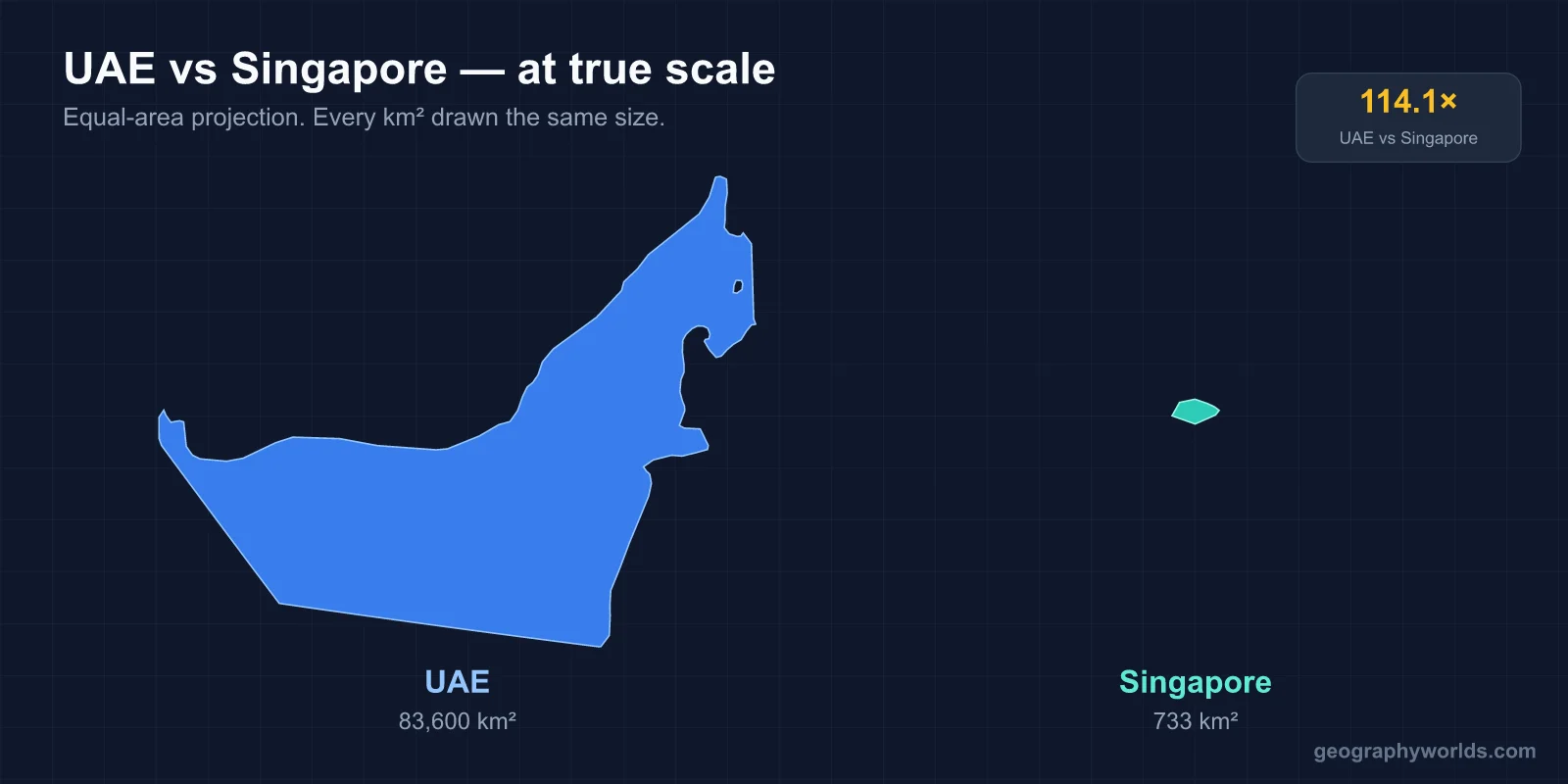
The United Arab Emirates is the bigger of the two, and by a wide margin: 83,600 km² against Singapore’s 744 km², so about 112 Singapores would fit inside it. The UAE also has more people, about 11.0 million in 2024 against 6.11 million in Singapore in 2025. Singapore is the richer country per person, with nominal GDP per capita of about US$107,800 against the UAE’s US$54,200 (IMF estimates for 2026). The UAE’s capital is Abu Dhabi, though Dubai is its largest city. Singapore is a city-state with no separate capital. Arabic is the UAE’s national language and English is the language most people actually use. Singapore has four official languages: English, Malay, Mandarin and Tamil. The rest of this comparison looks at what a visitor finds in each place: the scenery, the weather in each season, the cities, the food and the languages heard in the street.
Liwa’s dunes and the Hajar Mountains against Bukit Timah Hill
The UAE’s landscape changes a great deal from coast to interior. Its Persian Gulf coast runs for almost 650 km, and most of it is lined with salt pans (sabkha) that extend far inland. South and west of Abu Dhabi the sand rises into rolling dunes that merge into the Rub’ al Khali, the Empty Quarter of Saudi Arabia. On its northern edge lies the Liwa Oasis, about 150 km south-west of Abu Dhabi city. It is a curved band of some 50 villages stretching about 100 km from east to west. Farther east, near the Omani border, the Al Ain and Buraimi oasis sits on both sides of the frontier.

In the north-east the Hajar Mountains rise between the dunes and the Gulf of Oman coast. In Ras Al Khaimah, a high point on the Jebel Jais massif reaches 1,892 m, the highest point in the UAE; the true summit, at 1,934 m, is just across the border in Oman. Jebel Jais is where the UAE recorded snow for the first time, in 2004, and it has snowed there only a handful of times since, in 2009, 2017 and 2020. The emirate of Fujairah lies on the far side of the range and is the only one of the seven whose coastline lies solely on the Gulf of Oman, with none on the Persian Gulf.
Singapore is mostly flat and has been heavily reshaped. Most of it lies less than 15 m above sea level. Its highest point, Bukit Timah Hill, is only 164 m high and is made of granite. Land reclamation since 1819 has enlarged the country from about 582 km² in the 1960s to around 745 km² today. Much of the southern waterfront stands on reclaimed land; even Lau Pa Sat, now well inland, was built beside Telok Ayer Bay before the bay was filled in from 1879. Singapore has lost about 95 percent of its original forest. The Bukit Timah Nature Reserve and the Sungei Buloh Wetland Reserve together cover only about 0.25 percent of the land, yet they hold more than half of the country’s native plant and animal species. Since 1967 the government has pursued a “garden city” policy, and nearly 10 percent of the land is now parks and nature reserves, including the Singapore Botanic Gardens, the country’s first UNESCO World Heritage Site.
Dubai’s 42 °C August against Singapore’s year-round 25 to 33 °C
The weather is the biggest practical difference for a visitor. The UAE has a desert climate with distinct seasons. In Dubai the average daily high is 24 °C in January and 42.1 °C in August. On the coastal plain, midsummer highs often pass 45 °C, and in late summer a humid south-easterly wind called the sharqi makes the coast feel even hotter. Winter nights in January and February fall to between 10 and 14 °C. Rain is scarce. Dubai averages about 95 mm a year, mostly in short winter downpours between December and March, and May to October is almost completely dry.
Singapore sits about one and a half degrees north of the equator. It has a tropical rainforest climate with no real summer or winter. Temperatures usually range from about 25 °C at night to 33 °C in the afternoon. May and June are slightly the hottest months, and the record high is 37.0 °C. Rain is the main thing that changes during the year. Singapore averages about 2,340 mm annually, roughly 25 times Dubai’s total. There are two monsoon seasons: the Northeast Monsoon from mid-November to early March, and the Southwest Monsoon from June to September. February into early March is relatively dry, though even then rainfall exceeds 120 mm a month. The western side of the island is much wetter than the east, owing to a rain-shadow effect, so it can be sunny on one side of Singapore while it rains on the other.
In practice this means the best months for the UAE are November to March, when Dubai’s highs are between 24 and 31 °C. Singapore has no clear best season; visitors plan around the rain showers rather than the temperature. There is more detail in our guide to Singapore’s climate.
Seven emirates and two big cities against one city-state
The UAE is a federation of seven emirates, formed on 2 December 1971, and Ras Al Khaimah joined on 10 January 1972. The emirates vary hugely in size. Abu Dhabi covers 67,340 km², about 87 percent of the country, while Ajman covers only 259 km². A visitor usually splits time between two quite different cities. Dubai, founded in the early 18th century as a pearling and fishing settlement on its creek, had about 4 million people in 2025, 92 percent of them expatriates. Its skyline is led by the Burj Khalifa, which reaches 828 m to the top of its spire (829.8 m to the tip of its antenna) and has been the world’s tallest building since 2011. Oil made less than 1 percent of Dubai’s GDP in 2018. Abu Dhabi, the capital, is known above all for the Sheikh Zayed Grand Mosque, the country’s largest mosque, built between 1994 and 2007 on a site of more than 12 hectares.
In Singapore, the city and the country are the same place. The main island is only 50 km from east to west and 27 km from north to south. Its best-known sights are all in the south and east of the island: the Merlion, Marina Bay Sands, Gardens by the Bay, the shops of Orchard Road, Jewel Changi Airport and the resort island of Sentosa. Singapore became independent on 9 August 1965, when it left Malaysia after two years as a member state. With about 8,290 people per km², it is one of the most densely populated countries in the world, compared with about 132 per km² in the UAE. More on the Dubai skyline is in our Burj Khalifa guide.
Luqaimat and dates against hawker-centre chicken rice
Emirati cooking comes from the Bedouin diet of meat and camel milk, from the fish of the Persian Gulf, and from date palms, which archaeologists have traced in the region to the Umm an-Nar period of the third millennium BC. Traditional sweets include luqaimat, fried dough balls drizzled with date syrup or honey, and khabeesa, made from breadcrumbs with sugar, cardamom and saffron. Because the UAE is a major international hub, visitors also find cooking from almost every part of the world, especially from the home countries of its large expatriate communities.
In Singapore, visitors eat above all at hawker centres. These are open-sided complexes of small cooked-food stalls, built from the 1950s and 1960s to move unlicensed street hawkers into cleaner premises. Each stall has to display a hygiene grade, from A for scores of 85 percent or higher down to D. Most dishes come from one of the country’s main communities: Chinese, Malay or Indian. Hainanese chicken rice, brought by immigrants from Hainan in southern China, is generally treated as the national dish. Peranakan cooking mixes Chinese and Malay traditions.

Lau Pa Sat, whose name means “old market”, shows the history of the system. It started in 1824 as a waterfront fish market, was rebuilt in 1838, and was moved to its present site in 1894. Its stalls now serve office workers from the surrounding financial district.
Arabic and English in the Emirates, four official languages in Singapore
A visitor to the UAE hears Arabic less often than they might expect. Modern Standard Arabic is the national language and appears on signs and official documents. Emiratis speak Emirati Arabic, a Gulf dialect. But in 2020 immigrants made up about 88.5 percent of the population. In Dubai, Sharjah and Ajman, the largest nationalities are Indian (25 percent), Pakistani (12 percent), Emirati (9 percent), Bangladeshi (7 percent) and Filipino (5 percent). As a result, English, following British conventions, is the language most commonly spoken, and it is the usual shared language between communities.
Singapore’s language situation is planned. English, Malay, Mandarin and Tamil are all official. English is the working language of government, business, courts and schools, and in the 2025 census it was the main home language for 58.1 percent of residents, ahead of Mandarin at 26.6 percent. Malay is the national language. It is used in the national anthem, Majulah Singapura, and in military commands, a choice made in the 1960s partly to keep good relations with neighbouring Malaysia and Indonesia. In the 2020 census about 74.3 percent of residents were of Chinese descent, 13.5 percent Malay and 9.0 percent Indian. Nearly half a million people still speak southern Chinese varieties such as Hokkien, Teochew and Cantonese at home, though these are declining in favour of Mandarin and English.
The two countries do share a few things: a high Human Development Index (0.940 for the UAE, 0.946 for Singapore, both 2023) and a large foreign population: immigrants were about 88.5 percent of UAE residents in 2020, while non-residents make up about 31 percent of Singapore’s population. The UAE is compared with its Gulf neighbour in the United Arab Emirates against Qatar, which sets two oil-rich Gulf monarchies with mostly foreign-born populations side by side.