

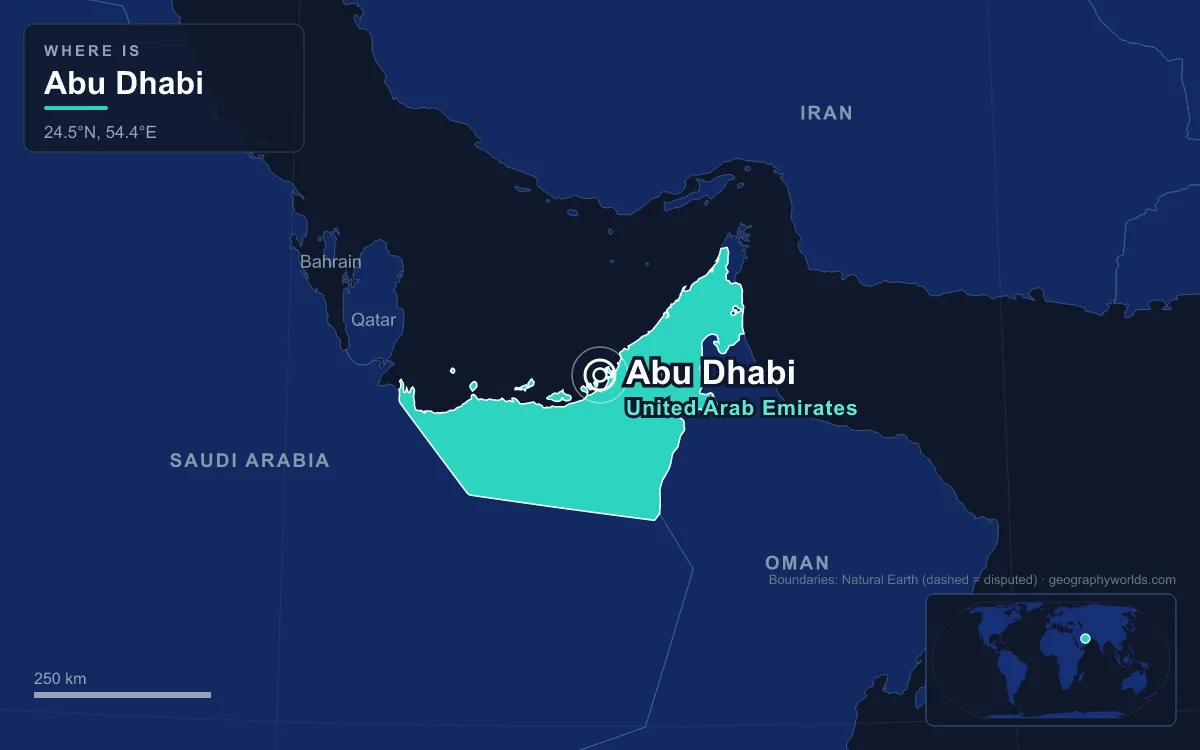
Abu Dhabi is the capital of the United Arab Emirates and of the Emirate of Abu Dhabi, the largest and wealthiest of the seven emirates. The city is built on a T-shaped island in the Persian Gulf, less than 250 metres off the central-western coast, and has spread across bridges onto the mainland and neighbouring islands. Its urban area had an estimated 2.5 million people in 2023, second in the country only to Dubai. It is the seat of the federal government and the President, and the home of the Abu Dhabi Investment Authority, one of the world’s largest sovereign wealth funds, with roughly US$1 trillion under management. All of this grew from a single freshwater well found in 1761.
Umm an-Nar and the Copper Trade, c. 2600–2000 BCE
The story begins on a small island just off the city. Umm an-Nar, “mother of fire”, gave its name to an Early Bronze Age culture that lasted from about 2600 to 2000 BCE across what is now the UAE and northern Oman. Its people were middlemen between the two great civilisations of the time. Sumerian texts refer to a land called Magan that sent copper and diorite to Mesopotamia and passed on goods such as carnelian jewellery from the Harappan cities of the Indus valley. The culture is recognised by round stone tombs built with carefully fitted outer walls. The main site on the island, Sas Al Nakhl, is protected, but it lies between an oil refinery and a military area, so the public cannot visit it.
Afterwards, and for a very long time, the island had no permanent town. The coast was used seasonally by herders and fishermen, and the area was known as Milh, Arabic for salt, probably because of its brackish water. A small island off the city still carries that name.
The Bani Yas Well and the First Watchtower, 1761–1793
The Bani Yas, the tribal confederation from which the ruling Al Nahyan family comes, lived in the Liwa Oasis in the far south-west of the present emirate. Around 1761 a hunting party led by Sheikh Dhiyab bin Isa found fresh water on the island. A popular story says the hunters were following a gazelle to the spring, which would explain the name: Abu Dhabi means “father of the gazelle”. The Al Bu Falah section of the tribe settled first, and its sheikhs have supplied the rulers ever since.
A conical watchtower was built in 1761 to guard the well, the only fresh water on the island. The first settlement had the tower and about twenty houses, and within two years it had grown to some 400 houses. In 1793 Sheikh Shakhbut bin Dhiyab expanded the tower into a small fort and moved his residence there. That fort, Qasr Al Hosn, remained the palace and seat of government until 1966, and it is still the oldest stone building in the city.

Pearls and the Trucial Coast, 1820–1930s
For the next century and a half Abu Dhabi was a pearling town. Most people lived in houses of palm fronds, called barasti, and only the wealthier families had mud-brick homes. Each summer the town filled with pearling crews. Divers went down without air tanks, protected only by leather nose clips and leather covers on their fingers and big toes. They stayed under for one to three minutes at a time and made up to thirty dives a day. Camel herding and date and vegetable growing in the inland oases of Al Ain and Liwa supported the rest of the economy.
British treaties shaped the region politically. Abu Dhabi signed the General Maritime Treaty of 1820, the Perpetual Maritime Truce of 1853 and the Exclusivity Agreement of 1892, which placed it under British protection as one of the Trucial States. Under Zayed bin Khalifa, known as Zayed the Great, who ruled from 1855 to 1909, the emirate fought a long war with Qatar from 1881 until a settlement brokered by Britain and the Ottomans in 1893. The pearl trade peaked in the late nineteenth and early twentieth centuries and collapsed once Japanese cultured pearls reached the market.
The Oil Concession Years, 1936–1966
With pearling finished, Sheikh Shakhbut bin Sultan turned to oil companies. On 5 January 1936 he signed an exploration agreement with Petroleum Development (Trucial Coast), an associate of the Iraq Petroleum Company, followed in January 1939 by a 75-year concession. The payments paid for a major extension of Qasr Al Hosn in the late 1930s. The first commercial discovery came offshore. In 1958 Abu Dhabi Marine Areas, a BP and Compagnie Française des Pétroles venture, struck oil in the Umm Shaif field at about 2,669 metres. The onshore discovery at Murban No. 3 followed in 1959, then Bu Hasa in 1962 and Lower Zakum in 1963. Exports began in 1962.
The town did not change much at first. Shakhbut, unsure whether oil income would last, preferred to save it. A few low concrete buildings went up, and the first paved road was finished only in 1961. The ruling family grew frustrated. On 6 August 1966, at the request of leading members of the ruling family and with British backing, Shakhbut was replaced in a bloodless palace coup by his younger brother Zayed bin Sultan, who had spent twenty years governing the Eastern Region from Al Ain.
Zayed’s Grid and the Maqta Bridge, 1966–1971
Zayed started spending quickly. He hired the Japanese architect Katsuhiko Takahashi, who in 1967 drew up a plan for a city of 40,000 people. Takahashi often worked from lines Zayed marked in the sand with a camel stick, and the plan introduced wide roads, a corniche and tree-planting. The Egyptian planner Abdulrahman Makhlouf continued the work after Takahashi left. The downtown grid still follows their numbering. The Corniche is Street No. 1 and the odd-numbered streets parallel to it continue inland: Khalifa Street is No. 3 and Hamdan Street No. 5. In 1968 the Al Maqta Bridge gave the island its first fixed link to the mainland.
That year also brought the political change that created the country. In January 1968 the British minister Goronwy Roberts told the Gulf rulers that Britain would withdraw from the region. On 18 February 1968, at a meeting on the border between Abu Dhabi and Dubai, Zayed and Sheikh Rashid bin Saeed Al Maktoum of Dubai agreed to form a federation. On 2 December 1971, the day after the British treaties ended, six emirates formed the United Arab Emirates, with Zayed as President. Ras Al Khaimah joined on 10 February 1972.
The “Temporary” Capital, 1971–1996
Surprisingly, the 1971 constitution did not make Abu Dhabi the permanent capital. Article 9 provided for a new capital called Al Karama, to be built on the border between Abu Dhabi and Dubai within seven years, and named Abu Dhabi only as the temporary seat of the union. Al Karama was never built. In the meantime, the oil price rise after the 1973 war multiplied the emirate’s income, and Zayed founded the Abu Dhabi Investment Authority in 1976 to invest the surplus. The Mussafah Bridge opened a second road link to the mainland in 1977. Between 1976 and 1983 Qasr Al Hosn was renovated and painted the bright white that gives it the nickname White Fort. Planners who had once allowed for 40,000 people were now allowing for 600,000, in tower blocks along wide grid roads.
The provisional arrangement finally ended in the 1990s. Constitutional Amendment No. 1, dated 2 December 1996, removed the word “temporary” from Article 9, and Abu Dhabi became the capital of the union without qualification. In the same period Dubai accepted the permanent constitution. The division of powers between the federation and the emirates is explained in our guide to the government of the United Arab Emirates.
Saadiyat, the Grand Mosque and a City of 2.5 Million, 1996–Today
Zayed died in 2004 and is buried in the courtyard of the Sheikh Zayed Grand Mosque, which opened in December 2007. Its complex covers more than 12 hectares and can hold about 41,000 worshippers. Zaha Hadid’s Sheikh Zayed Bridge opened in 2010 as the third mainland crossing. Saadiyat Island became a cultural district. The Louvre Abu Dhabi, built under a 2007 agreement with France that allows it to use the Louvre name until 2047, was inaugurated on 8 November 2017 by President Emmanuel Macron and Crown Prince Mohammed bin Zayed.

Qasr Al Hosn reopened as a museum in 2018 after a ten-year restoration. On 16 February 2023 the Abrahamic Family House was inaugurated on Saadiyat, bringing together a mosque, a church and the Moses Ben Maimon Synagogue, the country’s first purpose-built synagogue.
Most people who live in the capital were born elsewhere. In 2014 only 477,000 of the emirate’s 2.65 million residents were UAE nationals, and about 80 per cent were expatriates, many from India, Pakistan, Nepal, Bangladesh, the Philippines and across the Arab world. The emirate’s population passed 4.1 million in 2024, and Abu Dhabi produces about two-thirds of a national economy of roughly $503 billion. Its rivalry with the larger city up the coast is covered in our guide to the population of Dubai, and the churches, temples and mosques of the capital in our overview of religion in the United Arab Emirates.
Quick Facts About Abu Dhabi
- Country: United Arab Emirates
- Continent: Asia (Middle East)
- Country population: approximately 11.6 million
- Capital city status: Abu Dhabi is the capital of United Arab Emirates, the seat of national government, and the location of foreign embassies, parliament, and the head of state's official residence.
Frequently Asked Questions
What is the capital of United Arab Emirates?
The capital of United Arab Emirates is Abu Dhabi. Abu Dhabi is the seat of national government, hosts most foreign embassies and consulates, and is typically where the head of state and parliament are located.
What continent is Abu Dhabi in?
Abu Dhabi, the capital of United Arab Emirates, is located in Asia, in the Middle East region. As United Arab Emirates's capital, Abu Dhabi serves as the country's primary connection to the broader Asian political, economic, and cultural sphere.
Why is Abu Dhabi the capital of United Arab Emirates?
Abu Dhabi was chosen as the capital of United Arab Emirates for reasons that typically combine geography, history, and politics. Capital city selections often reflect a desire for centrality (being accessible from across the country), historical importance (being a longstanding seat of government or culture), or neutrality (being acceptable to multiple regions or ethnic groups within the country). The specific reasons for Abu Dhabi's designation are detailed in the city's history above.
What is Abu Dhabi known for?
As the capital of United Arab Emirates, Abu Dhabi is best known for housing the country's central government institutions — parliament, presidential or royal residences, supreme court, and key ministries. It is also typically a major cultural and economic center within United Arab Emirates, hosting national museums, embassies, and signature monuments. The introduction and history sections above provide detailed coverage of the city's specific notable institutions and landmarks.
Related Pages
- United Arab Emirates Country Guide — full geography, climate, economy, and culture overview
- Flag of United Arab Emirates — meaning, history, and design of United Arab Emirates's national flag