

A mountain is a large landform that rises steeply above the surrounding terrain, typically reaching at least 600 meters (2,000 feet) above sea level. Mountains are formed by tectonic forces, volcanic activity, or faulting, and they cover roughly 22% of the Earth's land surface, hosting unique ecosystems and supplying freshwater to half the world's population.
Introduction
Mountains are among the most dramatic and recognizable features on Earth. From the soaring peaks of the Himalayas to the volcanic cones of the Andes, they shape climate, redirect rivers, create ecological barriers, and influence human settlement patterns. Mountains are found on every continent and even beneath the oceans, where underwater mountain ranges like the Mid-Atlantic Ridge stretch for thousands of kilometers.
How Mountains Form
- Tectonic Collision: Continental plates collide, pushing crust upward (e.g., Himalayas)
- Volcanic Activity: Magma erupts and builds up cones and domes (e.g., Mount Fuji)
- Faulting: Blocks of crust are uplifted along fault lines (e.g., Sierra Nevada)
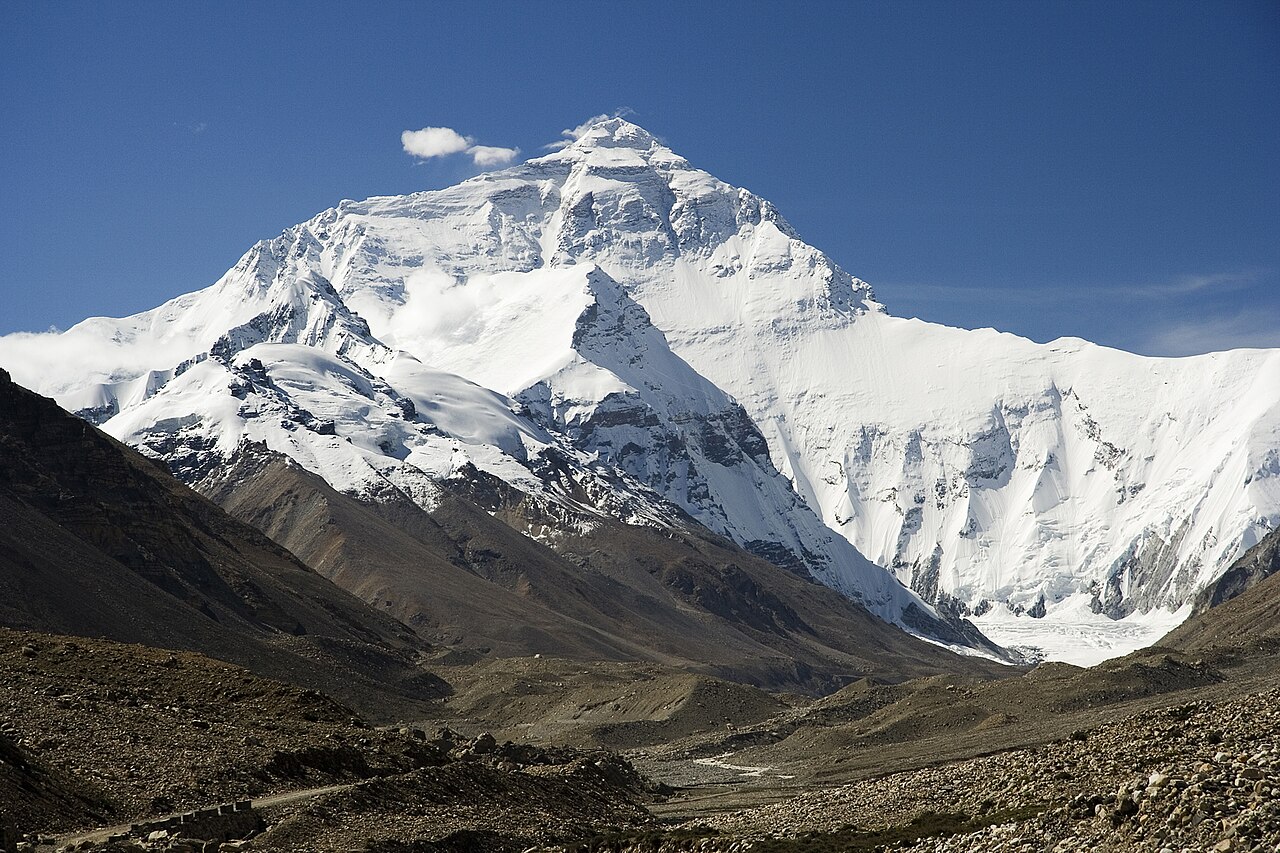
The most massive mountain ranges form at convergent plate boundaries where tectonic plates collide. The Himalayas were created — and are still growing — as the Indian Plate pushes into the Eurasian Plate. This collision began roughly 50 million years ago and has produced the tallest mountains on Earth, including Mount Everest at 8,849 meters.
Volcanic mountains form when magma from the Earth's mantle reaches the surface and accumulates. They can grow rapidly in geological terms — Parícutin in Mexico grew from a cornfield to a 424-meter cone in just nine years (1943-1952). Fault-block mountains form when sections of the Earth's crust are thrust upward along fractures, creating steep-sided ranges with flat tops or tilted surfaces.
Types of Mountains
- Fold Mountains: Formed by plate collision — Himalayas, Alps, Andes
- Volcanic Mountains: Built by eruptions — Mount Fuji, Kilimanjaro, Rainier
- Fault-Block Mountains: Uplifted along faults — Sierra Nevada, Tetons
- Dome Mountains: Magma pushes crust upward without erupting — Black Hills
Fold mountains are the most common and typically the tallest. They form when layers of rock are compressed and buckled by tectonic forces, folding like a crumpled tablecloth. The Alps, Andes, Rockies, and Appalachians are all fold mountains, though the Appalachians are much older and have been worn down by hundreds of millions of years of erosion.
Dome mountains form when magma pushes the overlying rock upward without breaking through the surface, creating a rounded dome shape. Erosion later exposes the igneous rock core. The Black Hills of South Dakota, which contain Mount Rushmore, are a classic dome mountain example.
Famous Mountains
- Mount Everest (Nepal/Tibet): Tallest above sea level at 8,849 m
- K2 (Pakistan/China): Second tallest and deadliest major peak
- Denali (USA): Tallest in North America at 6,190 m
- Kilimanjaro (Tanzania): Tallest in Africa, a freestanding volcanic mountain
- Mauna Kea (Hawaii): Tallest from base to summit (10,210 m from ocean floor)
Mount Everest holds the record for highest elevation, but Mauna Kea in Hawaii is actually taller when measured from its base on the ocean floor — over 10,000 meters total, though only 4,207 meters are above sea level. Chimborazo in Ecuador, while only 6,263 meters above sea level, has its summit farther from Earth's center than Everest due to the equatorial bulge.
Key Facts
- A mountain is a landform rising steeply at least 600 meters above its surroundings.
- Mountains cover about 22% of the Earth's land surface.
- The Himalayas are still growing by about 1 cm per year due to tectonic collision.
- Over half the world's freshwater originates in mountain watersheds.
- The tallest mountain from base to peak is Mauna Kea at 10,210 meters.
Fun Facts
- Olympus Mons on Mars is the tallest known mountain in the solar system at roughly 21.9 km — nearly three times the height of Everest.
- The Appalachian Mountains were once as tall as the Himalayas, but 480 million years of erosion have reduced them to gentle ridges.
- Mountains can create their own weather — air forced upward cools and releases moisture, which is why one side of a mountain is often lush while the other is a dry "rain shadow."
- More people have been to space than have summited K2, the world's second-tallest peak.
Final Thoughts
Mountains are among the most powerful forces shaping geography, climate, and human civilization. They create barriers and corridors, generate freshwater, support unique ecosystems, and inspire awe. Understanding how mountains form and change is fundamental to understanding the dynamic nature of our planet.
Test Your Knowledge!
Think you know your geographic features? Try our interactive quiz!
Play Geography Games →