

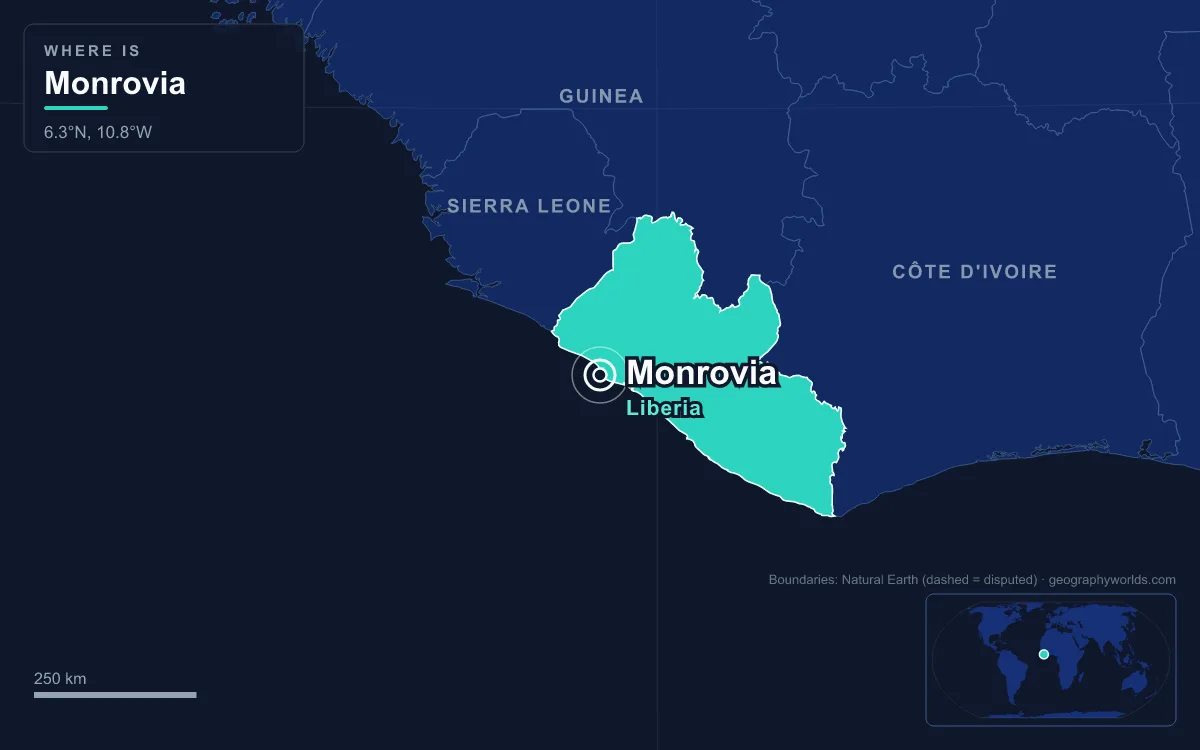
The capital of Liberia is Monrovia, a port city on the Cape Mesurado peninsula where the Mesurado River meets the Atlantic Ocean, on West Africa's coast between Sierra Leone and Ivory Coast. The 2022 census counted 1,761,032 people in the city and 2,225,911 in the wider metropolitan area, about a third of everyone in Liberia. Monrovia was founded in 1822 by the American Colonization Society as a settlement for free Black Americans, and in 1824 it was renamed after James Monroe, the sitting US president. That makes it one of only two national capitals named after an American president, the other being Washington, D.C. It is also often called the wettest capital city in the world, with an average of about 4,600 millimetres of rain a year.
Before the settlers came, the cape was known as Ducor, a trading and fishing place used by Dey, Kru, Bassa, Gola and Vai communities. Much of what Monrovia has become since can be read through four things: who holds power, how people worship, how the city earns its money, and what an ordinary rainy day looks like.
Capitol Hill: The Executive Mansion and the Temple of Justice
Power in Liberia sits on a rise just south of the old downtown called Capitol Hill. The Executive Mansion, the president's residence and office, faces the Capitol Building across the street. The current mansion was built under President William Tubman, who governed from 1944 to 1971. Work began around 1960 and it was dedicated on 3 January 1964, with the Liberian Construction Corporation doing the building and Israeli government money helping to pay for it.
The mansion has also witnessed some of the worst political violence in Liberia's history. President William Tolbert was killed inside it during Samuel Doe's coup of April 1980, and Tolbert and other victims of the coup were buried in a mass grave in Palm Grove Cemetery. Testimony to Liberia's Truth and Reconciliation Commission later described killings on the mansion grounds after Thomas Quiwonkpa's failed coup attempt in 1985. Then, on 26 July 2006, the 159th anniversary of independence, the mansion caught fire while President Ellen Johnson Sirleaf was hosting guests there. Reconstruction dragged on for years, and the building did not officially reopen until 14 February 2022.
Also on Capitol Hill stands the Temple of Justice, a modernist courthouse by the architect Tommaso Valle, dedicated in 1965. It houses the Supreme Court and the criminal courts of Montserrado County. During a renovation that began in 2008, its inscription was changed from "Let justice be done to all men" to "Let justice be done to all". The hill is a reminder of how long a small settler elite ran the state. In the early 1900s about 2,500 of Monrovia's 4,000 residents were Americo-Liberians, living in Monrovia proper, while Kru, Bassa and Grebo families lived apart in Krutown. Americo-Liberian dominance of the state lasted until the 1980 coup.
From Providence Island to the Masonic Temple: Faith in Monrovia
The city's religious story starts on a small island in the river mouth. On 7 January 1822 the first group of settlers, brought from Sherbro Island in modern Sierra Leone, landed on Dozoa Island, now Providence Island, before going ashore on the cape. The land had been acquired from local leaders in December 1821, in a deal valued at around $300 in trade goods. Historians still argue about the circumstances of that transaction.
Among the settlers was Lott Cary, a Baptist minister from Richmond, Virginia, who had bought his own freedom. In 1822 he founded the colony's first Baptist church, today's Providence Baptist Church, and he briefly ran the colony as acting agent in 1828 before his death that November. Cary was the first American Baptist missionary to Africa, and he also founded schools for local children.

A second institution mattered almost as much to the old elite. Liberian Freemasonry grew up with the settler community: St John's Lodge No. 3 was founded on Carey Street in 1857, and the Grand Lodge of Liberia followed in 1867. Its headquarters, the Masonic Temple at the western end of Benson Street in Mamba Point, was completed in 1967, with a columned front and a globe on the roof. Before 1980 many senior figures in the ruling True Whig Party were Masons, and Tolbert himself was Grand Master. That concentration of influence bred resentment, and after the coup Samuel Doe's government banned Masonic activity for a time.
Faith also shaped the city's recovery from war. In 2003 Leymah Gbowee and other organisers brought Christian and Muslim women together in the Women of Liberia Mass Action for Peace. Dressed in white, they gathered at a fish market in Monrovia to pray and sing, and kept up public pressure on the warring parties. The Second Liberian Civil War ended that year, and in 2005 Liberians elected Ellen Johnson Sirleaf, Africa's first elected female head of state.
The Freeport of 1948 and a Flag Flown Around the World
Monrovia's economy has long depended on the sea. Seagoing ships were exporting palm oil from the town by 1850. During the Second World War the United States sent forces to Liberia to protect rubber exports, and they built an artificial harbour with two breakwaters on Bushrod Island, north of the city. The Freeport of Monrovia opened there in 1948, and it is still the country's largest port, handling exports such as latex and iron ore. The government took it over from an American company in 1971 and set up the National Port Authority to run it. In 2010 it signed a $120 million concession with APM Terminals to modernise the port.
The same year the Freeport opened, Liberia created the maritime business that made "Monrovia" familiar in harbours around the world. Its open ship registry, set up in 1948 by Edward Stettinius, a former US Secretary of State, let foreign owners fly the Liberian flag. The first ship registered was the Greek shipping magnate Stavros Niarchos's World Peace, on 11 March 1949. By 1968 Liberia had overtaken the United Kingdom as the world's largest register. Between ten and fifteen percent of the world's merchant ships list Monrovia as their home port, even though the registry itself is run from Virginia.
Trade on land is more visible. Waterside, the main market district, sits just north of downtown facing the harbour, and its shops and stalls, many of them hung with clothing, spill out onto the street.

A different kind of commerce once looked down on all of it from Ducor Hill, the highest point in the city. The Ducor Palace Hotel opened there in 1960, built by the Israeli industrialist Moshe Mayer. It was Liberia's first international-class hotel, and it came under InterContinental management in 1962. The building is now an abandoned shell overlooking the ocean, the Saint Paul River and West Point.
West Point, Sinkor and 4,600 Millimetres of Rain
Everyday Monrovia is spread along the peninsula. Broad Street runs through the historic downtown at its tip. Mamba Point, to the west, has long been the diplomatic quarter, home to the US and British embassies. Sinkor, further east, began as a suburb and is now the city's midtown, with hotels, offices, the small Spriggs Payne Airport and the nightlife strip known as Airfield. Beyond it lie Congo Town, Paynesville and, north across the river, Bushrod Island and New Kru Town. The main international airport, Roberts International, is about 60 kilometres away at Harbel.
West Point shows the hardest side of city life. It is a peninsula of only 0.53 square kilometres, pushing into the Atlantic between the Mesurado and Saint Paul rivers. Fishermen occupied it in the 1940s or 1950s, and a 1970s attempt to move residents out failed. It is now one of Monrovia's most crowded neighbourhoods, and parts of it are being lost to coastal erosion. During the 2014 Ebola epidemic the government sealed West Point off for 18 days, a decision President Sirleaf later called a mistake. Liberia's outbreak was declared over on 3 September 2015.
Above all this is the weather. Monrovia has a tropical monsoon climate, and its temperature barely changes: the average is about 26°C and night-time lows stay between 22 and 24°C all year. The rain is another matter.
September alone averages more than 900 millimetres, and even the "dry" months from December to February are rarely completely dry. Radio is the main source of news partly because an unreliable grid makes television hard to watch. One local institution suits the conditions well. The Daily Talk is a news digest, mixed with Bible verses, chalked up each day on a roadside blackboard in Sinkor. It continues a long tradition, since the Liberia Herald, founded in Monrovia in the 1820s, was one of the first newspapers published in Africa.
Rebuilding after the civil wars of 1989–1997 and 1999–2003 is still going on, as roads rebuilt with World Bank funding since 2005 show. For the national picture, including Liberia's counties and its more than 20 indigenous languages, see our Liberia country guide. To see how Monrovia's downpours compare with other rainy places, read our list of the wettest countries in the world, or visit its neighbour on the same coast in our guide to Freetown, the capital of Sierra Leone, where British Black Loyalists had already been settled before Monrovia's founders arrived.
Quick Facts About Monrovia
- Country: Liberia
- Continent: Africa (West Africa)
- Country population: approximately 5.9 million
- Capital city status: Monrovia is the capital of Liberia, the seat of national government, and the location of foreign embassies, parliament, and the head of state's official residence.
Frequently Asked Questions
What is the capital of Liberia?
The capital of Liberia is Monrovia. Monrovia is the seat of national government, hosts most foreign embassies and consulates, and is typically where the head of state and parliament are located.
What continent is Monrovia in?
Monrovia, the capital of Liberia, is located in Africa, in the West Africa region. As Liberia's capital, Monrovia serves as the country's primary connection to the broader African political, economic, and cultural sphere.
Why is Monrovia the capital of Liberia?
Monrovia was chosen as the capital of Liberia for reasons that typically combine geography, history, and politics. Capital city selections often reflect a desire for centrality (being accessible from across the country), historical importance (being a longstanding seat of government or culture), or neutrality (being acceptable to multiple regions or ethnic groups within the country). The specific reasons for Monrovia's designation are detailed in the city's history above.
What is Monrovia known for?
As the capital of Liberia, Monrovia is best known for housing the country's central government institutions — parliament, presidential or royal residences, supreme court, and key ministries. It is also typically a major cultural and economic center within Liberia, hosting national museums, embassies, and signature monuments. The introduction and history sections above provide detailed coverage of the city's specific notable institutions and landmarks.
Related Pages
- Liberia Country Guide — full geography, climate, economy, and culture overview
- Flag of Liberia — meaning, history, and design of Liberia's national flag