

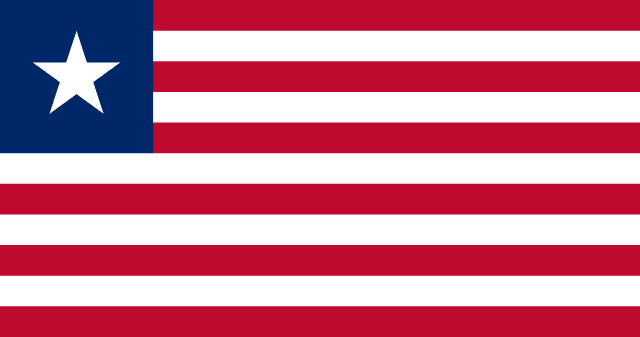
Few flags tell their origin story as plainly as Liberia's. Flutter it beside the Stars and Stripes and the family resemblance is unmistakable: the same crimson and white bands, the same blue rectangle anchored in the upper corner, the same lone star burning against the blue. That likeness is no coincidence. Liberia was founded in the nineteenth century by free-born Black Americans and formerly enslaved people who crossed the Atlantic to build a republic on the West African coast, and they carried the visual grammar of their old homeland into the design of their new one. The result, adopted in 1847, is one of the oldest national flags still flying in Africa.
A Banner Born of Migration
To understand the flag you have to understand the country. Liberia took shape through a settlement project that resettled freed and free-born African Americans on the coast of West Africa. When these settlers declared their independence and established the Republic of Liberia in 1847, they reached instinctively for the iconography they knew best. The flag was deliberately modeled after the United States flag, a tribute to the land the settlers had left and a statement about the kind of constitutional republic they hoped to create.
That heritage makes Liberia's flag a rare document in cloth. Most national flags evolve from royal standards, colonial banners, or revolutionary movements rooted in the soil they fly over. Liberia's instead records an act of return and reinvention.
The drafting of the flag was itself a notable moment. A committee of women is traditionally credited with designing and sewing the first national banner, and the early republic celebrated them as its makers. Before the 1847 flag, the settlers had flown a colonial-era ensign tied to the American sponsoring society that backed the settlement, a banner that also used red, white, and blue but bore a cross rather than a star. Casting it off for the lone-star design was a deliberate break, signaling that the settlers now flew under their own sovereign emblem.
Reading the Stripes and the Star
The design is built from three colors and a clear structure. Eleven horizontal stripes alternate red and white across the field, beginning and ending with red, and a blue canton sits in the upper hoist corner bearing a single white five-pointed star. The number eleven is no accident: the stripes stand for the men who signed Liberia's Declaration of Independence, fixing the founding moment into the proportions of the flag itself.
The lone white star carries the heaviest meaning. It represents freedom, and in the context of Liberia's founding that word lands with particular force. The country's name itself comes from the Latin root for liberty, and the single star against the blue field has long been read as the light of liberty shining over Africa, the first independent republic of its kind on the continent. Where the United States adds a star for every state, Liberia keeps just one, and that solitary point becomes a far more concentrated symbol. By convention the canton spans the height of the topmost five stripes, with the star centered inside it.
What the Colors Say
The red, white, and blue are not borrowed only for their look; each carries its own weight. Red is associated with courage and the valor of those who fought to establish and defend the republic. White speaks to purity and to the moral ideals on which the founders hoped to build their society. Blue, the color of the canton that frames the star, is tied to the African mainland and to fidelity.
Set side by side, the palette does double duty. It honors the heritage that inspired the design while reading, on Liberian terms, as a statement of courage, integrity, and loyalty to the new homeland.
A Flag Among Its Cousins
Liberia belongs to a small club of flags whose ancestry traces directly back to the United States banner, and the two are genuinely easy to confuse at a distance. The giveaways are the count and the canton: Liberia shows eleven stripes to the United States' thirteen, and one large star rather than fifty small ones.
The resemblance has had practical consequences. Because Liberia maintains one of the world's largest ship registries, its flag is among the most common sights at sea on commercial vessels, and sailors have long needed to distinguish it quickly from the American ensign. That deliberate echo of the American template is precisely what sets it apart from the Pan-African palette of red, gold, and green that most of the continent later embraced. Surrounded by neighbors flying those liberation-era colors, Liberia's red, white, and blue quietly announce a different and older path to nationhood.
One of Africa's Oldest Flags
Because it dates to 1847, the Liberian flag predates almost every other national flag on the continent. While much of Africa would not raise independent banners until the wave of decolonization more than a century later, Liberia's red-white-and-blue had already been flying for generations. That longevity gives the flag a special standing: it is both a national emblem and a piece of living history.
Its endurance is also remarkable given Liberia's turbulent modern history. Through political upheaval and years of conflict, the flag remained the constant marker of the state, carried forward by every government. If you want broader context on the nation behind the banner, the liberia country guide traces its geography and story in more depth.
The Flag in Everyday Liberian Life
Liberians mark a dedicated Flag Day each August honoring the banner and the ideals it carries, and the flag appears prominently around the country's Independence Day celebrations each July. It flies over government buildings, schools, and embassies, and travels with Liberian athletes onto the international stage, where the lone star is instantly recognizable.
The single-star motif has rippled outward into national life. The national football team is widely known as the Lone Star, drawing its identity straight from the canton, and the imagery surfaces in civic emblems and patriotic song. Schoolchildren learn the meaning of the eleven stripes alongside the names of the founding signers, so the flag doubles as a compact civics lesson stitched into fabric. A design conceived in the 1840s still does the everyday work of telling people, at a glance, who and what they belong to.
Interesting Facts at a Glance
- The flag was adopted in 1847, the same year Liberia declared itself an independent republic.
- Its eleven stripes represent the signers of Liberia's Declaration of Independence.
- The single white star stands for freedom and is read as the light of liberty over Africa.
- The design was modeled after the United States flag by the free and formerly enslaved African Americans who founded the country.
- A committee of women is traditionally credited with sewing the first flag.
- It is one of the oldest national flags in Africa, predating most of the continent's independence-era banners by over a century.
Frequently Asked Questions
When was the flag of Liberia adopted?
The flag was adopted in 1847, the year Liberia became an independent republic. That early date makes it one of the oldest national flags on the African continent and one that has flown continuously ever since.
What do the colors and star on the Liberian flag mean?
The eleven red and white stripes represent the signers of Liberia's Declaration of Independence, while the white five-pointed star in the blue canton symbolizes freedom. Red is linked to courage, white to purity and high ideals, and blue to the African mainland and to fidelity.
Who designed the Liberian flag and why does it look American?
The flag was created by the free-born and formerly enslaved African Americans who founded Liberia, and it was deliberately modeled after the United States flag as a nod to the homeland they had left. A committee of women is traditionally credited with sewing the first version. The key difference is the star: Liberia keeps a single one for freedom rather than a star for every state.
What continent is Liberia on, and how does its flag compare to similar ones?
Liberia is in West Africa. Its flag closely echoes the Stars and Stripes of the United States, but the lone star and the eleven stripes set it apart, giving it a distinct identity rooted in Liberia's own founding history.
How can you tell the Liberian flag apart from the United States flag?
Count the stripes and the stars. Liberia has eleven stripes and a single large white star, while the United States flag has thirteen stripes and fifty small stars. The lone Liberian star also fills much more of its blue canton, which is the quickest way to distinguish the two from a distance.