
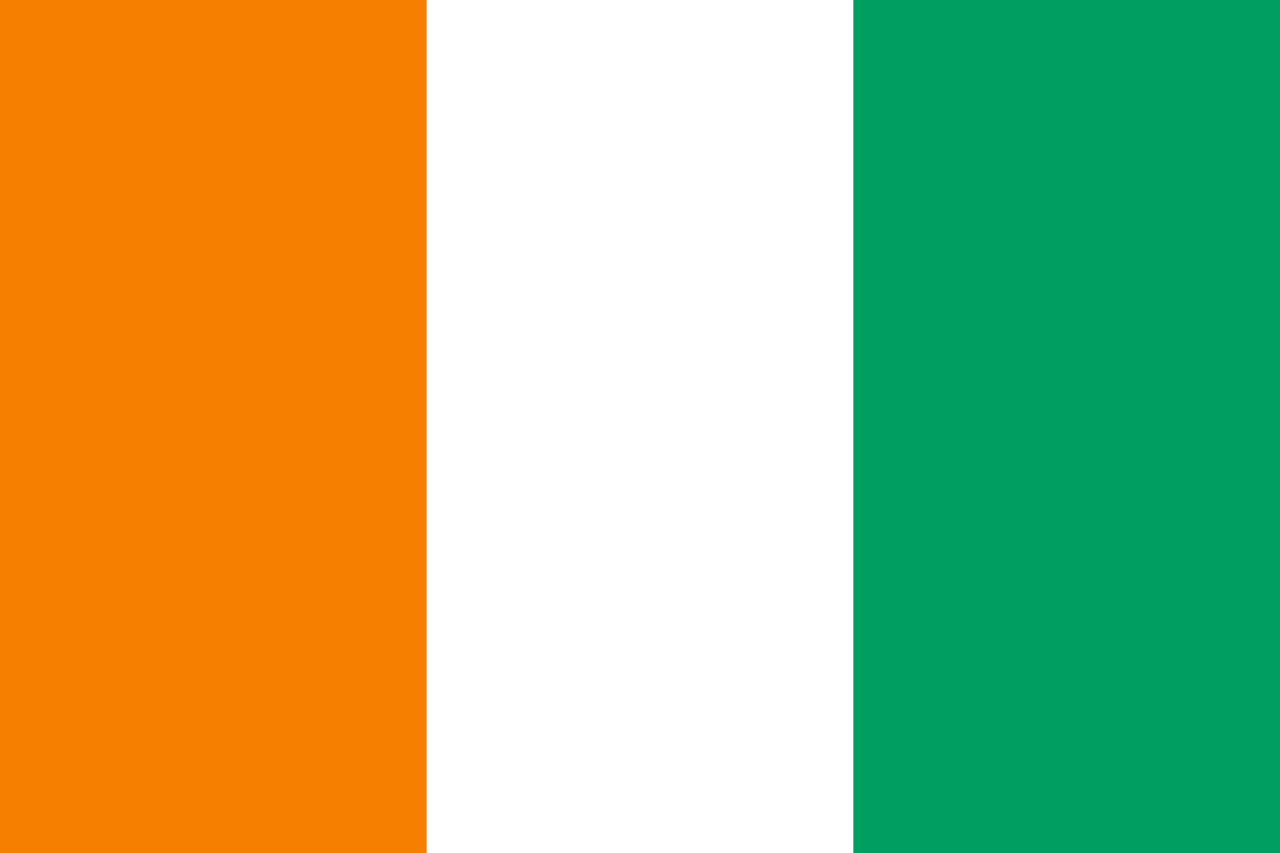
Stand at the edge of a Sunday football match in Abidjan or peer up at the flagpoles lining the boulevards of Yamoussoukro, and you will see the same three vertical bands overhead: a warm strip of orange nearest the pole, a clean band of white in the middle, and a deep green at the fly. The national flag of Ivory Coast is one of West Africa's most recognizable banners, deceptively simple yet rich in meaning. It is a flag born in the hopeful years before independence, and it has flown over the country ever since.
A Tricolor at a Glance
The Ivorian flag is a vertical triband of three equal stripes, with no emblem, star, or coat of arms breaking up the fields of color. From the hoist outward the order runs orange, white, and green. The absence of any central device is intentional: the colors carry the entire message on their own, a design philosophy shared by many flags from the French-influenced tradition of vertical tricolors.
Because each band is the same width and the layout is clean, the flag reads clearly from a distance and reproduces easily at any size. That clarity is part of why it has endured without redesign for more than six decades. The official proportions place the flag at a ratio of 2:3, and manufacturers reproduce the orange as a warm, slightly reddish hue rather than a pure yellow-orange.
What the Colors Mean
Each stripe was chosen to represent something essential about the young nation. The orange on the hoist side stands for the savannah of the north, the open grasslands that stretch across much of the country's interior. It also evokes the warmth of the land, the fertility of the soil, and the spirit of national growth.
The white center band represents peace, an aspiration placed deliberately at the heart of the design. Between the two colored stripes, it suggests unity binding the regions of the country together, and it is sometimes read as the rivers threading from the forested south to the dry north.
The green at the fly speaks for the forests of the south, the lush vegetation of the coastal and equatorial zones, and it carries a second meaning of hope for the future. Together the orange savannah and green forest frame the white peace between them, mapping the country's geography onto a single piece of cloth. The order itself tells a story: the eye travels from the warm, dry interior, through the calm of peace, to the green abundance of the coast.
How the Flag Came to Be
The flag was adopted in 1959, designed just before the country gained full independence from France on 7 August 1960. Before that, the territory had flown only the French Tricolore as its colonial standard, with no distinct banner of its own; for decades the only flag over the colony of Côte d'Ivoire was the blue, white, and red of the metropole. As the territory moved toward self-governance within the French Community in the late 1950s, a new national symbol was needed.
The vertical tricolor format itself echoes the French Tricolore, a common thread among nations that emerged from French colonial administration, but the Ivorian palette is entirely its own. By choosing colors tied to the land and to peace rather than to a ruling dynasty or a single ethnic group, the designers crafted a banner meant to belong to everyone within the new state's borders. In a country of enormous ethnic and linguistic diversity, that neutrality mattered: no faction could claim the flag as exclusively theirs. When independence arrived under the leadership of Félix Houphouët-Boigny, the flag was already in place, and it has remained unchanged ever since.
A Family of Look-Alike Flags
The Ivorian flag belongs to a small club of banners that share its colors or layout, and telling them apart is a favorite puzzle for flag enthusiasts. The most famous comparison is with the flag of Ireland, which uses the identical trio of orange, white, and green but reverses the order, placing green at the hoist and orange at the fly. The two are mirror images, and at a distance a viewer must check which color sits next to the pole to know which nation is flying.
The flag also sits beside its West African neighbor Niger, whose horizontal bands of orange, white, and green carry an orange disc in the center, and it is sometimes confused with the flag of India, which runs saffron, white, and green from top to bottom with a navy wheel at its heart. What ultimately distinguishes the Ivory Coast flag is its combination of a vertical layout, the orange-white-green order, and the complete absence of any central emblem.
A Symbol of Identity
Ivory Coast sits on the southern coast of West Africa, firmly on the continent of Africa, bordered by neighbors that share its colonial-era history. Against that backdrop the orange-white-green banner has become shorthand for Ivorian identity. It appears on government buildings, on currency and official documents, and in the hands of crowds during national celebrations.
The colors have also seeped into everyday culture and visual branding, from product packaging to political posters. To understand how that identity took shape across the country's regions and history, explore the broader story in this ivory coast country guide, which sets the flag in the wider context of the land it represents.
The Flag in Modern Life
Few moments showcase the flag more vividly than international football. The Ivorian national team, nicknamed Les Éléphants, has turned the orange, white, and green into a fixture of stadiums across the continent. When the team plays, supporters drape themselves in the tricolor and wave it through the streets. The country's hosting of the 2023 Africa Cup of Nations, which Les Éléphants won on home soil, saw the flag carried through Abidjan in some of the largest public displays in the nation's history.
Beyond sport, the flag is raised every 7 August for Independence Day and other civic occasions, flown at embassies abroad, and used as a unifying emblem when the country projects a shared sense of nationhood. Schoolchildren learn the meaning of its colors. Its simplicity makes it endlessly adaptable, equally at home on a soldier's shoulder patch and a child's hand-drawn poster.
Interesting Facts
- The flag is nearly identical to the flag of Ireland but with the colors reversed: Ireland places green at the hoist and orange at the fly, while Ivory Coast does the opposite.
- There is no star, crest, or symbol anywhere on the design, the meaning rests entirely in the three colors.
- The orange and green stripes literally map the country's two great landscapes, the northern savannah and the southern forest.
- The flag has flown without any redesign since its adoption in 1959, an unusually long stretch of stability.
- Before this flag, the colony flew only the French Tricolore, so this banner was the country's first truly national flag.
- The vertical tricolor layout reflects a design lineage shared with France and several West African neighbors.
Frequently Asked Questions
When was the flag of Ivory Coast adopted?
The flag was adopted in 1959, in the years just before the country achieved full independence from France in 1960. It was designed during that pre-independence period and has remained in continuous use ever since.
What do the colors of the Ivorian flag mean?
Orange represents the savannah of the northern part of the country, white stands for peace, and green represents the southern forests. Read together, the colors place the ideal of peace at the center, framed by the two defining landscapes of the nation.
What continent is Ivory Coast on, and how does its flag compare to similar ones?
Ivory Coast is located in West Africa, on the African continent. Its flag is most often compared to the flag of Ireland, which uses the same three colors but in the opposite order. The vertical tricolor format also resembles the French flag and those of several West African neighbors.
Is there an emblem or symbol on the flag?
No. The Ivorian flag is a plain vertical triband with no central emblem, star, or coat of arms. Its message is carried entirely by the arrangement and meaning of its three colors.
How is the flag of Ivory Coast different from the flag of Ireland?
Both flags use orange, white, and green in vertical bands, but the order is reversed. Ireland places green next to the pole and orange at the outer edge, while Ivory Coast does the opposite. Checking which color sits at the hoist is the quickest way to tell them apart.