
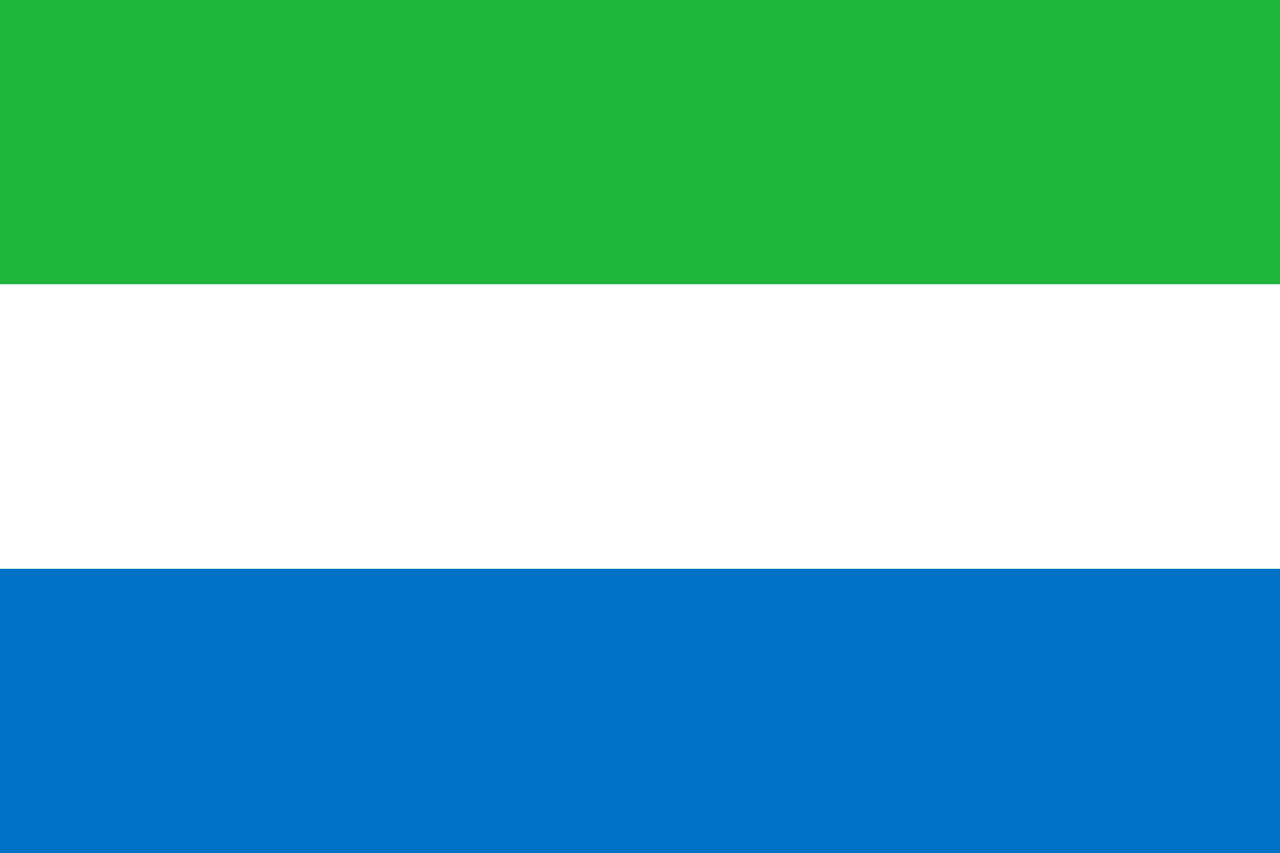
Few flags pack their entire national story into three quiet horizontal stripes, but the flag of Sierra Leone manages exactly that. Raised for the first time when the country gained independence from Britain in 1961, this green, white, and blue triband reads almost like a landscape: the forested hills, the open sky of peace, and the great natural harbor on the Atlantic that gave Freetown its reason to exist. There is nothing fussy about the design, and that restraint is part of its charm. It is a flag built to be understood at a glance, by a schoolchild or a sailor alike.
A Tricolor Born at Independence
Sierra Leone adopted its flag in 1961, the same year it stepped out from under British colonial rule and joined the family of independent African nations. The timing matters. Across the continent in that era, newly sovereign states were busy designing emblems that could replace imperial banners overnight, and many reached for bold, instantly recognizable patterns. Sierra Leone chose a simple horizontal arrangement of three equal bands rather than borrowing the pan-African red-gold-green palette that many of its neighbors favored. The result feels deliberately local, rooted in the geography of the place rather than in a shared continental slogan.
What the Three Colors Mean
Each stripe carries a distinct message, and together they sketch a portrait of the young republic. The meanings are official rather than decorative:
- Green sits at the top and stands for the country's agriculture and its mountains, a nod to the fertile, forested landscape that has long sustained its people.
- White occupies the central band and represents unity and justice, the civic ideals the new nation hoped to build upon.
- Blue runs along the bottom and honors the natural harbor of Freetown, one of the largest in the world, which has shaped Sierra Leone's history and economy for centuries.
It is worth pausing on that blue stripe. Plenty of national flags use blue for sea, sky, or rivers in a general way, but here it points to a specific, named place: the deep harbor that made Freetown a strategic Atlantic port. The flag is, in a small way, a piece of cartography.
Design and Layout
The construction could hardly be simpler. Three horizontal bands of equal height stack green over white over blue, with no central emblem, coat of arms, star, or stripe to interrupt them. This places Sierra Leone among the world's clean triband flags, a category that prizes clarity over ornament. The equal division gives each color the same visual weight, so no single idea dominates: agriculture, justice, and the harbor share the field as equal partners.
That plainness has practical virtues. A flag without intricate heraldry is easy to sew, cheap to reproduce, and unmistakable whether it is flying full size over a government building or printed thumbnail-small on a passport. It also reads correctly from a great distance, an underrated quality when a banner is snapping at the top of a pole or draped across a stadium.
Historical Background
To understand the flag, it helps to know the name on the map. Sierra Leone comes from Portuguese and is usually translated as "Lion Mountains," a name attributed to early Portuguese navigators who sailed along this stretch of the West African coast. Whether the lions in question were the literal beasts, the shape of the hills, or the roar of coastal thunderstorms is a matter of cheerful debate, but the mountainous green that crowns the flag echoes that ancient label.
The territory later became closely tied to the British, and Freetown grew as a settlement associated with the resettlement of freed people of African descent. By the mid-twentieth century, the global wave of decolonization had reached West Africa, and Sierra Leone moved toward self-government and then full independence in 1961. The flag was introduced at that moment of transition, a fresh symbol for a country writing the first chapter of its own sovereign history. Because it was designed for a clear purpose at a clear time, it has never needed a major redesign; the 1961 banner is essentially the flag that flies today.
Cultural Significance and National Identity
For Sierra Leoneans, the tricolor is shorthand for the nation itself. It appears on official documents, at embassies abroad, and on the uniforms and kit of national teams. Independence Day, marked each April, brings the green-white-blue out in force, draped from balconies and waved by crowds. Schoolchildren learn the meaning of the three stripes early, which is part of why a simple design endures: it is teachable. You can explain the whole flag in a single sentence about hills, justice, and the harbor.
The colors also turn up well beyond officialdom, painted on market stalls, stitched into clothing, and splashed across faces during football matches. A flag becomes a true national symbol not when a government adopts it but when ordinary people choose to wear it, and Sierra Leone's has crossed that line. Travelers curious about the wider country behind the banner can explore the sierra leone country guide for more on its geography and culture.
The Flag in Modern Life
Today the flag does the everyday work that national emblems do everywhere. It flies over the State House and government ministries, identifies Sierra Leonean diplomatic missions, and is hoisted at international gatherings where the country takes its seat. In sport, the green-white-blue follows the national football side, nicknamed in connection with the country's lion heritage, onto pitches across the region. At citizenship ceremonies, memorials, and civic celebrations, the tricolor provides a familiar focal point. Its consistency since 1961 means that a photograph of the flag from the early independence years is instantly recognizable to a Sierra Leonean scrolling past it on a phone today.
Interesting Facts at a Glance
- The flag has remained unchanged since its adoption in 1961, making it one of the more stable national emblems in West Africa.
- It uses no central symbol, coat of arms, or star, relying entirely on three colored bands.
- The country's name, "Lion Mountains," is reflected in the green stripe that honors its hills.
- The bottom blue band celebrates the harbor at Freetown, among the largest natural harbors anywhere.
- White appears in the middle rather than at the edge, a layout that frames unity and justice as the heart of the design.
Frequently Asked Questions
When was the flag of Sierra Leone adopted?
The flag was adopted in 1961, the year Sierra Leone became independent from Britain. It was introduced as the official national banner at independence and has been used without significant alteration ever since.
What do the colors of the Sierra Leone flag mean?
Green represents the country's agriculture and mountains, white symbolizes unity and justice, and blue honors the natural harbor of Freetown. Together the three equal bands summarize the nation's land, ideals, and coastal heritage.
What continent is Sierra Leone on?
Sierra Leone is in West Africa, on the Atlantic coast of the African continent. Its capital, Freetown, sits on a large natural harbor that the flag's blue stripe specifically commemorates.
How does the Sierra Leone flag compare to similar flags?
It belongs to the broad family of horizontal triband flags, sharing that clean three-stripe format with many nations. What sets it apart is its specific green-white-blue color order and meanings tied to local geography, rather than the pan-African red, gold, and green seen on several neighboring flags.