

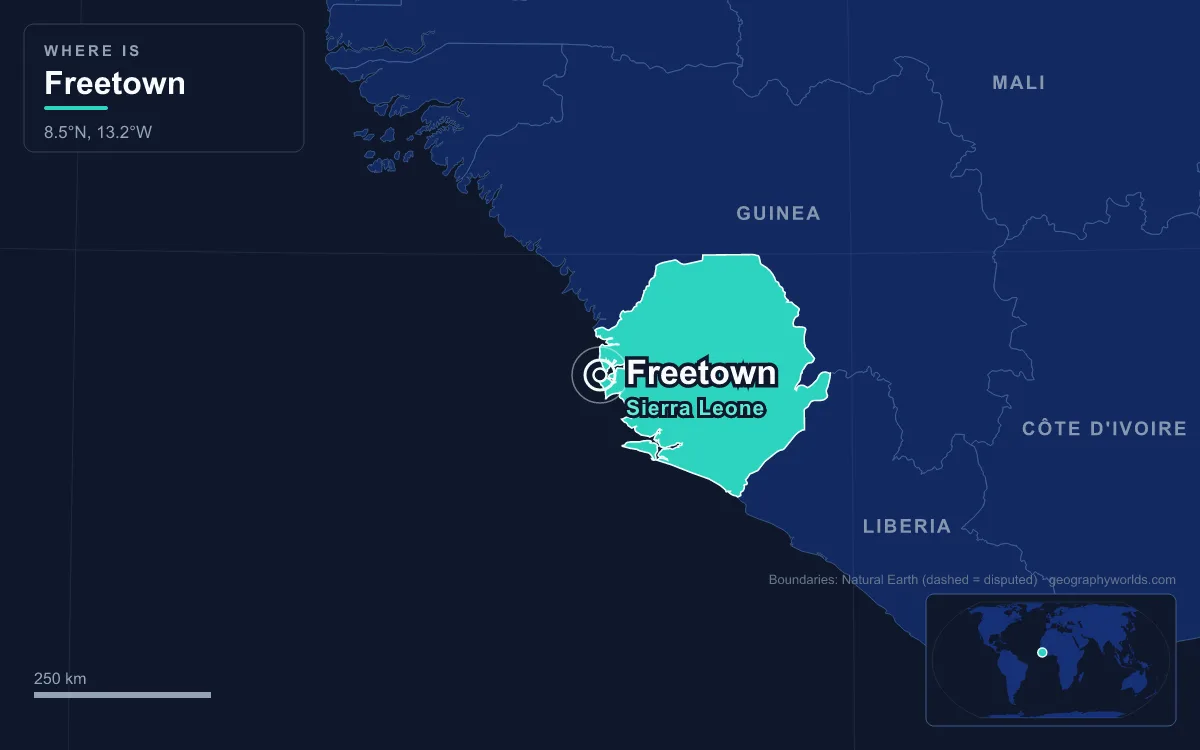
For more than two centuries Freetown was a city you could navigate by a single tree, until heavy rain brought most of it down on the night of 24 May 2023. Freetown is the capital and largest city of Sierra Leone, a port on the Atlantic coast of West Africa, set on the southern shore of the Sierra Leone River estuary with the forested hills of the Freetown Peninsula rising behind it. The 2024 census counted 1,347,559 people in the city. It was founded on 11 March 1792 by more than a thousand formerly enslaved Black Loyalists who had sailed from Nova Scotia, and the best way to understand it is through the handful of buildings and places that grew up around that first settlement.
The Cotton Tree and the Night It Fell in May 2023
When the Nova Scotian settlers came ashore in March 1792, Lieutenant John Clarkson, the Royal Navy officer and abolitionist who had recruited them, told the men to clear the land until they reached a large kapok, or cotton tree (Ceiba pentandra). Under its branches the preacher Nathaniel Gilbert gave a sermon, David George from South Carolina led what is recorded as the first Baptist service in Africa, and the settlement was christened Free Town, as the directors of the Sierra Leone Company had ordered. The tree was already mature: there are records of it from 1787, when an earlier group of settlers from London arrived, and its age was put at about 400 years.
It stood about 40 metres tall, with a girth of about 15 metres, in a roundabout at the heart of the old town, flanked by the Supreme Court and the Sierra Leone National Museum. The museum itself occupies the former Cotton Tree Telephone Exchange, which Governor Sir Robert Hall offered to the Sierra Leone Society in 1955; it opened on 10 December 1957, and its postal address was simply "Cotton Tree, Freetown". The tree appeared on a 1933 two-pence stamp and on the country's first banknotes in 1964, and thousands of fruit bats roosted in its crown.

Age caught up with it. The trunk had been braced with steel straps and concrete, it was scorched by lightning, and it caught fire in 2018 and again in January 2020. When the storm of May 2023 toppled most of it, President Julius Maada Bio called it the strongest symbol of the national story and ordered the fallen wood taken to a museum. A section of trunk survived, and a report in March 2024 described that remnant as healthy.
St George's Cathedral, Begun in 1817
A short walk from the roundabout stands St George's Cathedral, one of the grandest churches in Freetown. Work began in 1817 and finished in 1828, and it was built for the Church Missionary Society, the Anglican body that shaped much of nineteenth-century Freetown. It is now the cathedral of the Anglican Diocese of Freetown.
The congregation explains the building. After Britain made Freetown a Crown Colony in 1808, the Royal Navy squadron enforcing the ban on the Atlantic slave trade brought the people it freed from captured slave ships to Freetown. These Liberated Africans came from all along the West African coast, and together with the Nova Scotians, about 550 Jamaican Maroons who arrived in 1800, and soldiers who settled after the Napoleonic Wars, they became the Sierra Leone Creoles, or Krio. St George's became so closely tied to them that it was described as "that bastion of Creoledom". Their language, Krio, is today the city's lingua franca, spoken far beyond the Creole community, which forms only about 5 percent of Sierra Leone's population. From 1808 to 1874 Freetown also served as the capital of British West Africa, which is why so many colonial institutions of the region began here.
Fourah Bay College and Mount Aureol
The Church Missionary Society's other great project was education. On 18 February 1827, with the support of Governor Charles MacCarthy, it founded Fourah Bay College, the first Western-style university in sub-Saharan Africa. Its first student was Samuel Ajayi Crowther, who later became an Anglican bishop in West Africa. From 1876 to 1967 the college was affiliated with Durham University in England, and it drew students from across British West Africa. The concentration of schools earned colonial Freetown the nickname "Athens of Africa".
The college's first purpose-built home went up in Cline Town, in the east of the city. Governor William Fergusson laid the foundation stone in 1845, and construction was supervised by Edward Jones, an African American missionary from South Carolina who became the first principal. That building served the college until the Second World War, then became the headquarters of the Sierra Leone Government Railway and later a magistrates' court. It was declared a National Monument in 1955, fell out of use in 1990 and was gutted by fire in 1999.

The modern campus sits on Mount Aureol, high above the centre, and is a constituent college of the University of Sierra Leone. Davidson Nicol became its first Sierra Leonean principal in 1966, and the Institute of African Studies, begun the same year, relaunched the journal Sierra Leone Studies.
Tower Hill: From Fort Thornton to State House
The ridge called Tower Hill, just above the old town, has been the seat of power since the settlement's first years. Fort Thornton was built there between about 1792 and 1805 and named after Henry Thornton, the London banker who played a major part in founding the Sierra Leone Company. Inside it stood Government House, home of the British governors.
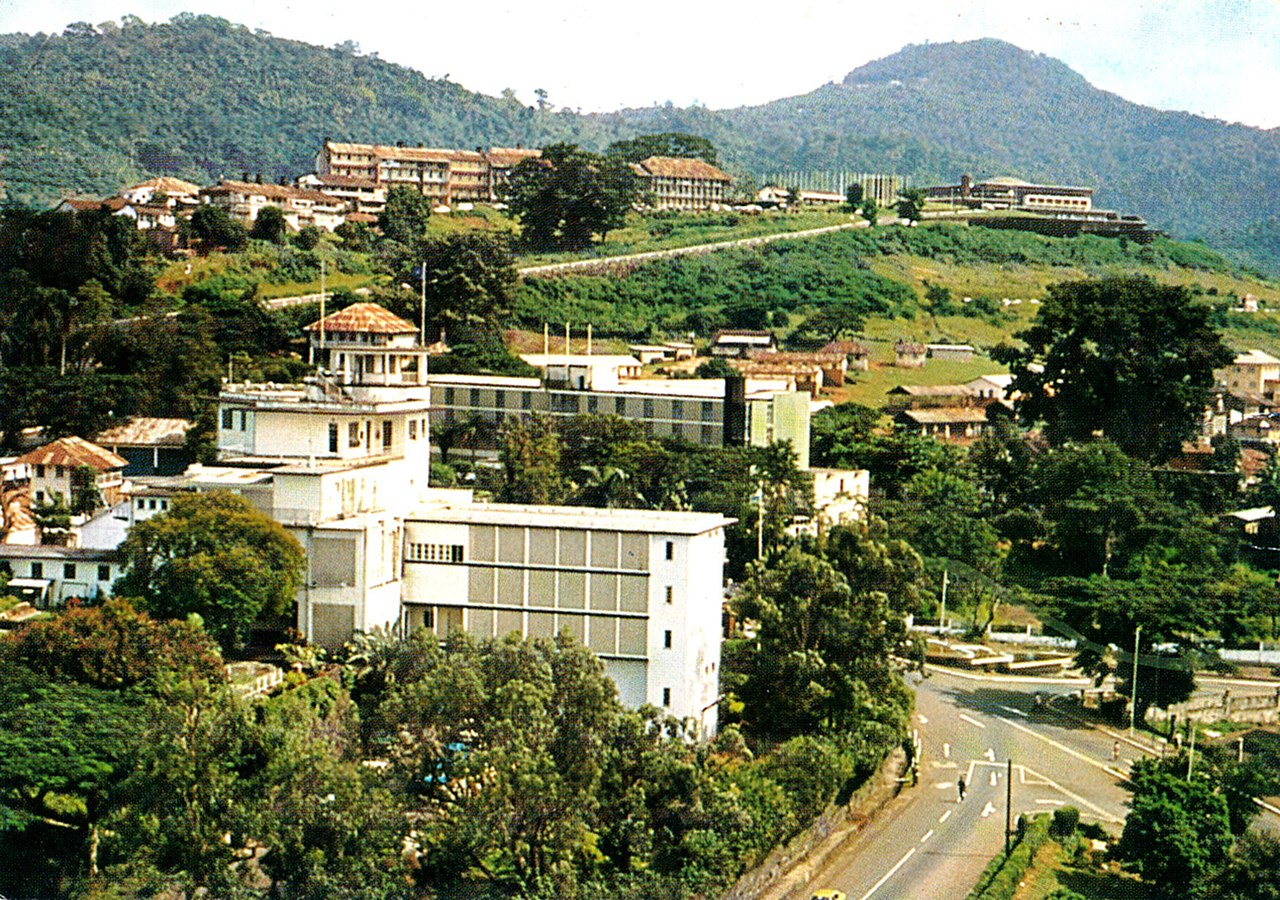
By the late 1940s the old house was considered near the end of its life, and in 1949 plans for a replacement were presented, drawn up by Robin Halliday Macartney of the Public Works Department. The new building was finished in 1954, and Governor Sir Robert Hall moved in that February. At his wish the old fortification walls were kept, declared National Monuments in 1949, and the lions on the gateposts were carried over from the earlier house. The design has two asymmetrical wings pivoting on a central tower that holds a spiral staircase above a mosaic of the world. Renamed State House, it served the prime minister from 1961, when Sierra Leone became independent, and the president from 1971. Today it is the president's principal workplace, and Sierra Leone's House of Parliament also sits on Tower Hill, while State Lodge, out in the West End neighbourhood of Hill Station, is described as the president's official residence.
Queen Elizabeth II Quay on the Sierra Leone River
Freetown exists because of its water. The Sierra Leone River estuary forms the largest natural harbour on the African continent, and the city's economy still turns on it. There are two harbours: the older Government Wharf close to the centre, and the larger Queen Elizabeth II Quay, which residents call the Deep Water Quay, on Fourah Point in Cline Town, east of downtown.
Construction of the quay began in 1953 on what was then Fourah Bay; by 1960 the whole bay had been filled in. The finished structure runs 1,067 metres end to end, with six berths for passenger and cargo ships and an allowance for a draught of about 9 metres. The government took over its management in 1964 and moved to privatise it in 2007. Fighting during the civil war of 1991 to 2002 did heavy damage, including a crater in berth 5 that was still being repaired a decade later. The harbour mattered in wartime too: in the Second World War Freetown was the assembly point for the SL convoys to Britain, and fighter aircraft landed at the port were sent inland by rail to Makeni to be assembled.
The National Railway Museum in Cline Town
That railway is the subject of the last landmark, also in Cline Town. The Sierra Leone Government Railway closed in 1974, but a collection of rolling stock was kept at the former workshops in Cline Town. It included one of the line's large Garratt locomotives, a Hunslet tank engine, the governor's coach and a coach prepared for Queen Elizabeth II's visit in 1961. Through the civil war the collection disappeared from view, and it was feared destroyed; in fact it survived while the workshops were used to shelter displaced people. Restoration began in 2004 at the initiative of a British army officer, Colonel Steve Davies, and the Sierra Leone National Railway Museum opened in 2005 with the backing of President Ahmad Tejan Kabbah. Alongside the engines are old photographs, tickets, maps and timetables.
The museum shows how much of Freetown's story is about recovery. The city was fought over in the late 1990s, taken by ECOWAS troops in 1998 to restore President Kabbah, and attacked again by the Revolutionary United Front. In August 2017 part of Sugar Loaf mountain collapsed after heavy rain, and the mudslide killed more than 300 people in Regent. Today the affluent West End, where Lumley Beach runs from Cape Sierra Leone to Lumley, draws visitors, while the East End wards around the quay hold most of the city's people. For the rest of the country, the Sierra Leone country guide takes the story beyond the peninsula, and there are shorter oddities in these facts about Sierra Leone; neighbouring Liberia's capital, founded by freed African Americans three decades later, makes a natural comparison in our guide to Monrovia.
Quick Facts About Freetown
- Country: Sierra Leone
- Continent: Africa (West Africa)
- Country population: approximately 9.0 million
- Capital city status: Freetown is the capital of Sierra Leone, the seat of national government, and the location of foreign embassies, parliament, and the head of state's official residence.
Frequently Asked Questions
What is the capital of Sierra Leone?
The capital of Sierra Leone is Freetown. Freetown is the seat of national government, hosts most foreign embassies and consulates, and is typically where the head of state and parliament are located.
What continent is Freetown in?
Freetown, the capital of Sierra Leone, is located in Africa, in the West Africa region. As Sierra Leone's capital, Freetown serves as the country's primary connection to the broader African political, economic, and cultural sphere.
Why is Freetown the capital of Sierra Leone?
Freetown was chosen as the capital of Sierra Leone for reasons that typically combine geography, history, and politics. Capital city selections often reflect a desire for centrality (being accessible from across the country), historical importance (being a longstanding seat of government or culture), or neutrality (being acceptable to multiple regions or ethnic groups within the country). The specific reasons for Freetown's designation are detailed in the city's history above.
What is Freetown known for?
As the capital of Sierra Leone, Freetown is best known for housing the country's central government institutions — parliament, presidential or royal residences, supreme court, and key ministries. It is also typically a major cultural and economic center within Sierra Leone, hosting national museums, embassies, and signature monuments. The introduction and history sections above provide detailed coverage of the city's specific notable institutions and landmarks.
Related Pages
- Sierra Leone Country Guide — full geography, climate, economy, and culture overview
- Flag of Sierra Leone — meaning, history, and design of Sierra Leone's national flag