
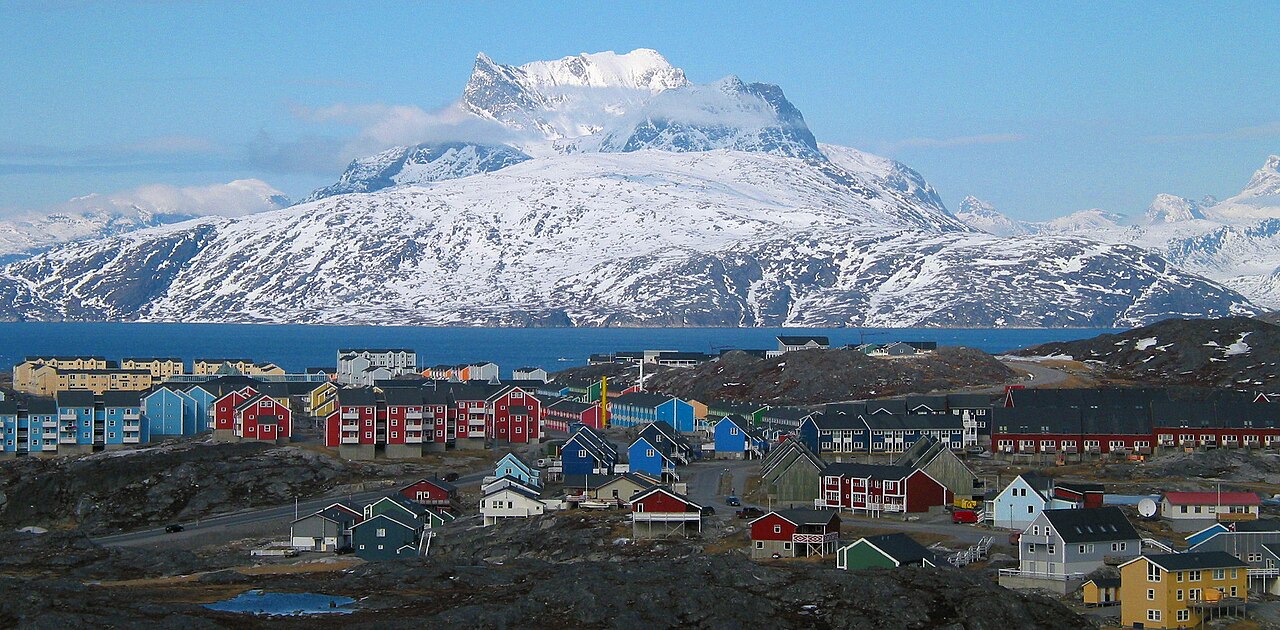
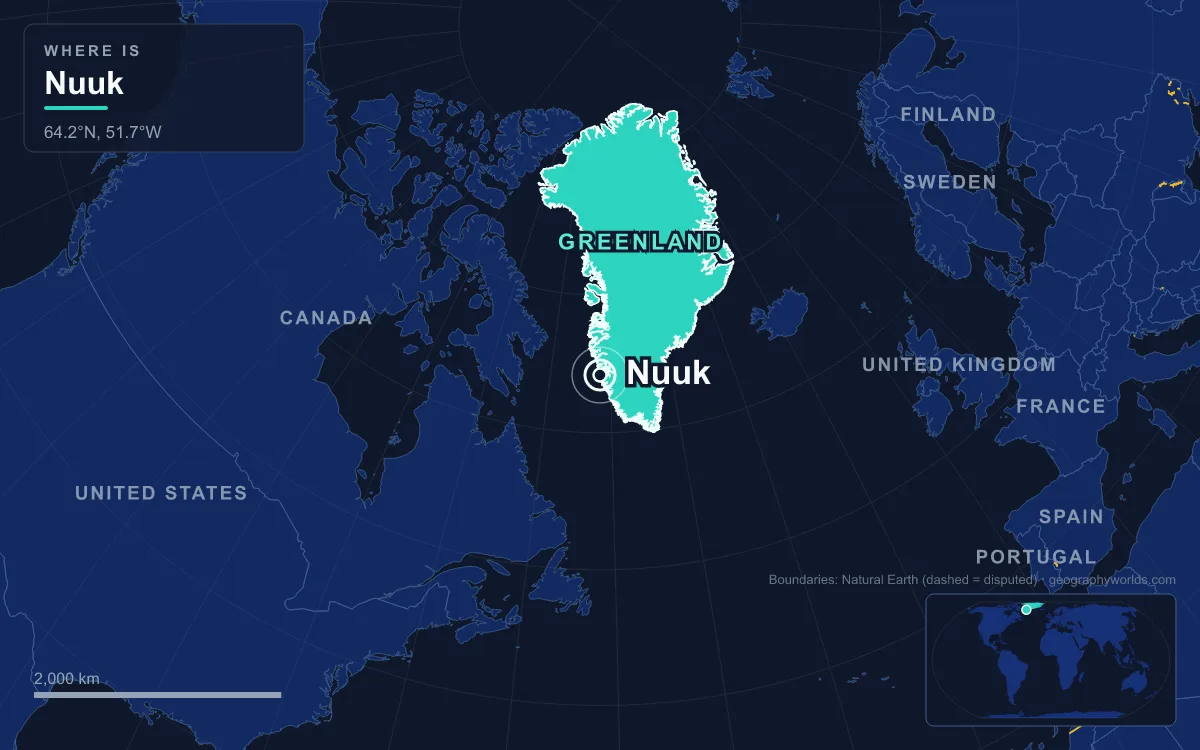
About 20,000 people, more than a third of Greenland’s entire population, live in Nuuk, the capital and largest town of Greenland, a self-governing territory within the Kingdom of Denmark. The January 2025 count was 20,113. The town sits at the mouth of the Nuup Kangerlua fjord on Greenland’s southwest coast, about 240 kilometres south of the Arctic Circle, and it is one of the smallest capitals in the world. Its name is Greenlandic for “cape”; until 1979 it was officially the Danish Godthåb, “good hope”. Nuuk is best understood through the people who have lived here: Paleo-Inuit hunters, Norse farmers, a Norwegian missionary, a garrison of convict colonists, Moravian Brethren, Danish planners, and the Inuit majority who now govern Greenland from this town.
Saqqaq, Dorset and Thule: Four Thousand Years at Nuup Kangerlua
The first people here were not Inuit. Around 2200 BCE, hunters of the Saqqaq culture were living near the now-abandoned settlement of Qoornoq in the fjord. The Saqqaq were the earliest known culture of southern Greenland, lasting from about 2500 to 800 BCE. They were followed by people of the Dorset culture, who lived around the former settlement of Kangeq at the fjord mouth and had disappeared from the Nuuk district before 1000 CE.
The ancestors of today’s Greenlanders arrived later. The Thule people developed in coastal Alaska by about 1000 CE and spread east across Arctic Canada, reaching Greenland by the 13th century. Every modern Inuit community in Greenland, including the Kalaallit of the west coast around Nuuk, descends from them. The fjord suited sea-mammal hunters. It runs inland for a long way, splitting into three arms around the islands of Sermitsiaq, Qeqertarsuaq and Qoornuup Qeqertarsua, and the peak of Sermitsiaq, 1,210 metres high and 20 kilometres northeast of town, can be seen from almost everywhere in Nuuk.
The Western Settlement: Norse Farmers from About 985
Around 985, Norse settlers from Iceland founded a second colony far up the Nuup Kangerlua. They called it the Western Settlement, although it lay more to the north than the west of its larger partner, the Eastern Settlement in the far south. Archaeologists have found the ruins of almost 95 farms, the largest at a site called Sandnæs, and at its peak the settlement probably held about 1,000 people. That was roughly a quarter of the Eastern Settlement, because the growing season this far north was shorter.
The medieval sources say little about these farmers, and their ending is murky. In the mid-14th century a Norwegian cleric, Ivar Bardarson, sent to Greenland in 1341 and later acting head of its diocese, travelled to the Western Settlement and found only empty farms. By 1360 he was back in Bergen. The Norse presence in Greenland as a whole died out during the 15th century, for reasons that are still debated. The Inuit remained.
Hans Egede, Claus Paarss and the Founding of Godthaab
Modern Nuuk began with a man looking for people who were no longer there. Hans Egede was a Norwegian Lutheran priest who heard stories in the Lofoten islands about the lost Norse colonies of Greenland. On 2 May 1721 he sailed from Bergen on the ship Haabet, “The Hope”, with his wife, four children and about forty colonists. On 3 July they reached Nuup Kangerlua and set up the Hope Colony on Kangeq Island. Egede searched the coast for descendants of the Norse and found only the Kalaallit, so he set about learning their language to preach to them instead.
In 1728 a royal expedition under Major Claus Paarss arrived with four supply ships and moved the colony to the mainland, to the Inuit settlement of Nûk, where they built a fort named Godt-Haab. Paarss’s colonists were mutinous soldiers, convicts and prostitutes, and within the first year most had died of scurvy and other diseases. Worse followed. A smallpox epidemic that broke out in 1733 killed most of the local Inuit population and, by 1735, Egede’s wife Gertrud as well. Egede went home to Denmark in 1736 after 15 years, leaving his son Poul to carry on.

Godthaab became the seat of the colony of South Greenland, while Godhavn, today’s Qeqertarsuaq, governed North Greenland until the two administrations were joined in Godthaab in 1940. The colonial core survives in Old Nuuk by the harbour. Hans Egede’s House, described as Greenland’s oldest building, is now used for government receptions. Nearby is the red wooden Church of Our Saviour, consecrated on 6 April 1849, which became Nuuk Cathedral in the 1990s.
New Herrnhut: How the Moravians Drew Greenlanders to Nuuk
A second group of missionaries did more to fill the town. In 1733 the Moravian Brethren, a Protestant missionary church, got permission to work in Greenland. By 1747 they had enough converts to build a mission house and formally found New Herrnhut next to the Danish colony. It became the nucleus of present-day Nuuk, as many Greenlanders from the southeast coast left their territory to live at the mission station. From this base the Moravians founded Lichtenfels in 1748, Lichtenau in 1774 and three more stations before their work in Greenland was ended in 1900 and folded into the Danish Lutheran Church.
Missionaries also shaped written Greenlandic, which has used the Latin alphabet since colonisation began in the 1700s. Poul Egede compiled the first Greenlandic dictionary in 1750, and Samuel Kleinschmidt devised the first orthography in 1851. In 1853 the Danish official Hinrich Johannes Rink arrived and was struck by how far Greenlandic culture had been pushed aside. In 1861 he founded Atuagagdliutit, Greenland’s first newspaper, based in Nuuk and edited by a Greenlander. It became an important symbol of Greenlandic identity.
Blok P and the Danish Planners of the 1950s and 1960s
The biggest change to the town’s population came in the 20th century. The 1953 Danish constitution ended Greenland’s status as a colony and made it part of the Danish state. That same year the Folketing, the Danish parliament, launched a programme to modernise Greenland by moving people out of small coastal settlements, which were considered unprofitable and unhealthy, into larger towns. Nuuk boomed. Its symbol was Blok P, built in 1965–1966, which held about 320 flats and at one point housed around 1 percent of Greenland’s entire population. When it went up, it was the largest building project in the Kingdom of Denmark.
It was also a poor fit for the people moved into it. Doorways were too narrow for residents in heavy winter clothing, and wardrobes were too small for fishing and hunting gear, which ended up on the balconies and blocked the fire exits. Blok P was demolished on 19 October 2012. Many tenants were offered new homes in Qinngorput, a district about 5 kilometres from the centre that was incorporated into the city in 2005 and now has the youngest average age in town.
Inuit, Danes and Newcomers in Today’s Nuuk
The modernisation drive and the jobs that came with self-government have kept Nuuk growing. Its population doubled between 1977 and 2024 and has risen by more than a third since 1990.
Nuuk is also the most Danish town in Greenland. Good jobs with high wages keep attracting people from Denmark, and in 2015 some 3,826 residents had been born outside Greenland. Half of all Greenland’s immigrants live in Nuuk, alongside a quarter of the country’s native-born population. Across Greenland as a whole, almost 90 percent of people are Inuit. In 2016 a Guardian article on indigenous influence in cities argued that tiny Nuuk might be the most indigenous city in the world. A resident of the town is a Nuummioq.

The town keeps its older inhabitants close. The Greenland National Museum opened its first exhibition in 1965 in the old Moravian mission house and moved in the 1970s to a 1936 warehouse in the colonial harbour, where its collection grew with Inuit objects returned from the National Museum of Denmark. Its best-known exhibits are the Qilakitsoq mummies. Eight bodies from the Thule period, buried around 1475, were found at an abandoned settlement on the Nuussuaq Peninsula far to the north; the museum displays three women and a six-month-old child.
Kalaallisut, Home Rule in 1979 and Self-Rule in 2009
The Inuit majority took political control step by step, and Nuuk was where it happened. In a referendum on 17 January 1979, Greenlanders voted for home rule, which took effect on 1 May that year. The new authorities took control of place names and chose Greenlandic ones over Danish, so Godthåb became Nuuk. On 21 June 2009 self-rule followed, handing Greenland responsibility for its courts, policing and natural resources. In June 2009 the government also made Greenlandic, or Kalaallisut, the sole official language, to protect it against Danish. About 57,000 people speak it as a first language, making it the largest language of the Eskaleut family.
Almost every institution of that self-government is here. The 31-seat parliament, the Inatsisartut, sits in Nuuk, and every major party has its headquarters in the town. Ilisimatusarfik, the University of Greenland and the country’s only university, was founded in 1987. Most of its courses are still taught in Danish, with a few in Kalaallisut. The Katuaq cultural centre, opened on 15 February 1997, has two auditoriums, an art school, a library and a café.
Shrimp Trawlers, Buksefjord Power and a Longer Runway
The trades that support the town connect it to the sea and to Denmark. Nuuk is home to almost half of Greenland’s fishing fleet, and its Royal Greenland processing plant takes in more than 50 million Danish kroner of seafood a year, about 80 percent of it shrimp. Container ships of the Royal Arctic Line bring clothing, flour, medicine and timber from Aalborg and return with frozen shrimp and fish. Since 1993 the town’s electricity has come mainly from the Buksefjord hydroelectric plant, along a line that crosses the Ameralik fjord in a single span of 5,376 metres, the longest free span in the world. The public sector is still the largest employer, and Greenland relies on block funding from Denmark.
No road links Nuuk to any other town, so the airport, 4 kilometres northeast of the centre, is the town’s real gateway. Built in 1979 with a 950-metre runway, it was rebuilt between 2019 and 2024 with a longer runway and a new terminal. It now has direct flights to Copenhagen and Keflavík, and seasonal routes to New York–Newark and Iqaluit in Arctic Canada.
Keflavík leads to Nuuk’s only rival for the title of northernmost capital, described in our guide to Reykjavík. Behind the town lies the ice that covers most of the island, explained in our guide to the Greenland ice sheet, and the rest of the country is covered in the Greenland country guide.
Quick Facts About Nuuk
- Country: Greenland
- Continent: North America
- Country population: approximately 56 thousand
- Capital city status: Nuuk is the capital of Greenland, the seat of national government, and the location of foreign embassies, parliament, and the head of state's official residence.
Frequently Asked Questions
What is the capital of Greenland?
The capital of Greenland is Nuuk. Nuuk is the seat of national government, hosts most foreign embassies and consulates, and is typically where the head of state and parliament are located.
What continent is Nuuk in?
Nuuk, the capital of Greenland, is located in North America. As Greenland's capital, Nuuk serves as the country's primary connection to the broader North American political, economic, and cultural sphere.
Why is Nuuk the capital of Greenland?
Nuuk was chosen as the capital of Greenland for reasons that typically combine geography, history, and politics. Capital city selections often reflect a desire for centrality (being accessible from across the country), historical importance (being a longstanding seat of government or culture), or neutrality (being acceptable to multiple regions or ethnic groups within the country). The specific reasons for Nuuk's designation are detailed in the city's history above.
What is Nuuk known for?
As the capital of Greenland, Nuuk is best known for housing the country's central government institutions — parliament, presidential or royal residences, supreme court, and key ministries. It is also typically a major cultural and economic center within Greenland, hosting national museums, embassies, and signature monuments. The introduction and history sections above provide detailed coverage of the city's specific notable institutions and landmarks.
Related Pages
- Greenland Country Guide — full geography, climate, economy, and culture overview
- Flag of Greenland — meaning, history, and design of Greenland's national flag