

At 64°08′ north, Reykjavík is the northernmost capital of any sovereign state. It is the capital and largest city of Iceland, on the southern shore of Faxaflói bay in the southwest of the island. The city had 139,804 residents on 1 January 2026, and the Capital Region around it, Reykjavík plus six neighbouring municipalities, is home to about 252,000, or roughly 64 percent of everyone in Iceland. Almost everything about the city is a matter of proportion: a small capital by world standards that is enormous compared with the rest of its country, a far-northern city with milder winters than its latitude suggests, and a place settled in the 9th century that was not a town until 1786. The numbers below show how those contrasts play out.
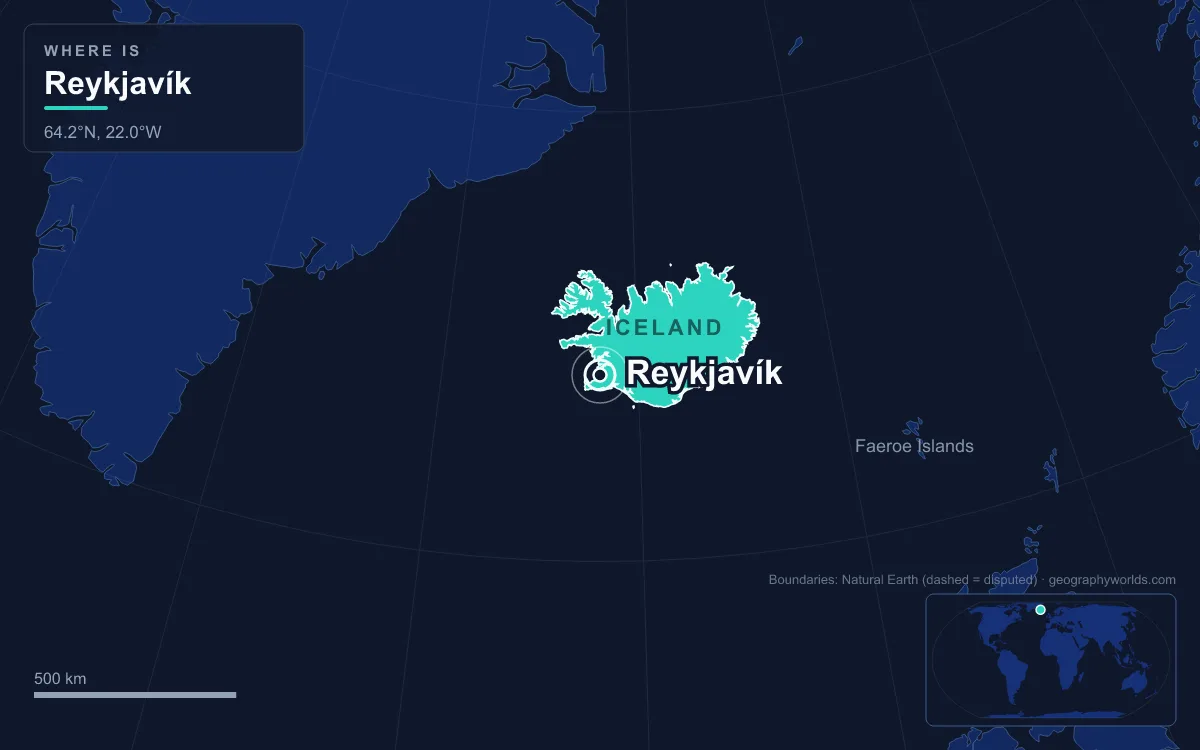
64°08′ North: Four Kilometres Short of Nuuk
Reykjavík lies about two and a half degrees south of the Arctic Circle. Only one capital lies further north: Nuuk, the capital of Greenland, at about 64°10′, roughly 4 kilometres closer to the pole. Greenland is a self-governing part of the Kingdom of Denmark, not an independent state, which is why Reykjavík keeps the record for sovereign capitals. Nuuk’s airport has direct flights to Keflavík, so the two northernmost capitals are only a short hop apart.
That latitude produces the most dramatic contrast in the city’s year. From 20 May to 24 July the sun never sinks more than 5 degrees below the horizon, so it never gets properly dark. Between 2 December and 10 January the day lasts less than five hours, and the sun rises no more than 3 degrees above the horizon. The monthly sunshine totals follow the same curve: the 1991–2020 averages range from 12.6 hours in December and 22.6 in January to 209 hours in May. Oddly, May is sunnier than June or July, which bring more cloud.
139,804 People in a Country of About 394,000
By any global measure Reykjavík is small: 139,804 people on 244 square kilometres. Inside Iceland, though, it is overwhelming. With about 394,000 people in the whole country in 2026, the city alone holds more than a third of the nation, and its metropolitan region nearly two-thirds. The next-largest municipalities are Reykjavík’s own suburbs: Kópavogur, with 40,040 people in 2025, and Hafnarfjörður, with 31,525. Outside the capital area, no municipality comes close.
The city is also changing faster than the country. On 1 January 2026, first- and second-generation immigrants made up 37,348 of Reykjavík’s residents, or 26.7 percent. In 1998 the figure was 3,106, just 2.9 percent, and it was still 10.4 percent in 2008. The most common foreign citizenships are Polish, Lithuanian, Ukrainian and Romanian, and roughly half of the city’s foreign residents come from countries that joined the European Union in 2004 or later. Nationally, Statistics Iceland counted 77,226 immigrants in 2026, or 19.6 percent of the population.
Its skyline, by contrast, is low, and its best-known landmark is a church. Hallgrímskirkja, on the Skólavörðuholt hill near the centre, rises 74.5 metres, which makes it the largest church in Iceland and the second-tallest building in the country. The state architect Guðjón Samúelsson was commissioned to design it in 1937, and he is said to have based its stepped concrete flanks on columns of basalt like those at Svartifoss. It took until 1986 to finish.

Akureyri, the Rival in the North
Iceland has one real city and one serious rival. Akureyri sits at the head of the Eyjafjörður fjord on the north coast and calls itself the “Capital of North Iceland”. It is the country’s fifth-largest municipality and the largest outside the Capital Region, with 20,284 people in 2026. That is about one-seventh the size of Reykjavík and about half the size of Kópavogur, which is itself a suburb of the capital.
The two towns share a starting date. Akureyri received its municipal charter in 1786, the same year Reykjavík got its trading charter, and both grew after World War II as Icelanders left farms for towns. The difference is that Reykjavík also got the parliament, the government and the international gateway, and the gap only widened. Akureyri’s strengths are its port and fishing, and a climate that is relatively mild for its position at the edge of the Arctic.
874 Versus 1786: A Settlement Nine Centuries Older Than Its Town
The Book of Settlement says Iceland’s settlement began here. According to that story, the Norwegian chieftain Ingólfr Arnarson threw his high-seat pillars overboard as he approached the coast and vowed to build wherever the gods brought them ashore. Two of his slaves searched for three years before finding them in this bay. The traditional date is 874. The name comes from the Old Norse reykr, “smoke”, and vík, “bay”, and is said to have been inspired by steam rising from the area’s hot springs.
For more than 900 years there was no town at all, only farms. In 1752 King Frederik V of Denmark gave the Reykjavík estate to the Innréttingar, a company led by Skúli Magnússon, and its wool workshops became the first real employer. In 1786 the Danish Crown ended its trade monopoly and gave six communities trading charters. Reykjavík was the only one to keep its charter permanently, which is why 1786 counts as its founding year.
Political weight followed later, and in stages. The Althing, the general assembly founded in 930 at Þingvellir, had been suspended; in 1845 it was re-established in Reykjavík as an advisory body. That move made the town Iceland’s capital in all but name. A constitution came in 1874, home rule and a minister for Iceland based in Reykjavík in 1904, and on 1 December 1918 Iceland became a sovereign kingdom in personal union with Denmark. In 1944 the Republic of Iceland was founded, and its president’s office was placed in Reykjavík.
From the 1940 Occupation to the 1986 Höfði Summit
On the morning of 10 May 1940, a month after Germany occupied Denmark and Norway, four British warships anchored in Reykjavík harbour. Within a few hours the occupation was complete, without armed resistance; local taxi and truck drivers even helped the troops, who had arrived with no vehicles. For the rest of the war British and then American soldiers were based in and around the city, and at times they were about as numerous as the townspeople. The occupation ended the unemployment of the Depression years. The British built Reykjavík Airport, still used for domestic flights and flights to Greenland, and the Americans built Keflavík, about 40 to 50 kilometres southwest of the city, which became the country’s main international airport.

After the war the city grew quickly, as better farm machinery sent rural families to the capital and new suburbs of apartment blocks spread outwards. Twice the small city found itself at the centre of world news. In 1972 it hosted the World Chess Championship between Bobby Fischer and Boris Spassky. In 1986 Ronald Reagan and Mikhail Gorbachev met at Höfði, a house built in 1909 for the French consul. The summit ended without an agreement, but it is remembered as an important step towards the end of the Cold War.
0.7 °C in January, 11.6 °C in July
Reykjavík’s climate is the biggest surprise of all. It is classed as subpolar oceanic. Warm water from the North Atlantic Current keeps winters mild, and the 1991–2020 mean for January is just 0.7 °C. Its winter temperatures are comparable to those of New York City, which lies more than 20 degrees further south. Temperatures very rarely fall below −15 °C. The trade-off is summer. With the city open to cool sea winds, the July mean is only 11.6 °C, and daytime temperatures of 10 to 15 °C are normal, much cooler than places at similar latitudes in mainland Scandinavia.
The records show how narrow the range is. The highest temperature ever measured in the city is 25.7 °C, on 30 July 2008. The lowest is −24.5 °C, on 21 January 1918, and the coldest month on record was January 1918, averaging −7.2 °C. The city is wet and windy rather than frozen. It averages 147 days a year with more than 1 millimetre of rain, and winter gales are common because of the Icelandic Low, a semi-permanent area of low pressure over the North Atlantic.
Reykjavík Energy and the Steam That Named the Bay
The same volcanic heat that gave the city its name now keeps it warm. Every building in Reykjavík is heated with geothermal water, and roughly 90 percent of buildings across Iceland are heated the same way. The hot water also fills the city’s many public pools and hot tubs, and in the busiest parts of the centre it runs under pavements and streets to melt the snow. Many private driveways have the same system. A public heating utility has operated since 1930. Since 1999 heating and electricity, joined by water in 2000, have been run by Orkuveita Reykjavíkur, Reykjavík Energy, which is 93.5 percent owned by the city and serves 20 communities in the southwest.
For a capital that sits 4 kilometres south of the northernmost one, that underground heat is what makes the numbers work. To compare Reykjavík with its only rival for the northernmost title, read our guide to Nuuk, the capital of Greenland. The weather beyond the capital is covered in the climate of Iceland, and the island as a whole in our Iceland country guide.
Quick Facts About Reykjavik
- Country: Iceland
- Continent: Europe (Northern Europe)
- Country population: approximately 402 thousand
- Capital city status: Reykjavik is the capital of Iceland, the seat of national government, and the location of foreign embassies, parliament, and the head of state's official residence.
Frequently Asked Questions
What is the capital of Iceland?
The capital of Iceland is Reykjavik. Reykjavik is the seat of national government, hosts most foreign embassies and consulates, and is typically where the head of state and parliament are located.
What continent is Reykjavik in?
Reykjavik, the capital of Iceland, is located in Europe, in the Northern Europe region. As Iceland's capital, Reykjavik serves as the country's primary connection to the broader Europen political, economic, and cultural sphere.
Why is Reykjavik the capital of Iceland?
Reykjavik was chosen as the capital of Iceland for reasons that typically combine geography, history, and politics. Capital city selections often reflect a desire for centrality (being accessible from across the country), historical importance (being a longstanding seat of government or culture), or neutrality (being acceptable to multiple regions or ethnic groups within the country). The specific reasons for Reykjavik's designation are detailed in the city's history above.
What is Reykjavik known for?
As the capital of Iceland, Reykjavik is best known for housing the country's central government institutions — parliament, presidential or royal residences, supreme court, and key ministries. It is also typically a major cultural and economic center within Iceland, hosting national museums, embassies, and signature monuments. The introduction and history sections above provide detailed coverage of the city's specific notable institutions and landmarks.
Related Pages
- Iceland Country Guide — full geography, climate, economy, and culture overview
- Flag of Iceland — meaning, history, and design of Iceland's national flag