

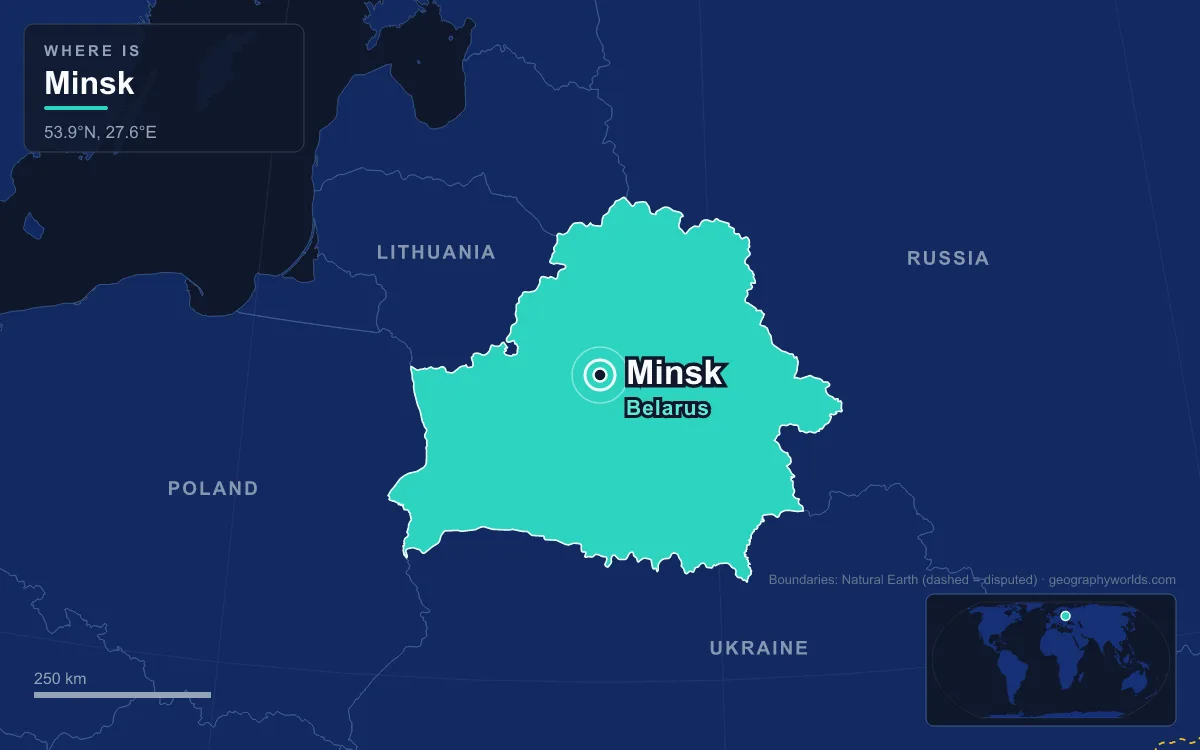
Minsk is the capital and largest city of Belarus, home to about two million people in 2026, which makes it the 11th-most populous city in Europe. It sits near the middle of the country on the Svislach River, on the southeastern slope of the Minsk Hills at an average height of about 220 metres. Its defining feature is that almost none of it is old: first recorded in 1067, the city was about 80% rubble by July 1944, and what stands today is a planned Soviet capital of broad avenues laid over a medieval street plan, later inherited by independent Belarus in 1991.
The Nemiga Battle and the Polotsk Princes (1067–1242)
Minsk enters written history through violence. The Primary Chronicle names it, as Měneskъ, in its entry for 1067, in connection with the Battle on the River Nemiga, and city authorities have fixed 3 March 1067 as the official founding date. The town was already fortified with wooden walls by then, so the real settlement is older. It lay on the Svislach valley, which had been the boundary between two East Slavic tribes, the Krivichs and the Dregoviches, and by 980 the area had been drawn into the Principality of Polotsk, one of the earliest principalities of Kievan Rus'.
The name itself is uncertain. One theory ties it to the Menka River, a tributary of the Ptsich; another links it to the word that survives in Russian as menyat, to barter or exchange, which would make Minsk a market place by name. The form with an i only appeared in the 16th century in Latin and Polish documents, while the Belarusian form Miensk survived in speech and was official in the Belarusian SSR until 1939.
In the early 12th century Polotsk broke into smaller fiefs, and one of its princes set up a separate Principality of Minsk. Kiev annexed it in 1129, but the Polotsk dynasty took it back in 1146, and by about 1150 Minsk rivalled Polotsk itself as the main city of the region. The Nyamiha stream, where the 1067 battle was fought, still flows under the city centre, now buried underground.

Magdeburg Rights and the Minsk Voivodeship (1242–1793)
Minsk avoided the Mongol invasion of Rus in 1237–1239, and in 1242 it joined the expanding Grand Duchy of Lithuania, apparently peacefully, with local elites keeping high rank. After the union of Lithuania and Poland in 1413 the town became the centre of a province, and in 1499 Alexander Jagiellon granted it town privileges under Magdeburg law, the legal charter that gave it its own council and courts.
The Union of Lublin in 1569 folded the Grand Duchy and Poland into a single Polish–Lithuanian Commonwealth, and from that year Minsk was capital of the Minsk Voivodeship. By the middle of the 16th century it was an important economic, cultural and Orthodox centre, and the Catholic and Eastern Catholic churches grew stronger after the Union of Brest. Two of the churches that still shape the Upper Town date from this period: the former Bernardine church built in 1642–1687, now the Orthodox Cathedral of the Holy Spirit, and the Jesuit church of 1700–1710, now the Cathedral of Saint Mary, which faces the restored 18th-century city hall across Freedom Square.
Across the river, the Trinity Suburb on the left bank of the Svislach was the trade and administrative quarter. Its name most likely comes from a Catholic Church of the Trinity founded by Jogaila in 1390, and a settlement of Lipka Tatars, first recorded in 1428, grew up at its northwestern edge.
War then emptied the town. Troops of Tsar Alexis took Minsk in 1655 and held it until 1660; by the end of that war it had only about 2,000 residents and 300 houses. During the Great Northern War it was occupied again in 1708 and 1709, first by Charles XII of Sweden and then by Peter the Great. By the late 18th century it was a small provincial town of little military or economic weight.
Governorate Town and Rail Junction (1793–1914)
The Second Partition of Poland handed Minsk to the Russian Empire in 1793, and in 1796 it became the seat of the Minsk Governorate. Napoleon's Grande Armée briefly held it in 1812.
The 19th century was when Minsk became a real city. Streets were cobbled in the 1830s, a public library opened in 1836 and the first theatre in 1844. By 1860 the population had reached 27,000. Transport then did the rest: the Moscow–Warsaw road came through in 1846, the Moscow–Warsaw railway in 1871, and the Romny–Libava line from Ukraine to the Baltic in 1873, which turned Minsk into a rail junction and a manufacturing town. Piped water arrived in 1872, telephones in 1890, a horse tram in 1892 and the first power generator in 1894. By 1900 there were 58 factories employing 3,000 workers.
The 1897 Russian census counted about 91,000 inhabitants, and Jews made up just over half of them. Russian was the mother tongue of about a quarter of residents, Polish of 11.4% and Belarusian of only 9%. The city was also politically lively: the first congress of the Russian Social Democratic Labour Party, forerunner of the Bolsheviks, met in Minsk in 1898, and Minsk, alongside Vilnius, was one of the major centres of the Belarusian national revival.
Front Line and Six Changes of Control (1915–1921)
The First World War put Minsk on the front line by 1915. It became the headquarters of the Russian army's Western Front, factories closed and residents left for the east. After the Treaty of Brest-Litovsk, German forces occupied the city on 21 February 1918, and on 25 March 1918 Minsk was proclaimed capital of the Belarusian People's Republic, a short-lived national republic declared under German occupation.
That republic did not last the year. The Red Army took Minsk in December 1918, and in January 1919 the city was declared capital of the Byelorussian SSR. Polish forces then held it during the Polish–Soviet War, from 8 August 1919 to 11 July 1920 and again from 14 October 1920 to 19 March 1921. The Treaty of Riga finally left Minsk on the Soviet side, and in 1922 the Byelorussian SSR became one of the founding republics of the Soviet Union, with Minsk as its capital.
Soviet Capital, Ghetto and Rubble (1922–1944)
A reconstruction programme began in 1922, and by 1924 there were 29 factories running again. Through the 1920s and early 1930s Belarusian was the main language of administration and education in the city, before Russian regained ground from the late 1930s. On the eve of the Second World War, Minsk had roughly 239,000 to 300,000 people, depending on the source and date.
German forces captured the city in the Battle of Białystok–Minsk in late June 1941, after heavy bombing. Minsk became the administrative centre of Generalbezirk Weißruthenien, and on 20 July 1941 the occupiers established the Minsk Ghetto, the largest in the German-occupied Soviet Union, which held close to 100,000 Jews, most of whom were murdered. By 1942 the city had also become a major centre of the Soviet partisan movement, the reason it was named a Hero City in 1974.
The Red Army retook Minsk on 3 July 1944 during Operation Bagration. By then factories, power stations, bridges, most roads and 80% of the houses had been destroyed, and the population had fallen to about 50,000.
Independence Avenue and the Million Mark (1944–1991)
Minsk was not restored; it was redrawn. In the 1940s and 1950s the historic centre was replaced by Stalinist architecture of grand buildings, wide squares and broad avenues. The spine of that plan is today's Independence Avenue, which runs about 15 kilometres northeast from the centre, crosses five squares (Independence, October, Victory, Yakub Kolas and Kalinin) and has been renamed 14 times. Its 1940s–1950s architectural ensemble is on UNESCO's World Heritage Tentative List.
Industry drove the growth. Minsk Automobile Plant was set up in 1944, Minsk Tractor Works in 1946, the Horizont television maker in 1950 and the Atlant refrigerator plant in 1959. Western geographers even coined the term Minsk phenomenon for the Soviet emphasis on research-intensive industry in urban development. Young workers poured in from rural Belarus, along with skilled migrants from elsewhere in the USSR, and villages on the edge were rebuilt as mikroraions of dense apartment blocks. The city passed one million people in 1972 and 1.5 million in 1986.
Construction of the Minsk Metro began in 1977, and the first line opened in June 1984, the ninth metro system in the Soviet Union. It kept expanding through the 1990s, unlike those of Yerevan or Samara, and today has 3 lines and 36 stations over about 45 kilometres.
Capital of Independent Belarus (1991–today)
When the Soviet Union dissolved, Minsk became the capital of the Republic of Belarus. Embassies opened, Soviet administrative buildings became government offices, and Minsk was named one of the administrative capitals of the Commonwealth of Independent States; it is also one for the Eurasian Economic Union. The early 1990s brought an economic crisis and stalled projects, but unlike many post-Soviet cities Minsk was not heavily de-industrialised, and about 40% of its workforce is still in manufacturing.
The city dominates the national economy. It generates nearly 46% of the Belarusian state budget, and in 2012 its companies made 76% of the country's trucks, 89.3% of its television sets and 99.3% of its washing machines. It also has the highest salaries in the country, an average gross monthly wage of 3,240 Belarusian roubles, roughly US$1,000, in December 2023.
The newest landmarks sit at the far end of Independence Avenue. The National Library of Belarus, opened on 16 June 2006, is a 23-storey rhombicuboctahedron 73.6 metres high, with an observation deck on the roof and about 10 million items in its collections. A third metro line opened in November 2020, and a second phase reached Slutski Hastsinets in December 2024.

The same avenues have also been the stage for political conflict. In 2020 Minsk saw mass anti-government protests, and on 15 November of that year alone more than 1,000 protesters were arrested after the death of opposition activist Raman Bandarenka.
Physically, Minsk still follows the land that shaped it. The Svislach crosses the city from northwest to southeast in a meltwater valley left by the last ice age, six smaller rivers flow within the limits, and the Zaslawskaye reservoir, built in 1956 and known locally as the Minsk Sea, lies just 5 kilometres beyond the northwestern edge. The climate is humid continental, with an average of −4.2 °C in January, 19.1 °C in July and 686 millimetres of precipitation a year.
For how the capital fits into the wider country, see our Belarus country guide, and for the five states that surround it, the guide to the countries that border Belarus.
Quick Facts About Minsk
- Country: Belarus
- Continent: Europe (Eastern Europe)
- Country population: approximately 8.9 million
- Capital city status: Minsk is the capital of Belarus, the seat of national government, and the location of foreign embassies, parliament, and the head of state's official residence.
Frequently Asked Questions
What is the capital of Belarus?
The capital of Belarus is Minsk. Minsk is the seat of national government, hosts most foreign embassies and consulates, and is typically where the head of state and parliament are located.
What continent is Minsk in?
Minsk, the capital of Belarus, is located in Europe, in the Eastern Europe region. As Belarus's capital, Minsk serves as the country's primary connection to the broader Europen political, economic, and cultural sphere.
Why is Minsk the capital of Belarus?
Minsk was chosen as the capital of Belarus for reasons that typically combine geography, history, and politics. Capital city selections often reflect a desire for centrality (being accessible from across the country), historical importance (being a longstanding seat of government or culture), or neutrality (being acceptable to multiple regions or ethnic groups within the country). The specific reasons for Minsk's designation are detailed in the city's history above.
What is Minsk known for?
As the capital of Belarus, Minsk is best known for housing the country's central government institutions — parliament, presidential or royal residences, supreme court, and key ministries. It is also typically a major cultural and economic center within Belarus, hosting national museums, embassies, and signature monuments. The introduction and history sections above provide detailed coverage of the city's specific notable institutions and landmarks.
Related Pages
- Belarus Country Guide — full geography, climate, economy, and culture overview
- Flag of Belarus — meaning, history, and design of Belarus's national flag