
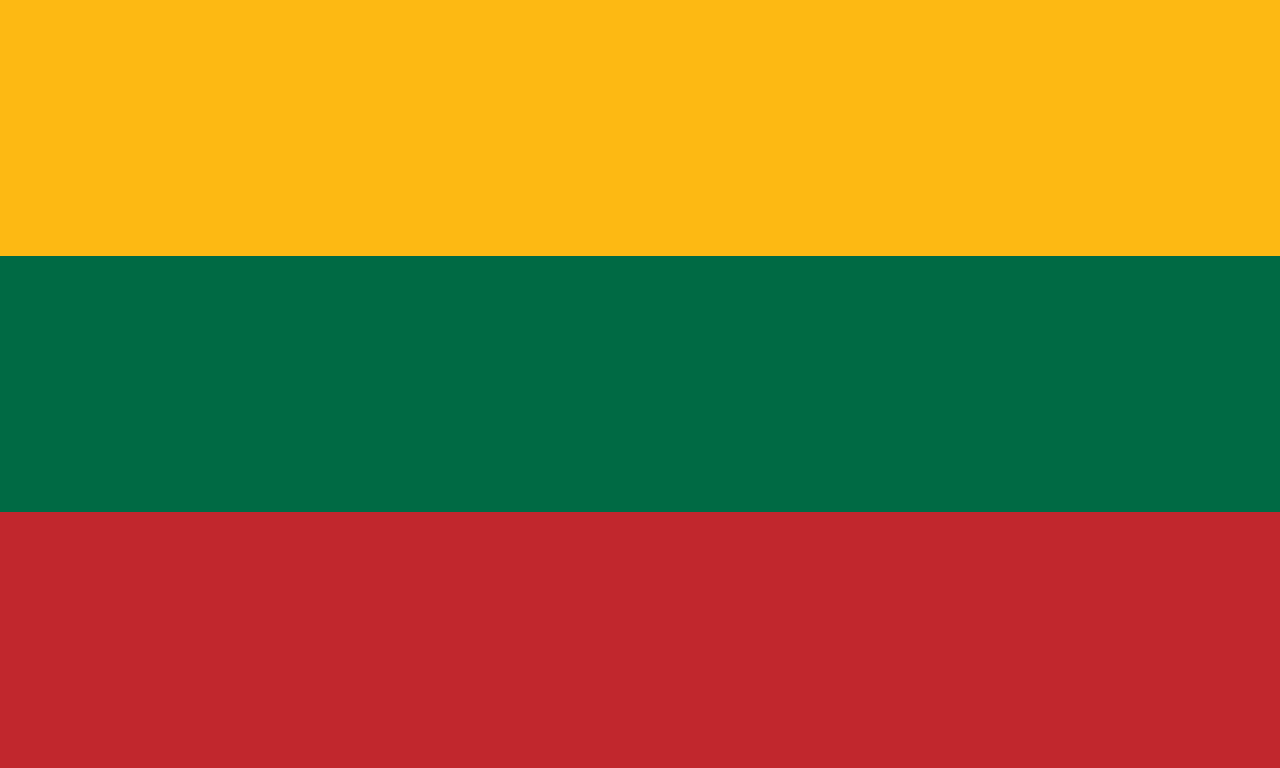
Few national emblems carry the weight of survival quite like the Lithuanian tricolor. A clean horizontal band of yellow, green, and red, it looks almost deceptively cheerful for a banner that disappeared for half a century before being hauled back into the daylight in 1990. To understand this flag is to understand a small Baltic nation that refused to let go of its identity, even when the state itself was erased from the map. The design is simple, but the story stitched into those three stripes is anything but.
In this guide we will walk through what the colors stand for, how the flag is built, where it came from, how it stacks up against other tricolors that share its palette, and why Lithuanians treat it with such evident pride today.
What the Three Colors Represent
The Lithuanian flag speaks in a language of earth, light, and sacrifice. The top band of yellow stands for the sun, prosperity, and the golden ripeness of the country's wheat fields and rye harvests. It is the color of light and warmth, an apt symbol for a northern land where summer days stretch long and the sun is genuinely cherished.
The central band of green represents nature, the forests, meadows, and rolling countryside that define so much of Lithuania's landscape. It is also widely read as a symbol of hope and the freedom of the open land. Lithuania remains one of Europe's more heavily wooded nations, so this middle stripe feels less like an abstraction and more like a window onto the terrain itself.
The bottom band of red carries the heaviest meaning. It stands for courage and the blood shed by those who fought and died defending the nation across its long and frequently embattled history. Placed at the base, it anchors the brighter colors above, a quiet reminder that the country's freedom rests on sacrifice.
The Design and Layout
At its core, the Lithuanian flag is a horizontal triband: three equal horizontal stripes stacked one atop the other, yellow on top, green in the middle, red at the bottom. There is no emblem, no star, no coat of arms layered over the field. The power of the design lies in its restraint.
Because the bands are equal in height and run side to side rather than top to bottom, the flag reads clearly from a distance and is easy to reproduce, whether stitched onto a parade banner, printed on a sports jersey, or waved by hand at a public gathering. The order of the colors matters and never changes; yellow always leads, red always closes. That fixed sequence is what makes the flag instantly recognizable and distinct from other tricolors built from a similar set of hues.
A Flag That Came Back From the Dead
The yellow-green-red combination has roots in the early twentieth century, emerging as Lithuania asserted its modern statehood in the aftermath of the First World War. Through the interwar decades it flew over an independent republic, becoming familiar to a generation that finally had a country of its own to celebrate.
Then came the long eclipse. Under Soviet rule, Lithuania's tricolor was suppressed and replaced by Soviet-style symbolism, and merely displaying the old flag could be treated as an act of defiance. Yet the banner never truly vanished; it survived in memory, in private keeping, and in the determination of people who regarded it as the rightful emblem of their nation.
When the independence movement gathered force at the end of the 1980s, the tricolor reappeared in public, raised at rallies and draped across crowds as a declaration of intent. With the restoration of independence, the flag was formally re-established in 1990, closing the circle on decades of forced absence. To call it merely "adopted" undersells the moment; it was restored, returned to the role it had held before the occupation. Readers who want the broader national context can explore our lithuania country guide for more on the country's geography and history.
How It Compares to Similar Flags
Yellow, green, and red is one of the world's most heavily used color combinations, which means Lithuania's flag occasionally gets mistaken for relatives it has nothing to do with. The trick to telling them apart lies in orientation, proportion, and the presence or absence of added emblems.
- Bolivia uses a red-yellow-green horizontal triband, the reverse vertical order of Lithuania's, and its state flag adds a central coat of arms.
- Ghana arranges red, yellow, and green horizontally with a black star in the middle band, a feature Lithuania's plain field never carries.
- Ethiopia stacks green, yellow, and red with a central emblem, again a different sequence and a busier center.
- Guinea, Mali, and Senegal use vertical stripes of similar colors rather than Lithuania's horizontal bands.
What sets the Lithuanian flag apart is its specific top-to-bottom order of yellow, green, then red, combined with a completely uncluttered field. No star, no shield, no inscription. Once you fix that sequence in mind, the look-alikes sort themselves out quickly.
Cultural Significance and National Identity
For Lithuanians, the tricolor is bound up with the idea of endurance. Because the flag was banned and then reclaimed, it functions as living proof that the nation outlasted the regime that tried to erase it. That history gives the colors an emotional charge that goes well beyond decoration.
The palette also reaches into everyday culture. The same yellow, green, and red appear in elements of traditional Lithuanian dress and folk textiles, tying the formal state symbol to the older fabric of rural craft and custom. When people see those three colors woven into a sash or a woven band, the flag and the folk tradition reinforce one another, blurring the line between official emblem and inherited heritage.
The Flag in Modern Life
Today the tricolor is a constant presence in Lithuanian public life. It flies over government buildings, schools, and public squares, and it appears in force on the calendar's patriotic days, including celebrations tied to the country's independence and its restoration. On these occasions homes, balconies, and streets fill with the familiar bands.
The flag travels well beyond ceremony, too. Lithuanian sports fans, especially the country's famously passionate basketball supporters, drape themselves in yellow, green, and red at international competitions, turning arenas into seas of the national colors. Whether at a solemn commemoration or a roaring sports crowd, the same three stripes do the work of saying, without a word, exactly who is in the room.
Quick Facts Worth Knowing
- The flag is a horizontal triband of yellow, green, and red, in that fixed top-to-bottom order.
- It was restored as the national flag in 1990, after independence from Soviet rule was reclaimed.
- Yellow stands for the sun, green for nature, and red for courage and sacrifice.
- The same colors appear in traditional Lithuanian clothing and folk textiles.
- Lithuania sits in Northern Europe, among the three Baltic states on the eastern shore of the Baltic Sea.
- The design carries no emblem or coat of arms, distinguishing it from look-alike tricolors such as Ghana's and Bolivia's.
Frequently Asked Questions
When was the Lithuanian flag adopted?
The current flag was formally restored in 1990, when Lithuania reclaimed its independence. The yellow-green-red tricolor itself dates back to the early twentieth century and the country's first period of modern statehood, so 1990 marks a return of an older design rather than an entirely new creation.
What do the colors of the Lithuanian flag mean?
Yellow represents the sun, light, and prosperity; green represents nature, the country's forests and fields, and hope; and red represents courage and the blood shed by those who defended the nation. Together they blend the land, its light, and its sacrifices into a single banner.
Who designed the Lithuanian flag?
The tricolor emerged from Lithuania's national movement in the early twentieth century rather than from a single famous designer credited in popular memory. It grew out of a collective effort to give the newly independent republic a distinct emblem, and the yellow-green-red arrangement became the accepted standard.
What continent is Lithuania on, and how does its flag compare to similar ones?
Lithuania is in Europe, specifically Northern Europe, as one of the three Baltic states. Its flag shares its yellow, green, and red palette with several African and South American flags, but it is set apart by its particular top-to-bottom color order and its plain field with no central emblem.