

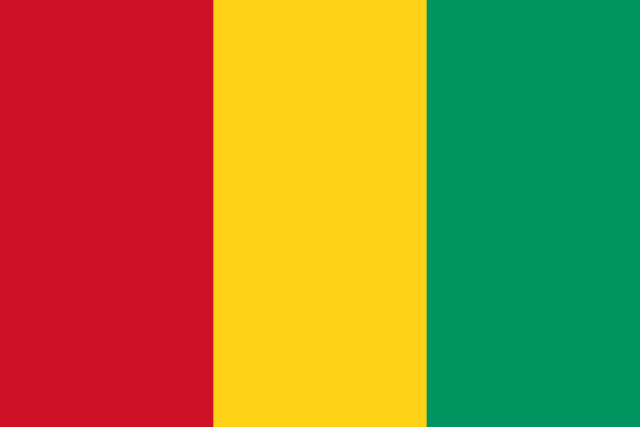
Few flags announce their geography and their politics as quickly as Guinea's. Three bold vertical bands of red, yellow, and green run side by side, instantly recognizable as part of the Pan-African color family that sweeps across the continent. Yet behind that clean, almost minimalist arrangement sits one of the most significant moments in twentieth-century African history: the day a West African nation looked France in the eye and chose to walk away. Raised in 1958, the flag of Guinea is both a simple piece of design and a declaration that still resonates across the region today.
A Tricolor of Independence
The flag is a vertical triband, divided into three equal stripes arranged from the hoist (the side nearest the flagpole) to the fly. Red sits closest to the pole, yellow runs down the center, and green completes the design on the outer edge. There is no emblem, no star, and no crest stamped over the cloth. The strength of the flag lies entirely in its proportions and its color, and that restraint is deliberate. A young country emerging from colonial rule wanted a banner that was instantly legible from a distance and easy to reproduce on everything from official buildings to handheld banners at a rally.
The official proportions follow a tidy two-to-three ratio, and the three stripes are exactly equal in width, so no single color dominates the cloth. That balance is part of the message, as none of the three values the flag represents, sacrifice, wealth, or the land, is allowed to outweigh the others.
Anyone who has glanced at a world map will notice the resemblance to the flag of France, the former colonial power, which also uses a vertical tricolor. The echo is structural rather than symbolic. Where France flies blue, white, and red, Guinea answers with red, yellow, and green, swapping the colonial palette for the colors of a continent reclaiming its own story.
What the Colors Mean
The three colors are the classic Pan-African trio, and in Guinea each one carries a specific weight. Red, on the hoist side, stands for the blood and sacrifice of those who struggled for independence and for the labor of the people who built the nation. Yellow, in the center, evokes the sun and the mineral wealth buried in Guinean soil, a country famously rich in bauxite, gold, and other resources. Green, on the fly side, represents the lush vegetation and agricultural abundance of the land, from coastal lowlands to forested highlands.
Read from the pole outward, the flag moves from the human cost of freedom, through the wealth that freedom was meant to unlock, to the green country that all of it was for. Some Guinean accounts also tie the three bands to the national motto, Travail, Justice, Solidarité, meaning work, justice, and solidarity, lending the colors a civic reading.
This palette is sometimes traced back to the colors associated with Ethiopia, the African nation that famously resisted colonization, and to the broader Pan-African movement that adopted red, gold, and green as a shared emblem of solidarity. By choosing them, Guinea placed itself within a family of newly independent states rather than standing alone.
Born in the Vote of 1958
To understand the flag, you have to understand the year it appeared. In 1958, France offered its African colonies a referendum on joining a new French Community while remaining tied to Paris. Most territories said yes. Guinea, under the leadership of Ahmed Sékou Touré, said no, with more than ninety percent of voters rejecting the proposal. The decisive rejection of continued French oversight made Guinea the first of France's sub-Saharan African colonies to claim full independence that year, a distinction that still defines the nation's sense of itself.
The break was abrupt and costly. France withdrew its administrators, aid, and investment almost overnight, in some accounts even stripping equipment from offices as it left. Against that backdrop, raising a brand-new flag was not a ceremonial flourish but an act of defiance, a way of insisting that the country could stand on its own colors. The flag was adopted in that same charged moment of October 1958, hoisted as the standard of a fledgling republic that had just chosen uncertainty over comfort.
Its design consciously mirrored the green, gold, and red of Ghana, which had become independent the year before under Kwame Nkrumah, a leader Sékou Touré admired and worked alongside in early dreams of African unity. The two men briefly formed a Ghana-Guinea union, and the shared colors were a visual handshake between the pioneering states.
A Symbol of National Identity
For Guineans, the tricolor is shorthand for sovereignty that was chosen rather than granted. Because independence came through an act of refusal at real economic and political cost, the flag carries a particular charge of self-determination. It appears on the national football team's jerseys, on currency and official seals, and at the head of every state ceremony. Schoolchildren learn the meaning of the three bands as part of their civic education, linking the cloth to the founding story of the country.
The colors also stitch Guinea into a wider conversation about African unity. Anyone curious about the land behind the banner, its mountains, rivers, and cities, can explore more in our guinea country guide, which sets the flag in its full geographic and cultural context.
The Flag in Modern Life
Today the red, yellow, and green appears far beyond government offices. It is waved at independence celebrations each October second, draped over crowds at international matches, and flown alongside the banners of regional bodies such as the African Union and the Economic Community of West African States. The national side, the Syli National, named for the elephant that once graced the country's coinage, turns stadiums into seas of the tricolor whenever it plays at the Africa Cup of Nations. Because the design is so simple, it adapts easily to bunting, face paint, murals, and digital avatars, which keeps it vivid in everyday national life rather than confined to formal occasions.
That same simplicity, however, means Guinea is occasionally confused with other Pan-African tricolors. Mali flies the identical three colors in the reverse order, with green at the hoist, and Senegal uses the same trio with a green star added at the center. Spotting the difference comes down to remembering which color hugs the pole and whether any emblem interrupts the central band, and for Guinea the answer is always red at the pole and nothing in the middle but plain yellow.
Quick Facts Worth Knowing
- The flag is a plain vertical tricolor with no symbols, badges, or text.
- The color order from the flagpole outward is red, yellow, green.
- The official proportion is two units tall to three units wide, with equal stripes.
- It was adopted in 1958, the year Guinea broke from France.
- Guinea was the first French sub-Saharan colony to gain full independence.
- The design mirrors Ghana's colors as a gesture of Pan-African solidarity.
- Mali uses the same three colors in the opposite arrangement.
- Guinea is located in West Africa, on the continent of Africa.
Frequently Asked Questions
When was the flag of Guinea adopted?
Guinea adopted its flag in 1958, the same year the country declared independence from France. The banner went up almost immediately as the standard of the newly proclaimed republic, making the flag inseparable from the nation's founding moment.
What do the colors of the Guinea flag mean?
The three Pan-African colors each hold a distinct meaning. Red honors the sacrifice and labor of the people, yellow represents the sun and the country's mineral wealth, and green stands for the land's vegetation and agriculture. Together they express both struggle and natural abundance.
Why does the Guinea flag look like the flags of Mali and Senegal?
All three nations use the Pan-African trio of red, yellow, and green to signal shared identity and solidarity. The difference is in the arrangement: Guinea reads red-yellow-green from the pole, Mali reverses it to green-yellow-red, and Senegal adds a green star to the center stripe.
Who designed the flag and why was it modeled on Ghana's?
The flag was created under the first president, Ahmed Sékou Touré, at the moment of independence. He admired Kwame Nkrumah of Ghana, the continent's first sub-Saharan state to break free, and deliberately borrowed Ghana's green, gold, and red so that the two countries' banners would echo one another as a symbol of Pan-African unity.
What continent is Guinea on?
Guinea sits in West Africa, on the continent of Africa. It borders the Atlantic Ocean to the west and shares frontiers with several neighbors, placing it firmly within the cluster of nations that popularized the Pan-African color scheme.