
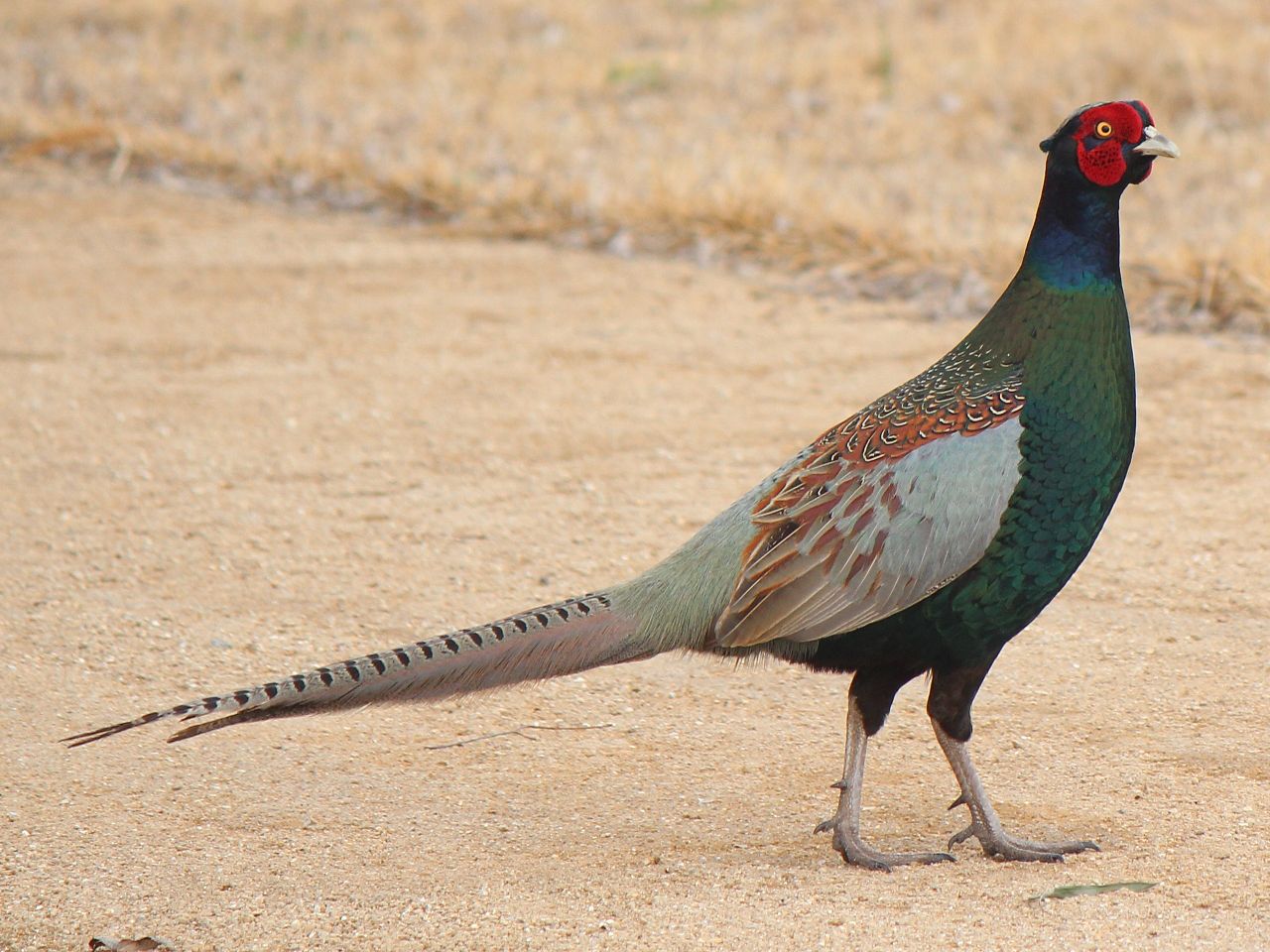
The national animal — more precisely the national bird — of Japan is the Green Pheasant (Phasianus versicolor), known in Japanese as the kiji. It was formally designated by the Ornithological Society of Japan in 1947, and it holds the distinction of being endemic to the country: this striking bird breeds in the wild nowhere else on Earth.
What the Green Pheasant Looks Like
The Green Pheasant is a large, ground-dwelling game bird, and the difference between the sexes is dramatic. Males are unmistakable, draped in iridescent bottle-green plumage across the breast and flanks that shifts to deep purple and blue on the neck. They wear bright red bare skin around the eyes, called wattles, and trail a long, slender, barred tail that can make up a substantial part of their roughly 80-centimetre body length. A mature male weighs around 0.9 to 1.1 kilograms.
Females, by contrast, are a mottled buff-brown with dark barring — drab on purpose, since they do the incubating and need to vanish against dead grass and soil. This camouflage is one reason the species thrives in farmland: a sitting hen is almost invisible at the edge of a rice paddy.
Why Japan Chose the Pheasant
When the Ornithological Society of Japan selected a national bird in 1947, the Green Pheasant won out for three reinforcing reasons. First, it is endemic, so it carries an unambiguously Japanese identity. Second, it is widespread and familiar, seen across much of rural Japan rather than confined to a remote habitat. Third, and perhaps most importantly, it is woven into the country's cultural memory in a way few animals are.
The pheasant appears in classical poetry, in painting, and in The Tale of Genji, often cited as one of the world's earliest novels. Its most famous role, though, is in the beloved folk tale Momotaro (Peach Boy), where a pheasant joins a dog and a monkey as the hero's loyal companions on the quest to defeat demons on Onigashima. To Japanese audiences, the bird is shorthand for courage and steadfast allegiance.
Where the Green Pheasant Lives
The species ranges across Japan's three largest islands — Honshu, Shikoku, and Kyushu — while a related form occupies the northern island of Hokkaido. It favours a patchwork of open country: grasslands, the margins of woodland, scrub, and above all the mixed agricultural landscape of rice paddies bordered by hedgerows and small fields.
This preference ties the bird closely to traditional Japanese farming. The bunds and weedy edges around flooded paddies offer both food and cover, and the pheasant is comparatively tolerant of people, turning up at the fringes of small towns and suburban parks. It feeds on seeds, grains, green shoots, insects, and other invertebrates, foraging on foot and flushing into noisy, low flight only when startled.
Conservation and Status Today
The Green Pheasant is currently listed as Least Concern by the IUCN, meaning it is not at risk of extinction nationally. That said, the picture is not uniformly bright. Local populations have thinned in places where habitat has been lost to urban expansion and where traditional rice cultivation — the very farming style that suited the bird — has been abandoned or industrialised.
Hunting is permitted but regulated through a licensing system, the pheasant being a popular game bird. A subtler threat comes from the release of non-native Ring-necked Pheasants for sport, which can hybridise with the native species and dilute its distinct genetics in some regions. For a bird that is a point of national pride, protecting the working farmland it depends on is as important as any hunting rule. You can learn more about the country and its landscapes in our japan country guide.
Key Facts at a Glance
- Common name: Green Pheasant; Japanese name: kiji
- Scientific name: Phasianus versicolor
- Status: national bird of Japan since 1947
- Endemic to Japan — found in the wild nowhere else
- Male body length: roughly 80 cm; weight about 0.9–1.1 kg
- Habitat: grasslands, woodland edges, and farmland on Honshu, Shikoku, and Kyushu
Frequently Asked Questions
Does Japan have a national animal as well as a national bird?
Japan's officially recognised national symbol in the animal kingdom is the Green Pheasant, designated as the national bird in 1947. Japan has no separate, formally legislated national land mammal, so the pheasant is the animal most widely cited as the national emblem.
What is the difference between a male and female Green Pheasant?
Males are vividly coloured with iridescent green and purple plumage, red facial wattles, and a long barred tail, while females are plain brown with dark barring for camouflage. This stark contrast is typical of pheasants, where males display and females stay hidden while nesting.
Is the Green Pheasant endangered?
No. It is classified as Least Concern, though some local populations have declined because of habitat loss and the decline of traditional rice farming. Regulated hunting and hybridisation with introduced pheasants are managed concerns rather than threats to the species overall.
What other creatures are linked to Japan?
Beyond the Green Pheasant, animals strongly associated with Japan include the Japanese macaque (the snow monkey), the red-crowned crane, the koi carp, and the sika deer of Nara, all of which feature prominently in Japanese culture and tourism.
