

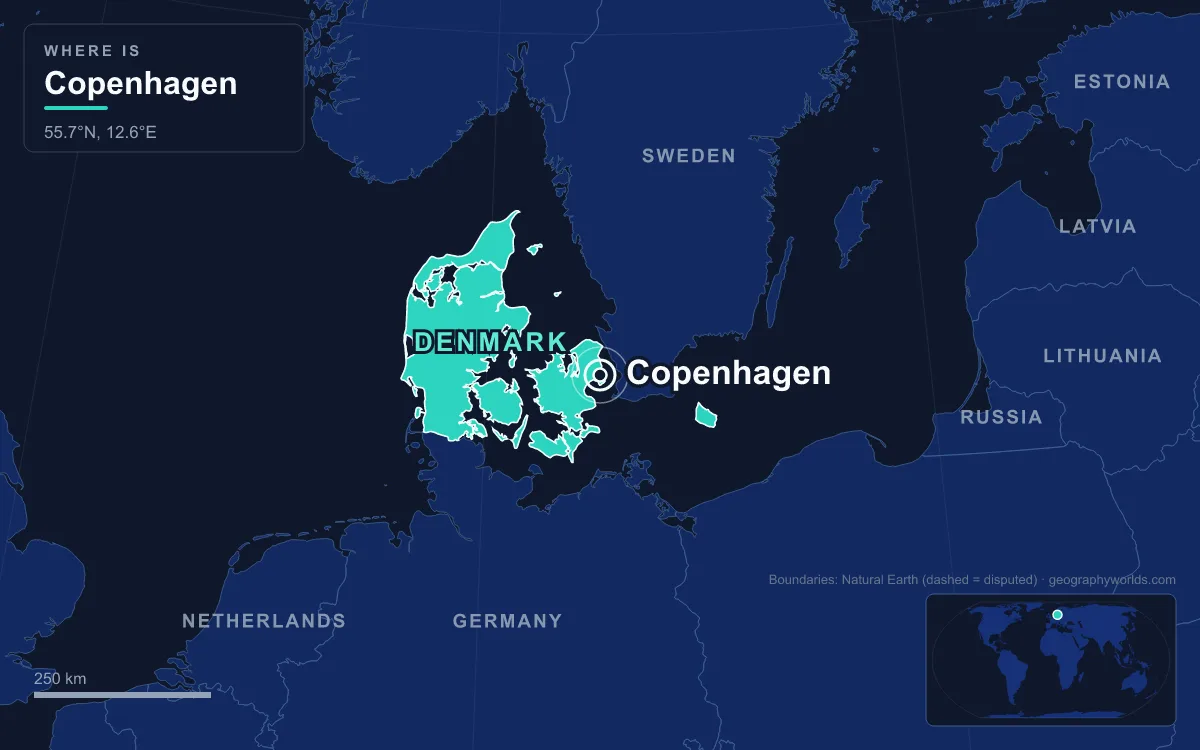
The capital of Denmark is Copenhagen (København in Danish), a city on the east coast of the island of Zealand, with a smaller part on the island of Amager, facing Malmö in Sweden across the Øresund strait. The municipality had 644,431 inhabitants in 2022, and the urban area 1,396,508 on 1 January 2025. It has been the Danish capital since the early 15th century, and its name still describes what it was made for: Købmannahavn, the "merchants' harbour", at the narrow entrance to the Baltic Sea. Power, faith, trade and ordinary life have each left a specific mark on the city, and each can still be found on a map of its centre.
Power on Slotsholmen: From Absalon's Castle of 1167 to Christiansborg
Archaeology shows a town here by the 11th century, centred on Gammel Strand, the "old shore", where a natural harbour and rich herring grounds drew fishermen and merchants. Remains of a large merchant house from about 1020 have been found near Kongens Nytorv. The traditional founding date, though, is political. Around 1160 King Valdemar I gave the town to Absalon, Bishop of Roskilde, and in 1167 Absalon built a fortress on the islet of Slotsholmen to fend off Wendish pirates raiding the coast.
For more than two centuries the crown and the bishops fought over who owned it. The castle was occupied and plundered between 1249 and 1259, and in 1370, after defeating Valdemar IV, the Hanseatic League sent 40 stonemasons to take it apart stone by stone. The crown finally won in 1416, when Eric of Pomerania took control of the town, and from then on Copenhagen was the seat of royal power. In the 16th century it served as the de facto capital of the Kalmar Union that joined Denmark, Norway and Sweden.
The same islet has held the centre of power ever since. Copenhagen Castle replaced Absalon's fortress; Christian VI tore it down in 1731–32 to build the first Christiansborg Palace. That palace burned in 1794 and its successor in 1884, and the present building, in neo-baroque style, was finished in 1928. It houses the Folketing (parliament), the Prime Minister's Office and the Supreme Court, which makes it the only building in the world holding all three branches of a country's government. Danes call it simply Borgen, "the castle", as shorthand for politics itself. The royal family, burned out in 1794, moved to Amalienborg, four matching palaces around an octagonal square, where the monarch still lives.

Faith at Vor Frue Kirke, Stormed on 27 December 1530
Absalon built churches as well as walls. Work on the Collegiate Church of St Mary began no later than 1187 on the highest point of the young town, and it was consecrated in 1209. A fire in 1314 destroyed the limestone Romanesque church so completely that it was rebuilt in the new fashion of oversized red brick, in Gothic style, work that went on until 1388. A school grew up beside it, and in 1479 part of that school received a charter as the University of Copenhagen, the oldest university in Denmark, with professors brought from Cologne.
The Reformation turned the church into a battleground. Most citizens had chosen to follow Luther, while Catholic officials at St Mary's tried to hold it as a centre of resistance, and a royal decree ordered Catholic and Lutheran priests to share it. On 27 December 1530 hundreds of Copenhageners stormed the church, smashed every statue, dismantled the choir stalls and stripped its 17 gilded altars. Even the name changed: St Mary's became Vor Frue Kirke, the Church of Our Lady. The university closed during the upheaval and reopened in 1537 as a centre of Lutheran teaching.
The church standing on Frue Plads today is the fourth version. Designed by Christian Frederik Hansen in neoclassical style and completed in 1829, it replaced a building wrecked in the British bombardment of 1807, and it is now the Lutheran cathedral of Copenhagen, beside the university's historic main building.
Trade on the Øresund: Herring, the Sound Dues and Børsen
Copenhagen's wealth came from its position. It sits at the main approach to the Baltic and to the rich North German towns of the Hanseatic League, and after Absalon took over, the town grew tenfold, living largely on salted herring shipped across Catholic Europe for Lent. The Hanseatic towns noticed. They besieged and sacked Copenhagen repeatedly, and in the 13th century it became only the second Danish town, after Kalundborg, to be ringed with a stone wall; from about 1290 until the mid-19th century everyone entering had to pass through one of four gates or the harbour.
The strait itself became a source of revenue. From 1429, under Eric of Pomerania, every foreign ship passing through the Øresund had to stop at Helsingør and pay the Sound Dues, with cannon on both shores to enforce payment. In 1567 the toll became a tax of 1 to 2 percent of cargo value, and to stop captains undervaluing their loads, the crown reserved the right to buy the cargo at the declared price. In the 16th and 17th centuries the dues brought in up to two-thirds of Denmark's state income, which made its kings unusually independent of the nobility. They lasted until the Copenhagen Convention of 1857.
Christian IV, crowned in 1596, spent that money turning Copenhagen into the commercial capital of the north. He added Christianshavn, a merchants' district modelled on Amsterdam, and Nyboder, rows of housing for navy personnel. Beside the palace he built Børsen, the exchange, largely completed between 1620 and 1624, with 40 trading offices on the ground floor and a spire of four intertwined dragon tails 56 metres high. It housed the stock market until 1974. On 16 April 2024 a fire during renovation work destroyed about half the building and brought the spire down. Trade still crosses the strait, but now by the Øresund Bridge to Malmö, opened in July 2000, which has turned the two cities into a single region of about 4.1 million people.
Daily Life Inside and Beyond the Ramparts, 1711 to 1901
For most of its history, ordinary Copenhageners lived squeezed inside the walls, and disaster came often. Plague killed about a third of the population between June 1711 and March 1712. The fire of 1728 burned 1,600 houses and five churches in four days, about a third of the city, and the fire of 1795 destroyed another quarter and left 3,500 homeless. Rebuilding produced the city's most elegant district, Frederiksstaden, with Amalienborg at its centre.
The waterfront most visitors know was working space. Nyhavn, the canal running from Kongens Nytorv to the inner harbour, was dug between 1670 and 1675 by Danish soldiers and Swedish prisoners of war, and it was known for beer, sailors and prostitution. Its oldest house, No. 9, dates from 1681, and Hans Christian Andersen lived on the canal for 18 years, including 1845 to 1864 at No. 67. When road transport took the small freight ships away after the Second World War, the quay became a car park, and it was only pedestrianised in 1980.
War and crowding eventually pushed people outward. In 1801 Nelson defeated the Dano-Norwegian fleet off the city, and in 1807 a British force of 30,000 bombarded Copenhagen from 2 to 5 September, killing 195 civilians, wounding 768 and burning roughly 1,000 buildings, the Church of Our Lady among them. Because the old ramparts had barely moved since Christian IV while the population quadrupled, buildings grew taller and rooms smaller. In 1852 building beyond the lakes on the western edge was finally allowed, and Nørrebro, Vesterbro and Frederiksberg filled with apartment blocks. The old centre, home to about 125,000 people before that, peaked at 140,000 in the 1870 census; today about 25,000 live there. In 1901 the city absorbed communities with 40,000 residents, leaving Frederiksberg as an enclave surrounded by Copenhagen.
Two Wheels on Holmens Kanal: How Copenhagen Commutes Today
The habit most associated with modern Copenhagen started early. The city had about 2,500 bicycles in 1890 and 80,000 just 17 years later; its first bicycle path opened on Esplanaden in 1892. During the Second World War petrol rationing made cycling the dominant way of getting around. Car ownership then cut the bicycle's share of trips to an all-time low of about 10 percent in the late 1960s and early 1970s.
The 1973 oil crisis reversed that. Denmark, heavily dependent on imported oil, rationed petrol and introduced car-free Sundays, and the Danish Cyclists' Federation grew quickly and organised large demonstrations for safer routes. Today about 1.2 million kilometres are cycled in the city every day, and 62 percent of residents commute to work, school or university by bicycle.

The rest of the transport network followed the same planning logic. The post-war Finger Plan channelled housing and jobs along five commuter rail lines radiating from the centre, and the metro, begun in 1992, opened in 2002 alongside the new district of Ørestad on Amager. The city also rebuilt its economy after coming close to bankruptcy in the 1980s and 1990s, recovering by 2010 on services, pharmaceuticals, IT and clean technology.
Put together, the four threads explain the capital. Power has stayed on Absalon's islet for more than 850 years; faith left a cathedral now in its fourth building; trade built a city on a toll gate; and daily life moved from cramped lanes inside the ramparts to the bike lanes of Nørrebro. For how the city spreads across Zealand and Amager, read our guide to Copenhagen's geography; for the strait that made it rich, see the Øresund Strait; and to see who sits in Christiansborg today, look at the government of Denmark.
Quick Facts About Copenhagen
- Country: Denmark
- Continent: Europe (Northern Europe)
- Country population: approximately 6.0 million
- Capital city status: Copenhagen is the capital of Denmark, the seat of national government, and the location of foreign embassies, parliament, and the head of state's official residence.
Frequently Asked Questions
What is the capital of Denmark?
The capital of Denmark is Copenhagen. Copenhagen is the seat of national government, hosts most foreign embassies and consulates, and is typically where the head of state and parliament are located.
What continent is Copenhagen in?
Copenhagen, the capital of Denmark, is located in Europe, in the Northern Europe region. As Denmark's capital, Copenhagen serves as the country's primary connection to the broader Europen political, economic, and cultural sphere.
Why is Copenhagen the capital of Denmark?
Copenhagen was chosen as the capital of Denmark for reasons that typically combine geography, history, and politics. Capital city selections often reflect a desire for centrality (being accessible from across the country), historical importance (being a longstanding seat of government or culture), or neutrality (being acceptable to multiple regions or ethnic groups within the country). The specific reasons for Copenhagen's designation are detailed in the city's history above.
What is Copenhagen known for?
As the capital of Denmark, Copenhagen is best known for housing the country's central government institutions — parliament, presidential or royal residences, supreme court, and key ministries. It is also typically a major cultural and economic center within Denmark, hosting national museums, embassies, and signature monuments. The introduction and history sections above provide detailed coverage of the city's specific notable institutions and landmarks.
Related Pages
- Denmark Country Guide — full geography, climate, economy, and culture overview
- Flag of Denmark — meaning, history, and design of Denmark's national flag