

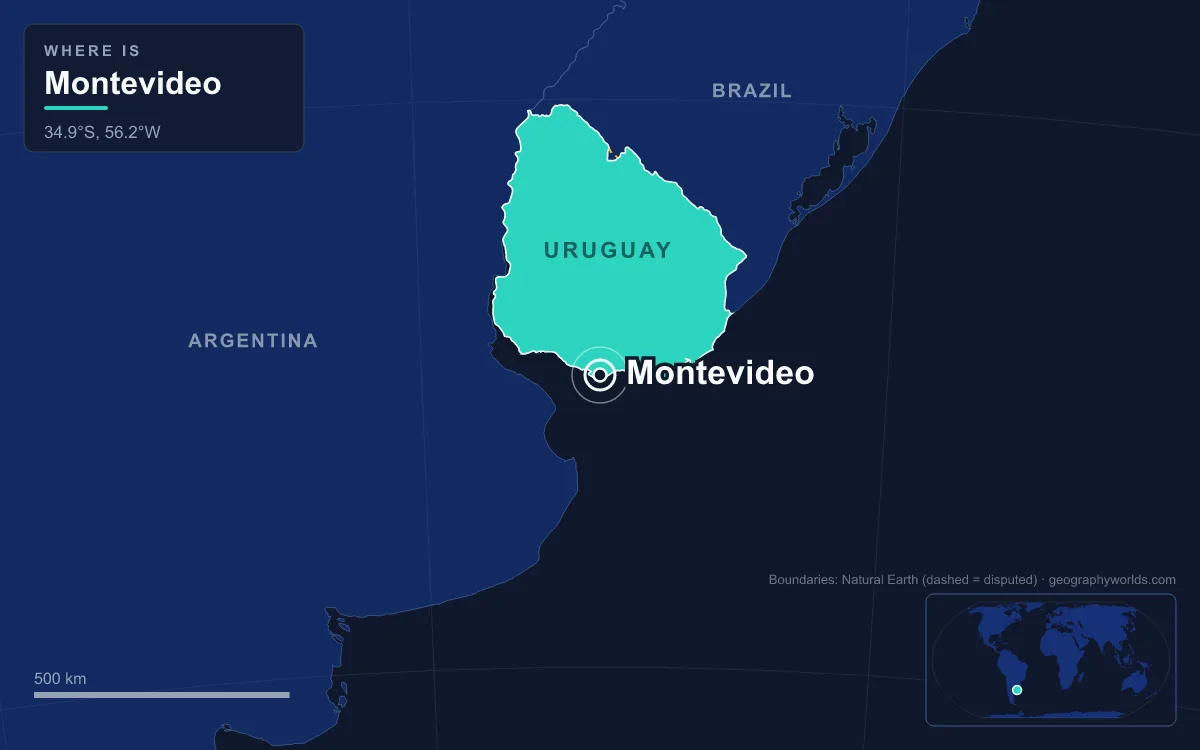
Montevideo is the capital and largest city of Uruguay, set on the northern shore of the Río de la Plata where the estuary opens toward the Atlantic. The 2023 census counted 1,287,452 people in the city proper, about 36.8% of the national total, living on just 201 square kilometres, and the metropolitan area holds roughly 2 million of Uruguay’s almost 3.5 million people. Its defining trait is imbalance: no other Uruguayan city comes close to it, and the one city that dwarfs it, Buenos Aires, sits 230 kilometres away across the water.
Montevideo by the Numbers: 0.1% of the Land, 37% of the People
Uruguay covers about 176,214 square kilometres of land. Montevideo’s 201 square kilometres amount to roughly 0.11% of that surface, yet more than a third of the country lives inside the city limits, and closer to three in five live in the wider metropolitan area that spills into Canelones and San José departments. The Montevideo Department that contains the city is, in the words of its own description, by far the smallest of Uruguay’s 19 departments by area and by far the most populous.
This concentration is not new. Montevideo grew from a fortified harbour town into a city of 309,331 people by 1908, when around 30% of its residents had been born abroad, mostly in Spain and Italy. Italians and Spaniards together made up more than 70% of Uruguay’s foreign-born population, and nearly all of them arrived through this port. Smaller communities from France, Germany, Portugal, Poland, Ireland, Croatia, Lithuania, Armenia, Lebanon and Japan settled here too, along with Ashkenazi and Sephardic Jews. About 20,000 Jews live in Montevideo today, more than half of Uruguay’s Jewish population.
The city’s weight is economic as well as demographic. The headquarters of nearly every state enterprise are here: ANCAP for fuel, UTE for electricity, ANTEL for telecommunications, OSE for water and BROU, the country’s largest bank. The Port of Montevideo, on the northern edge of the Ciudad Vieja, is the country’s main port and one of the few deep-draft ports in the Southern Cone. In 2022 the city’s GDP was projected at about US$53.9 billion.
Montevideo Against Salto: An Elevenfold Gap
Most countries have a clear second city that acts as a counterweight to the capital. Uruguay does not. Salto, in the northwest of the country, is the second most populous city, and the 2023 census counted 114,084 people there. Montevideo is more than eleven times its size. Maldonado, the departmental capital next to the resort of Punta del Este, ranks fourth with about 102,000 people, and Las Piedras, which is effectively a northern suburb of Montevideo, had 61,292.
The pattern follows from history. Montevideo was founded as a Spanish military stronghold in 1724, when Bruno Mauricio de Zabala, governor of Buenos Aires, drove out a Portuguese garrison that had built a fort on the bay in November 1723. Zabala’s diary gives 24 December 1726 as the formal foundation, and the town gained its own cabildo, independent of Buenos Aires, on 1 January 1730. In 1776 Spain made it the main naval base for the South Atlantic. The interior of the Banda Oriental, by contrast, stayed a thinly peopled cattle frontier. When mass immigration began in the late 19th century, newcomers landed at Montevideo and mostly stayed there.
Across the Río de la Plata from Buenos Aires
If Montevideo towers over the rest of Uruguay, it is modest next to its neighbour across the estuary. Buenos Aires lies 230 kilometres to the west, on the southern shore. The Argentine capital’s city proper holds about 3.1 million people, and its urban area about 16.7 million, making Greater Buenos Aires roughly eight times the size of Greater Montevideo. The Río de la Plata between them widens from about 2 kilometres at its source to around 220 kilometres at its mouth, and more than 2.2 million people a year cross it on Buquebus ferries alone.
For most of the colonial period the two ports were rivals. Montevideo’s natural bay, which shelters ships and was one of the reasons the city was founded, gave it an edge as a harbour, while Buenos Aires held the seat of the viceroy. In 1807 British troops under Samuel Auchmuty captured Montevideo and held it for seven months before the defeat of John Whitelocke’s force ended the invasion. During the May Revolution of 1810 the Spanish colonial government retreated to Montevideo, which remained loyal to Spain while Buenos Aires broke away.
The rivalry softened into kinship. Both cities speak Rioplatense Spanish, both claim tango, and both share a European-inflected streetscape. The contrast today lies in scale. The Argentine capital is an Alpha-minus global city in the GaWC ranking; Montevideo was classed as a beta city in 2018, eighth in Latin America. Montevideo does host the administrative headquarters of Mercosur and ALADI, the region’s two main trade blocs, a role that has drawn comparisons with Brussels.
Palacio Salvo and Palacio Barolo: Twin Towers on Two Shores
The clearest physical expression of the two cities’ closeness is a pair of buildings by the same man. Mario Palanti, an Italian architect living in Buenos Aires, designed the Palacio Barolo on Avenida de Mayo in Buenos Aires and then used a similar design for the Palacio Salvo in Montevideo, at the corner of Avenida 18 de Julio and Plaza Independencia. The Salvo, commissioned by the brothers Ángel, José and Lorenzo Salvo and finished in 1928, rises 27 storeys to 105 metres including its beacon. It was briefly the tallest building in Latin America and, at completion, the tallest reinforced-concrete structure in the world.

The Barolo held the title of tallest building in Buenos Aires until the Kavanagh Building of 1936. The Salvo stood on the site of La Giralda, the café where Gerardo Matos Rodríguez first played the tango “La Cumparsita” in 1917, and the building now houses a tango museum. Uruguay’s tallest building today is the 157-metre Antel Tower by the bay, designed by Carlos Ott and completed in 2002, but Palacio Salvo remains the city’s emblem.
The architecture reflects another contrast. Montevideo is regarded as one of the cities with the strongest art deco influence anywhere, a legacy of the prosperous 1920s and 1930s, when Uruguay was dubbed the “Switzerland of America” for its banking sector and stability. Divorce was legalised in 1907, women’s suffrage came in the same wave of reform, and the city’s Rambla was built in the 1910s.
A 22-Kilometre Rambla and a 134-Metre Hill
Montevideo is a low city. Its average elevation is 43 metres, and the highest point is the Cerro de Montevideo, 134 metres above the bay, crowned by the Fortaleza del Cerro. Every theory about the city’s name involves that hill: the “Monte” is the Cerro, and a navigator on Ferdinand Magellan’s expedition recorded in January 1520 a hat-shaped mountain he called “Montevidi.”
What the city lacks in height it makes up in shoreline. The Rambla, a continuous coastal avenue and promenade, runs for more than 22.2 kilometres along the Río de la Plata, from the port past Pocitos and Punta Carretas to Carrasco. Building across it is strictly regulated and the beaches are state-owned, which is why a capital of 1.3 million people has an unbroken public waterfront. The Rambla has been proposed as a World Heritage Site.
Montevideo Weather: 16.7 °C a Year and Snow in 1930
Montevideo has a humid subtropical climate with four distinct seasons but few extremes. The annual mean temperature is 16.7 °C and rainfall of about 950 millimetres is spread evenly through the year. Winter days from June to August typically reach 10–18 °C, with nights between 3 and 10 °C; summer days from December to February usually run from 24 to 32 °C.
Compared with Buenos Aires, the Uruguayan capital is noticeably milder in summer, because an evening sea breeze off the estuary cools the city. Hot spells come with north winds from the continental interior and can push temperatures above 35 °C, but they usually end in thunderstorms as cold fronts arrive from the southwest. The record range runs from −5.6 °C to 42.8 °C. Snow is almost unknown: flurries have been recorded only four times, in 1850, 1853, 1917 and on 13 July 1930, the opening day of the first World Cup.
Estadio Centenario and 1930: A Small Capital’s Outsized Record
That World Cup is the sharpest contrast of all between Montevideo’s size and its reach. Uruguay, one of the smallest countries in South America, hosted the first FIFA World Cup in 1930, and every match was played in Montevideo. The Estadio Centenario, named for the centenary of Uruguay’s 1830 constitution, was built in 1929 and 1930 for the tournament.

On 30 July 1930, in front of 68,346 spectators, Uruguay beat Argentina 4–2 in the final at the Centenario, the old rivalry across the Río de la Plata settled on the Montevideo side. In 1983 FIFA declared the stadium the first Historical Monument of World Football, and it remains the only building with that status. The ground in Parque Batlle is still the national stadium and the home of the national team, the centre of Uruguay’s sporting identity.
The same out-of-proportion pattern shows in the city’s festivals. Uruguay’s Carnival, rooted in Afro-Uruguayan candombe and the satirical murga, is considered the longest carnival in the world, and in Montevideo the celebrations can last up to 40 days, from the inaugural parade in January through the Desfile de Llamadas and the contest at the Teatro de Verano. Candombe comes from the city’s Afro-Uruguayan community, descendants of enslaved Africans brought through the port in colonial times; in the 2023 census 10.7% of Montevideo’s residents identified as Black.
A city of 1.3 million that holds more than a third of its country, sits in the shadow of a metropolis eight times larger, and still hosted a World Cup final and what is often called the world’s longest carnival is a place defined by its ratios. For how the capital fits into the rest of the nation, from the cattle ranches of the interior to the Atlantic beaches of Rocha, see our guide to Uruguay.
Quick Facts About Montevideo
- Country: Uruguay
- Continent: South America
- Country population: approximately 3.4 million
- Capital city status: Montevideo is the capital of Uruguay, the seat of national government, and the location of foreign embassies, parliament, and the head of state's official residence.
Frequently Asked Questions
What is the capital of Uruguay?
The capital of Uruguay is Montevideo. Montevideo is the seat of national government, hosts most foreign embassies and consulates, and is typically where the head of state and parliament are located.
What continent is Montevideo in?
Montevideo, the capital of Uruguay, is located in South America. As Uruguay's capital, Montevideo serves as the country's primary connection to the broader South American political, economic, and cultural sphere.
Why is Montevideo the capital of Uruguay?
Montevideo was chosen as the capital of Uruguay for reasons that typically combine geography, history, and politics. Capital city selections often reflect a desire for centrality (being accessible from across the country), historical importance (being a longstanding seat of government or culture), or neutrality (being acceptable to multiple regions or ethnic groups within the country). The specific reasons for Montevideo's designation are detailed in the city's history above.
What is Montevideo known for?
As the capital of Uruguay, Montevideo is best known for housing the country's central government institutions — parliament, presidential or royal residences, supreme court, and key ministries. It is also typically a major cultural and economic center within Uruguay, hosting national museums, embassies, and signature monuments. The introduction and history sections above provide detailed coverage of the city's specific notable institutions and landmarks.
Related Pages
- Uruguay Country Guide — full geography, climate, economy, and culture overview
- Flag of Uruguay — meaning, history, and design of Uruguay's national flag