

Djibouti City is the capital and by far the largest city of the Republic of Djibouti. It stands on a low peninsula on the southern shore of the Gulf of Tadjoura, where the Gulf of Aden narrows toward the Red Sea in the Horn of Africa. Around 777,000 people lived there in 2024, counting the suburb of Balbala, which is roughly three in every four of the 1,066,809 people recorded in the national census of 20 May 2024. The country takes its name from the city, and the city exists because of its harbour. France founded it in 1888, the railway it later built to Addis Ababa made it Ethiopia's port, and Ethiopian trade still accounts for about 70 percent of the cargo that passes through it.
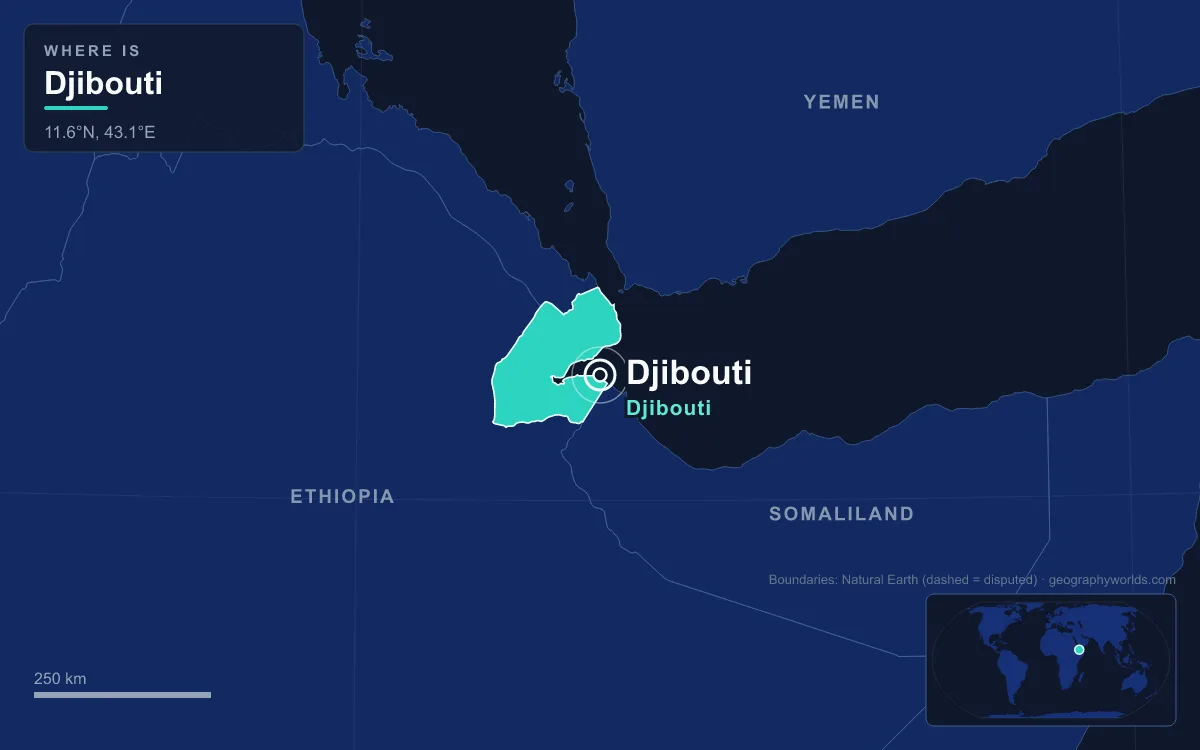
A tour of six places explains how a stretch of coast with no town on it became a capital of three-quarters of a million people. Each one belongs to a different chapter of the story: the colonial grid, the older Muslim quarter, the harbour, the railway, the foreign military bases and the informal city that grew up outside the checkpoint.
Place du 27 Juin and the Arcades of the 1888 Town
The oldest part of Djibouti City is laid out around a handful of squares, and the square named for the date of independence, 27 June 1977, sits at its centre. It is known for its Moorish-inspired arches, and the streets around it keep colonial facades from the 1890s onward alongside newer shops and apartment blocks. The arcades give shade in a city where July afternoons average about 42 °C.
None of this existed before the late 1880s. France had first gained a foothold on the north side of the Gulf of Tadjoura at Obock, signing treaties with local Issa and Afar sultans between 1883 and 1887. An exchange of Franco-British diplomatic notes on 2 and 9 February 1888 fixed the limit between the two powers' colonies and left the southern shore, including the rocky headland of Ras Djibouti, under French authority. The French founded the town there in 1888 on a previously uninhabited coast, judging the harbour better than Obock's and the route to Harar shorter. The village of Ambouli, about 3 kilometres to the south, already existed among date palms and orchards.
The settlement became the capital of French Somaliland in 1896, when Léonce Lagarde became the first governor of the French Somali Coast. By 1895 it already had 5,000 inhabitants, and by the start of the 20th century about 10,000. Issa and Afar herders settled in what is now downtown and became its first dockworkers, while Yemeni, Egyptian, Greek, Armenian and Italian traders set up shop beside them. That mix explains the nickname the city later earned, the "French Hong Kong in the Red Sea". A 1949 plan formalised the pattern that visitors see today: a grid of streets, large blocks of small houses arranged around open spaces, and cultural buildings grouped into a civic centre.
The Hamoudi Mosque, Built Around 1906
A short walk from the colonial squares, the white minaret of the Hamoudi Mosque rises over the African quarter. Haji Hamoudi built it around 1906, which makes it one of the older mosques still standing in the capital. It has about 2,000 square metres of interior space and room for up to 1,000 worshippers, beneath a tiered white tower.

The mosque is a reminder that the French town was never only French. Islam is followed by about 94 percent of Djibouti's people, and the city's two largest communities are Somali and Afar, both speaking Cushitic languages. As a first language, Somali has about 303,100 speakers in the city and Afar about 101,200. French and Arabic are the official languages. French survives from the colonial period as the main language of schooling, while about 40,000 residents speak the Ta'izzi-Adeni dialect of Arabic brought by Yemeni families. The city also hosts the Regional Somali Language Academy, launched on 28 June 2013 by the governments of Djibouti, Somalia and Ethiopia.
The Fontainebleau Wreck and the Deep-Water Port
Djibouti's harbour has an odd origin. On 12 July 1926 the Fontainebleau, a Messageries Maritimes steamer carrying cotton to China, caught fire as it approached the port. The captain flooded the holds and ran the ship aground in the middle of the harbour, where it blocked traffic. The city's answer was to turn the wreck into the foundation of a new deep-water port, joined to the Marabout plateau by a 700-metre jetty. Work began in 1931, and the first phase was finished in 1935. In 1933 Djibouti became the first town in French Somaliland to be wired for electricity, and an oil terminal followed in 1937.
After 1946, when the colony became an overseas territory, customs and tax measures were aimed at letting the port compete with British Aden across the gulf. Today the Port of Djibouti is the main sea outlet for landlocked Ethiopia: about 70 percent of its cargo goes to or from Ethiopia, and that traffic makes up more than 95 percent of Ethiopia's foreign trade. The Doraleh Container Terminal, about 5 kilometres west of the city, was run in partnership with Dubai's DP World until February 2018, when Djibouti revoked the concession by presidential decree. That started a legal dispute that has lasted for years, with London courts and arbitrators repeatedly ruling in DP World's favour.
Nagad Station and the Addis Ababa–Djibouti Railway
The railway is why the port grew in the first place. The metre-gauge Ethio-Djibouti Railway, built between 1897 and 1917, ran 784 kilometres from Djibouti to Addis Ababa, with about 100 kilometres of it inside Djibouti. Before it opened, the journey from the coast to the Ethiopian capital took six weeks by camel and mule caravan. The line let Djibouti take the trade in Harari coffee and other goods from southern Ethiopia and the Ogaden away from the older caravan port of Zeila, in what was then British Somaliland.
The old line deteriorated in the 1980s for lack of spare parts and maintenance, Addis Ababa had lost its rail link to the sea by 2004, and the track has now been abandoned inside Djibouti. Its replacement is the electrified, standard-gauge Addis Ababa–Djibouti Railway. The roughly 100-kilometre Djiboutian section was inaugurated on 10 January 2017 at the new Nagad passenger station, outside the city centre, with a freight terminal at the Port of Doraleh. Ethiopia owns 75 percent of the operating company and Djibouti 25 percent. The results have fallen short of the plans. The line was designed for 24.9 million tonnes of freight a year, but in 2019 its revenue of about US$40 million did not cover operating costs of about US$70 million, and power problems mean most Ethiopian cargo still reaches the port by road. For more on the city at the other end of the line, see our guide to Addis Ababa, the capital of Ethiopia.
Camp Lemonnier and the Bases Beside Ambouli Airport
Djibouti–Ambouli International Airport opened in 1948 about 6 kilometres from the centre. On the southern side of its runway is Camp Lemonnier, first built for the French Foreign Legion and named after General Émile-René Lemonnier. Djibouti leased it to the United States in 2002. It is now the largest US military base in Africa and home to the Combined Joint Task Force – Horn of Africa.
Camp Lemonnier is only one of several foreign bases here. France keeps its largest overseas base in Djibouti, and China opened its first official overseas military base near the Port of Doraleh in 2017, built at a cost of about US$590 million. Japan and Italy also have bases, and rents from the US, China, France, Japan and Italy together are reported to bring in about US$125 million a year. The reason is geography. The city lies on the Gulf of Aden side of the Bab-el-Mandeb Strait, the southern entrance to the Red Sea and so to the shipping route through the Suez Canal. American personnel may leave the camp only with special permission, and much of the city is off limits to them, so the base and the town lead largely separate lives.
Balbala, From a 1966 Checkpoint to a City of Half a Million
West of the Ambouli river lies Balbala. It is officially a suburb, yet it now holds most of the capital's people, with an estimated 554,350 residents in 2024. Its origins are political. After riots in 1966, during unrest over the territory's future, the French colonial authorities put up a checkpoint at the entrance to the city to keep out "subversive elements". Migrants who could not get past it settled just outside, beside an informal cattle market and a caravan stop. Police raids and deportations from the city pushed even more people there.

A referendum on 8 May 1977 backed independence by 98.8 percent, and Hassan Gouled Aptidon became the first president when the republic was declared on 27 June. After that the checkpoint came down, and Balbala was gradually turned into a formal district. It has officially been part of the city since 1987. Residents were given building rights, and schools and a hospital followed. By 2000 the district had about 80,000 people and the country's second-largest hospital. Much of it is still very poor, with over 80 percent of homes built from corrugated sheeting, planks and metal panels and limited piped water or electricity. Waves of arrivals into the capital from Ethiopia and Somalia in 1985 and 1991, and from Yemen in 2015, have kept the wider city growing.
Today the city is run as three communes, Ras-Dika, Boulaos and Balbala. It is also the smallest of the country's six regions, at about 200 square kilometres, and it holds the presidential palace, the 65-seat National Assembly and the headquarters of the regional bloc IGAD. The Djibouti of the arcades and the Djibouti of Balbala are the same capital seen from either side of the old checkpoint. For the rest of the country beyond the capital, continue with our country guide to Djibouti.
Quick Facts About Djibouti
- Country: Djibouti
- Continent: Africa (East Africa)
- Country population: approximately 1.2 million
- Capital city status: Djibouti is the capital of Djibouti, the seat of national government, and the location of foreign embassies, parliament, and the head of state's official residence.
Frequently Asked Questions
What is the capital of Djibouti?
The capital of Djibouti is Djibouti. Djibouti is the seat of national government, hosts most foreign embassies and consulates, and is typically where the head of state and parliament are located.
What continent is Djibouti in?
Djibouti, the capital of Djibouti, is located in Africa, in the East Africa region. As Djibouti's capital, Djibouti serves as the country's primary connection to the broader African political, economic, and cultural sphere.
Why is Djibouti the capital of Djibouti?
Djibouti was chosen as the capital of Djibouti for reasons that typically combine geography, history, and politics. Capital city selections often reflect a desire for centrality (being accessible from across the country), historical importance (being a longstanding seat of government or culture), or neutrality (being acceptable to multiple regions or ethnic groups within the country). The specific reasons for Djibouti's designation are detailed in the city's history above.
What is Djibouti known for?
As the capital of Djibouti, Djibouti is best known for housing the country's central government institutions — parliament, presidential or royal residences, supreme court, and key ministries. It is also typically a major cultural and economic center within Djibouti, hosting national museums, embassies, and signature monuments. The introduction and history sections above provide detailed coverage of the city's specific notable institutions and landmarks.
Related Pages
- Djibouti Country Guide — full geography, climate, economy, and culture overview
- Flag of Djibouti — meaning, history, and design of Djibouti's national flag