
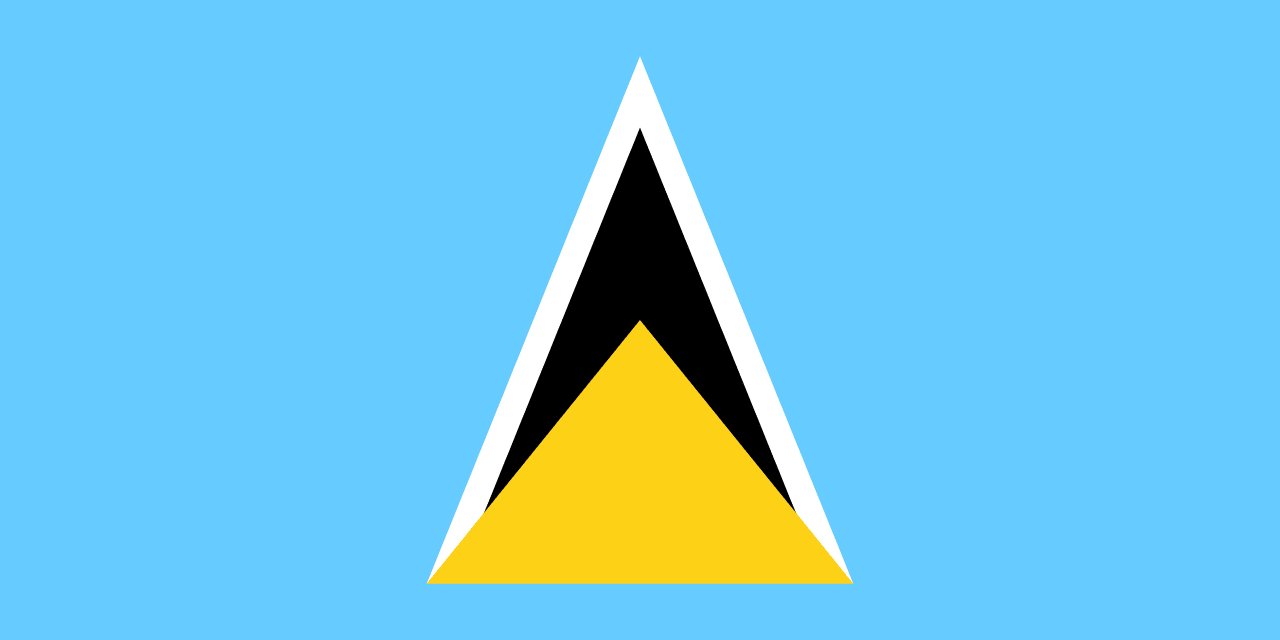
Few national flags capture the geography of their homeland as literally as the flag of Saint Lucia. Where many countries reach for abstract stripes or heraldic beasts, this small eastern Caribbean nation chose to put its most recognizable landscape feature right at the center of its banner. Look at the flag and you are, in a real sense, looking at the island itself: a deep blue sea, a bright tropical sun, and the twin volcanic peaks that rise dramatically from the coast. Adopted in 1979, the design is at once modern, minimalist, and unmistakably rooted in the natural identity of the country.
A Snapshot of the Design
The Saint Lucian flag is built on a cerulean blue field, a clear sky-and-sea tone that immediately signals the island's Caribbean setting. Resting at the center is a striking arrangement of geometric shapes: a set of triangles layered on top of one another. The visual effect is of two arrowhead forms rising from a common base, framed by contrasting colors. There are no words, no stars, and no coat of arms cluttering the composition. Instead, the strength of the flag comes from its restraint, a simple field punctuated by a single bold emblem that does a remarkable amount of symbolic work.
The shapes are intentionally crisp and balanced, sitting squarely in the middle of the blue ground rather than drifting toward a corner or edge. This central placement gives the flag a sense of stillness and focus, as if the eye is meant to settle directly on the peaks. It is a design that reads cleanly whether printed on a tiny lapel pin or stretched across a stadium banner.
What the Colors Mean
The palette of Saint Lucia's flag draws on four colors: cerulean blue, yellow, black, and white. Each carries its own layer of meaning. The blue represents the surrounding Caribbean Sea and the Atlantic Ocean, the waters that have shaped the island's history, economy, and daily life. It is the backdrop against which everything else is set, a reminder that this is fundamentally an island nation.
The yellow evokes the tropical sunshine that bathes the island and, by extension, the warmth and brightness of its people. The black and white together carry a powerful social message: they are read as a symbol of the harmony between the different ethnic groups who make up Saint Lucian society, living and working side by side. In this reading the colors are not merely decorative but a quiet statement about national unity and shared identity built from diverse roots.
The Pitons at the Heart of the Flag
The central emblem is the flag's defining feature, and it represents the Pitons, the two volcanic spires that are Saint Lucia's most famous landmark. Gros Piton and Petit Piton rise steeply near the town of Soufrière on the island's southwestern coast, and their distinctive cone-like silhouettes are recognized around the world. By placing stylized triangular peaks at the center of the flag, Saint Lucia turned a piece of its physical geography into a national emblem.
This is more than a pretty postcard image. The Pitons are a source of genuine national pride, and their importance is recognized internationally: the area around them is a UNESCO World Heritage Site, valued for its volcanic landscape and biodiversity. Anyone who wants to understand how deeply the mountains are woven into the island's sense of self can explore the broader story in our saint lucia country guide. On the flag, the triangles do double duty, standing for the peaks themselves while also lending the design its sense of upward motion and aspiration.
How the Flag Came to Be
Saint Lucia's flag did not appear out of nowhere in 1979. The design has its origins in the period when the island was moving toward greater self-government, and it was modified from an earlier version before reaching the form widely flown today. The year 1979 is significant because that is when Saint Lucia achieved independence, and the flag became the emblem of the new sovereign state.
The general concept, a blue field carrying the symbolic triangular peaks, was retained through this transition, which is why Saint Lucians have long associated the banner with their homeland even as small refinements were made to its proportions and exact shapes over the years. The continuity of the core idea is part of what gives the flag its sense of authenticity: it was not imposed from outside but grew out of the island's own emerging identity. Rather than discarding what came before, the country chose to refine and carry forward a design its people already recognized.
How It Compares to Other Flags
Set Saint Lucia's flag beside its Caribbean neighbors and the differences are immediately clear. Many island nations in the region favor horizontal or diagonal bands of color, the Bahamas, Barbados, and Jamaica among them. Saint Lucia instead opted for a centered emblem on a plain field, which makes it stand apart at a glance.
It is sometimes confused, at a casual glance, with other flags that use a blue ground and a central motif, but the triangular Pitons are unique to Saint Lucia and serve as an instant identifier. The closest comparison is often drawn with the flag of Cape Verde or other nations that center their geography or shapes, yet none reproduce the layered arrowhead peaks. The black-and-white element framed by yellow is also distinctive; few flags pair those particular tones in that arrangement. The result is a banner that, while sharing the blue Caribbean palette common across the region, is genuinely difficult to mistake for any other.
The Flag in National Life
Today the flag is a constant presence in Saint Lucian public life. It flies over government buildings, schools, and the official residences of the state, and it appears prominently each year around Independence Day in late February, when the country celebrates the 1979 milestone with parades, ceremonies, and displays of national color. Citizens wave it at cultural festivals and carry it abroad as a marker of identity wherever the diaspora has settled.
In international sport, the banner travels with Saint Lucian athletes to regional games and the Olympics, where its bright blue and central peaks make it instantly recognizable in the procession of nations. Whether stitched onto a uniform, painted on a face at carnival, or hoisted on a fishing boat, the flag functions as shorthand for a small but proud island that punches well above its size on the world stage.
Interesting Facts About the Flag
- The triangular emblem represents the Pitons, twin volcanic peaks that are a UNESCO World Heritage Site.
- The flag was adopted in 1979, the same year Saint Lucia became independent.
- Its four colors, cerulean blue, yellow, black, and white, each carry distinct symbolic meanings.
- The blue field stands for the Caribbean and Atlantic waters that surround the island.
- The black and white together symbolize harmony between the country's different ethnic groups.
- Unlike many Caribbean flags built from stripes, Saint Lucia's uses a single centered emblem.
Frequently Asked Questions
When was the flag of Saint Lucia adopted?
The flag was adopted in 1979, the year Saint Lucia gained its independence. Its central design, however, was modified from an earlier version used during the island's move toward self-government, so the core concept predates full independence.
What do the colors of the Saint Lucia flag mean?
The cerulean blue represents the Caribbean Sea and the surrounding ocean. The yellow stands for sunshine and the warmth of the people, while the black and white together symbolize the harmony among the different ethnic groups that make up Saint Lucian society.
What do the triangles on the flag represent?
The central triangles depict the Pitons, the two iconic volcanic peaks near Soufrière on the island's southwest coast. They are a national symbol and a UNESCO World Heritage Site, which is why they were chosen as the flag's defining emblem.
What continent is Saint Lucia on?
Saint Lucia is an island nation in the eastern Caribbean, part of the Lesser Antilles in North America. It sits in the chain of islands stretching between the Caribbean Sea and the Atlantic Ocean, which is why its flag leans so heavily on the color blue.