
Few national flags announce their identity as boldly as the flag of Barbados. With three clean vertical bands and a single, unmistakable emblem at its heart, it manages to be instantly recognizable while telling a layered story about the sea, the land, and a young nation stepping out from under colonial rule. Raised for the first time when the island became independent in 1966, the design has come to feel inseparable from Barbadian identity, fluttering over cricket grounds, government buildings, and beachside celebrations alike.
This article unpacks what makes the Barbadian flag so distinctive: the meaning behind its ultramarine, gold, and black, the symbolism of the famous broken trident, the moment in history it was born, and how it stands apart from the many other flags that share its tropical color palette.
A Tricolor Built From Sea, Sand, and Symbol
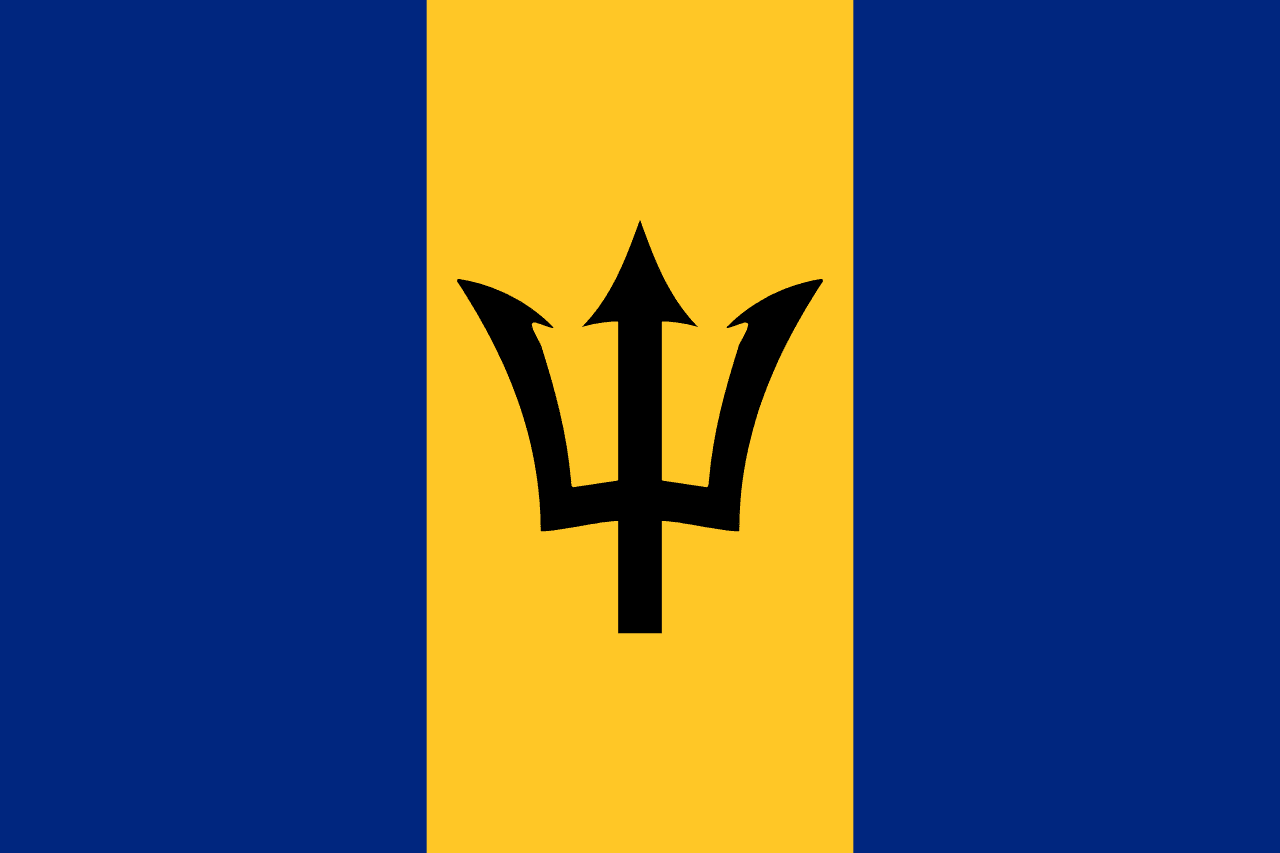
The flag of Barbados is a vertical triband, meaning it is divided into three equal upright stripes. The two outer bands are a deep ultramarine blue, and the central band is a warm gold. Centered within that gold stripe sits a black emblem: the head of a trident, broken off at the shaft.
The arrangement is deliberately simple, and that simplicity is part of its power. Where many flags crowd in coats of arms, stars, or written mottoes, Barbados chose a minimalist composition that reads clearly from a great distance and on a windblown pole. The proportions and the single off-center focal point give the flag a confident, modern look that has aged remarkably well since its debut.
What the Colors Actually Mean
Each color on the flag carries a specific, place-rooted meaning rather than an abstract political one. The two ultramarine bands stand for the sea and the sky that surround and arch over this Caribbean island, a reminder that Barbados is shaped by the Atlantic on every side. The gold central band represents the sand of the island's beaches, the bright coastline that has long defined the Barbadian landscape.
The black trident, set against the gold, ties the natural symbolism to the human story. Black gives the emblem its visual weight and lets it cut sharply against the lighter stripe, ensuring the trident remains the unmistakable center of attention. Together, blue, gold, and black weave a portrait of the nation's geography: ocean, shore, and the people who built a country between them.
The Broken Trident and Its Meaning
The single most important element of the flag is the trident head, and the detail that gives it meaning is what is missing. This is not a whole trident but a broken one, snapped off where the three-pronged head would have joined its handle.
The trident is associated with Poseidon, the sea god of classical mythology, and it had appeared on the colonial-era emblem of Barbados as a complete object. By breaking the shaft, the new design made a pointed statement: the country was severing its formal ties to its colonial past. The fractured trident represents the break from British rule and the birth of an independent Barbados. In this way the emblem doubles as both a nod to the island's maritime soul and a declaration of self-determination. The three points are often read as standing for the principles of democracy: government of, for, and by the people.
How the Flag Came to Be
Barbados adopted its flag in 1966, the year it gained independence from the United Kingdom. The transition from colony to sovereign nation called for symbols that belonged to Barbadians rather than to an imperial administration, and the flag was central to that reinvention.
The design emerged from a national competition held to choose a banner for the new country, a process that invited citizens to imagine how their island should present itself to the world. The winning concept kept the trident, an image already linked to Barbados, but transformed it. Rather than discard the symbol entirely, the design reclaimed it, cutting it loose from its colonial framing so that an old emblem could carry a new, forward-looking message. That continuity-with-a-twist is why the flag feels both rooted and fresh. To learn more about the island's wider story, geography, and culture, see our barbados country guide.
How It Compares to Similar Flags
The vertical triband is a popular format around the world, which means Barbados shares structural DNA with several well-known flags, yet none of them are easy to confuse with it once you know what to look for.
- Canada: Canada's flag is also a vertical triband with a single central emblem, but its outer bands are red and its center white, anchored by a maple leaf rather than a trident.
- Nigeria: Nigeria uses a green-white-green vertical triband with no central emblem at all, relying purely on color.
- France and Ireland: These classic European tribands use entirely different color schemes and, like Nigeria, carry no central symbol.
- Other Caribbean flags: Many neighboring nations favor blue and gold to evoke sea and sand, so the palette alone is not unique to Barbados. The black broken trident, however, is unmistakably Barbadian.
What ultimately sets the Barbadian flag apart is that distinctive emblem. Plenty of flags use ultramarine and gold, and plenty use the vertical triband layout, but the broken trident is a signature element found nowhere else, instantly identifying the banner as belonging to Barbados.
The Flag in National Life
For Barbadians, the flag is woven into the rhythm of public life. It flies prominently every November during Independence celebrations, when the anniversary of 1966 turns the whole island into a sea of ultramarine and gold. Schoolchildren learn the meaning of the colors and the trident as part of understanding who they are as citizens.
The flag also travels with the nation in sport, most visibly in cricket, a passion that runs deep across the island, where supporters wave it during matches and athletes carry it at international events. It marks embassies and official buildings, appears on civic documents and ceremonies, and surfaces in everyday design from clothing to local branding. Even as Barbados continued to evolve politically into the twenty-first century, the flag remained a steady, unifying constant, a piece of national identity that did not need to change.
Quick Facts Worth Knowing
- Barbados is an island nation in the Caribbean, generally grouped with North America among the world's continents.
- The flag's three official colors are ultramarine blue, gold, and black.
- The trident emblem is broken on purpose, symbolizing the clean break from British colonial control.
- The trident traces back to Poseidon, the sea god, fitting for an island defined by the ocean.
- The flag is a true vertical triband, with the gold band sitting between two equal blue bands.
- It was selected through a public design competition ahead of independence in 1966.
Frequently Asked Questions
When was the flag of Barbados adopted?
The flag was adopted in 1966, the same year Barbados became an independent nation after ending its status as a British colony. It was raised as part of the country's independence celebrations and has represented Barbados ever since.
What do the colors of the Barbados flag mean?
The two ultramarine blue bands represent the sea and sky surrounding the island, while the gold central band stands for the sand of its beaches. The black broken trident at the center symbolizes independence and the break from the colonial past.
Why is the trident on the flag broken?
The trident is shown broken to symbolize Barbados severing its ties with Britain and its colonial history. The emblem was adapted from an earlier colonial badge, and snapping off the shaft transformed it into a statement of independence and self-government.
What continent is Barbados on, and how does its flag compare to similar ones?
Barbados is a Caribbean island typically associated with North America. Its vertical triband layout resembles flags like Canada's and Nigeria's, but the unique black broken trident on a gold band makes it impossible to mistake for any other national flag.