
Few national symbols manage to say so much with so little. The flag of Nigeria is built from just two colors and three simple stripes, yet it carries the weight of Africa's most populous nation and the aspirations of more than 250 ethnic groups. Adopted on the very day Nigeria became independent in 1960, it has remained completely unchanged ever since. Behind its clean geometry lies a memorable origin story involving a national competition, thousands of hopeful designers, and a young student who would have his work flown over every government building in the country.
A Flag of Green and White
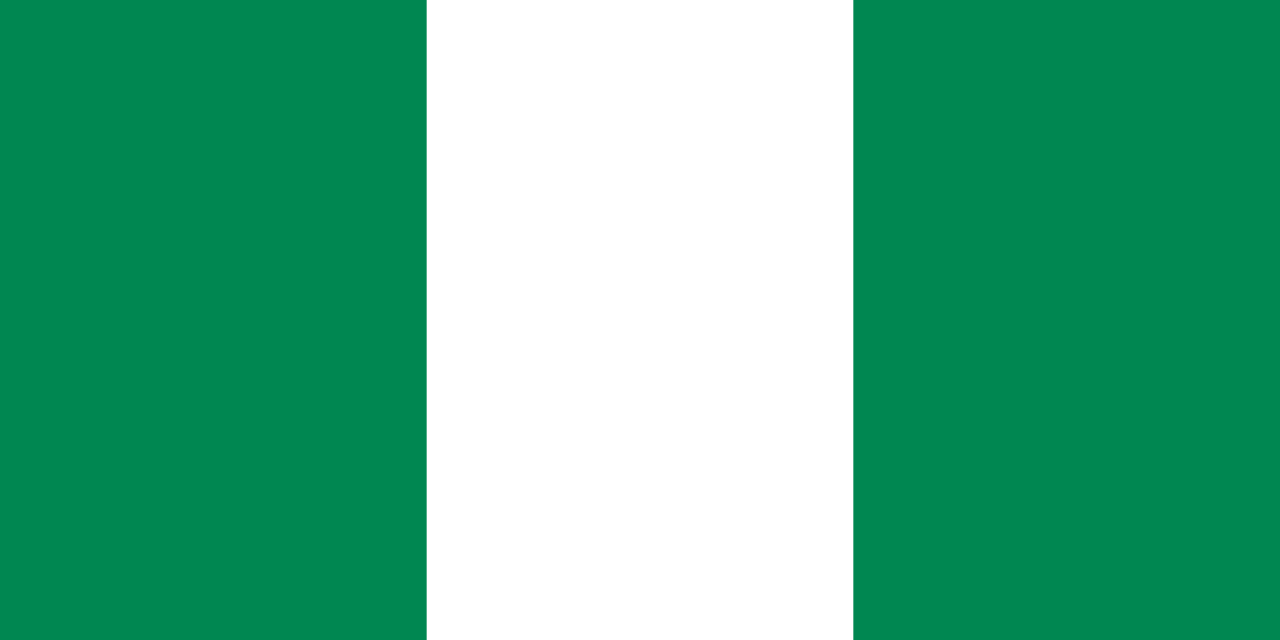
Nigeria's flag uses only two colors, green and white, arranged in three equal vertical bands. The two outer bands are green and the central band is white. The green is not a generic forest tone but a specific shade often described as "Nigerian green," chosen to evoke the lush vegetation, dense forests, and fertile farmland that stretch across much of the country, from the palm groves of the south to the savanna of the north. Agriculture and natural abundance sit at the heart of the design.
The white band in the center represents peace and unity. In a nation where hundreds of languages are spoken and several major religions coexist, that emphasis on harmony is deliberate, speaking to the hope that diverse peoples can share a single national identity without erasing what makes each group distinct.
Design and Proportions
The construction of the flag is refreshingly straightforward. Three vertical stripes of equal width divide the field into thirds, with the white stripe flanked symmetrically by green. The flag follows a 1:2 ratio, meaning it is twice as wide as it is tall, a proportion inherited in part from British conventions of the colonial era. This balance gives the banner a clean, elongated look that reads clearly whether stitched onto a lapel pin or hoisted on a stadium pole.
The symmetry is part of the appeal. Because the design is mirror-imaged left to right, there is no "wrong way" to display it horizontally, and its bold simplicity makes it instantly recognizable. There are no crests, stars, or emblems competing for attention, which is precisely why it works so well as a unifying image. Vexillologists often praise this kind of minimalism: a child can draw the Nigerian flag from memory, and that ease of reproduction is a practical hallmark of strong design.
The Student Who Designed a Nation's Flag
The story of how this flag came to be is one of the most charming in vexillology. In 1959, as Nigeria prepared for independence from British rule, the government held a national competition to design the new flag. The response was overwhelming, with more than 2,870 entries submitted from across the country and beyond, a small act of nation-building in itself.
The winning design came from Michael Taiwo Akinkunmi, a 23-year-old Nigerian student then studying in London. His original concept featured a red sun resting on the central white band, intended to represent "the bright future" of the soon-to-be independent nation. The judges admired the green-white-green layout but removed the red sun, leaving the spare two-color design we know today. For his winning entry, Akinkunmi received a prize of £100, and on October 1, 1960, his flag was raised for the first time as Nigeria celebrated its independence.
If you want to understand the country whose identity this banner represents, the nigeria country guide offers a fuller picture of its geography, peoples, and history.
From Colonial Ensign to National Banner
Before the green and white, the flag flying over the territory was a British colonial ensign, a defaced Blue Ensign bearing the Union Jack in the canton alongside a colonial badge. That symbol belonged to the imperial system rather than to the people living under it, so the 1959 competition was a chance to retire a borrowed identity and replace it with one chosen at home. Remarkably, the design has survived every political upheaval since, including military coups, a civil war, and the transition to democratic rule, never once being redesigned. That permanence is itself a quiet statement of continuity in a country that has changed enormously in other respects.
How It Compares to Similar Flags
At a glance, Nigeria's vertical tricolor invites comparison with two flags in particular. The first is Ireland, whose green-white-orange bands share the same vertical structure, though Ireland's orange band and Nigeria's repeated green quickly set them apart. The second is Ivory Coast, which also uses a vertical layout, though its orange-white-green palette makes it clearly distinct. What separates Nigeria most decisively is its symmetry: the green-white-green arrangement is mirrored, with no third color at all. This makes it unusual among national flags, most of which use three different colors when they adopt a tricolor format. It also means Nigeria sits apart from the classic pan-African palette of red, gold, and green, charting its own restrained path while still being unmistakably African.
A Symbol of Unity and Pan-African Pride
Nigeria is a country of extraordinary diversity, home to more than 250 ethnic groups and an even larger number of languages and dialects. The flag's central white band was never just decorative; it was a promise of cohesion among communities with very different traditions, faiths, and histories, a daily reminder that shared nationhood must be cultivated rather than taken for granted.
Because Nigeria is the most populous nation on the African continent, its flag is also one of the most widely seen symbols of African identity anywhere in the world. For many, the green and white have come to represent hope and progress not only for Nigerians but for the broader pan-African movement.
The Flag in Everyday Life
The most visible moment for the flag each year is Independence Day on October 1, when it appears in parades and ceremonies across the country, often accompanied by the raising of the flag at Eagle Square in Abuja. Beyond official occasions, the green and white truly come alive in the world of sport. Nigerian football supporters are famous for their exuberant flag-waving during FIFA World Cup qualifiers and the Africa Cup of Nations, turning stadiums into seas of green and white whenever the Super Eagles take the field.
The flag also features prominently at Nollywood events and at cultural festivals organized by the Nigerian diaspora worldwide. It appears on jerseys, lapel pins, market stalls, and the backdrops of music videos by Afrobeats stars whose songs now travel the globe. Whether it is draped over the shoulders of a triumphant athlete or printed on a banner thousands of miles from Lagos, the design carries a recognizable energy and pride.
Interesting Facts About the Nigerian Flag
- The original winning design included a red sun on the white band, but the judges removed it before adoption.
- Designer Michael Taiwo Akinkunmi was just 23 years old and studying in London when he created it.
- He won a cash prize of £100 for the winning entry.
- The flag has never been changed since it was first raised at independence in 1960.
- As Africa's most populous country, Nigeria gives its flag one of the largest constituencies of any banner on the continent.
Frequently Asked Questions
When was the flag of Nigeria adopted?
The flag was officially adopted and raised for the first time on October 1, 1960, the day Nigeria gained its independence. It was selected through a national design competition held the previous year, in 1959.
What do the colors of the Nigerian flag mean?
The two green stripes represent Nigeria's natural wealth, including its forests, vegetation, and agricultural land. The white central stripe stands for peace and unity among the country's many ethnic and religious groups.
Who designed the flag of Nigeria?
It was designed by Michael Taiwo Akinkunmi, a 23-year-old Nigerian student living in London at the time. His entry won a national competition that drew over 2,870 submissions, and he received a £100 prize for it.
Why was the red sun removed from the original design?
Akinkunmi's original entry placed a red sun on the central white band to symbolize "the bright future" of the new nation. The competition judges preferred a cleaner look and removed the sun before adoption, leaving the symmetrical green-white-green design. The change gave the flag its distinctive minimalism.
What continent is Nigeria on, and which flags look similar?
Nigeria is located in Africa. Its green-white-green vertical layout invites comparison with flags such as those of Ivory Coast and Ireland, both of which also use vertical bands; however, Nigeria's design is distinct in using only green and white in a symmetrical green-white-green arrangement.