
Few flags capture the spirit of their homeland as vividly as the flag of the Bahamas. Raised for the first time at the stroke of midnight on July 10, 1973, when the archipelago became an independent nation, it distills an entire scattered country of islands, cays, and shimmering shallows into three bold bands and a single dark triangle. Where many newly independent nations leaned on the colors of former colonial powers or pan-regional movements, the Bahamas chose a palette pulled straight from its own horizon: the turquoise of the sea, the gold of sun and sand, and the black of a determined people. The result is a banner that feels less like an abstract emblem and more like a snapshot of standing on a Bahamian beach looking out at the water.
A Country Painted in Sea, Sun, and Strength
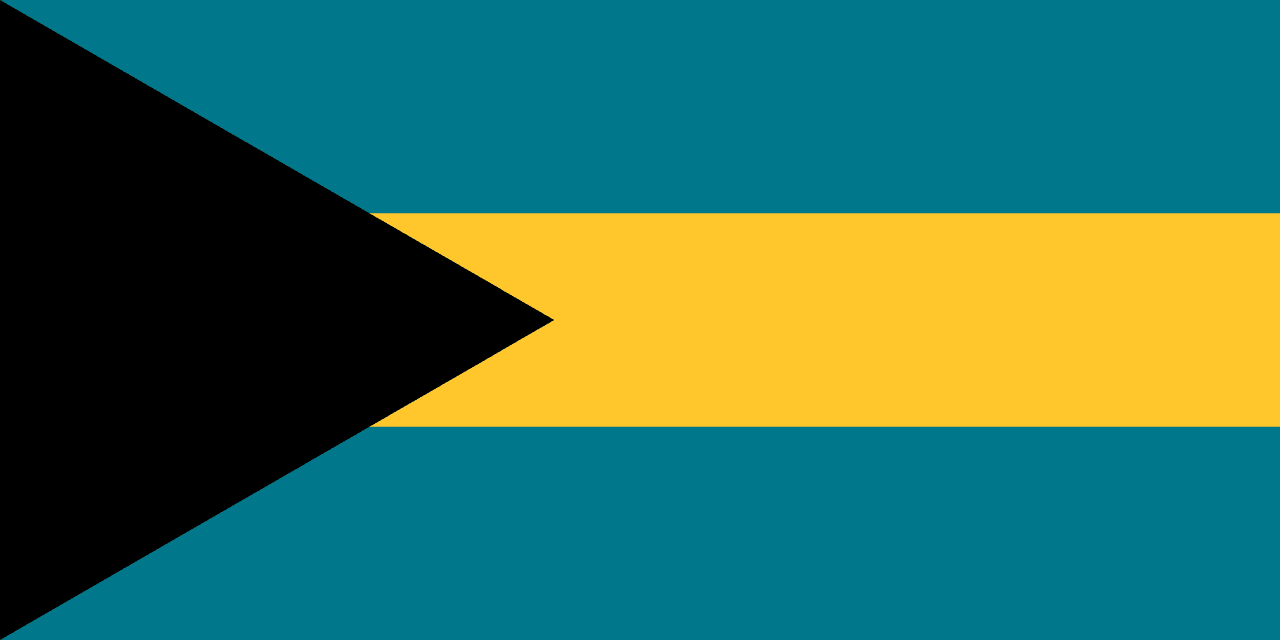
The Bahamian flag uses just three colors, and each was selected deliberately to speak about the land and its people. The aquamarine, that luminous blue-green so closely tied to the Caribbean and Atlantic waters surrounding the islands, represents the surrounding sea that has shaped every aspect of life across the archipelago. The gold stands for two of the nation's most abundant natural gifts: the bright sun that warms the islands year-round and the pale sand that lines hundreds of beaches. The black, meanwhile, carries the heaviest symbolic weight, representing the strength, vigor, and unity of the Bahamian people. Together the three colors form a kind of shorthand for the country itself, a people of strength reaching forward to enjoy and develop the rich natural resources of land and sea.
Reading the Design
The layout is elegant in its simplicity. The field is divided into three equal horizontal stripes: aquamarine on the top, gold in the center, and aquamarine again along the bottom. Overlaying this striped background, anchored against the hoist (the side nearest the flagpole), is a solid black equilateral triangle pointing toward the center and the fly end. The triangle's apex thrusts inward, breaking the horizontal calm of the stripes with a sense of direction and momentum.
That geometry is more than decoration. The two aquamarine bands frame a golden core, evoking the way the islands sit cradled between sea and sky, ringed by clear water and topped by sunlit sand. The black triangle, projecting outward from the hoist, is widely understood to symbolize the enterprise, vigor, and forward-looking determination of the Bahamian people as they harness the resources represented by the colors behind it. The design avoids any crest, animal, star, or coat of arms, relying entirely on color and shape to deliver its message, which gives it a clean, modern confidence that has aged remarkably well.
From Colony to Nation: How the Flag Came to Be
For centuries the islands flew British colonial ensigns, defaced with local badges in the manner common across the British Empire. As the Bahamas moved toward self-governance in the mid-twentieth century, the question of a distinct national identity took on real urgency. In the lead-up to independence, the islands held a public design competition, inviting Bahamians to propose a flag that would represent the new country. No single submitted entry was adopted outright; instead, a committee blended the strongest ideas into a composite design, which explains why the final flag feels both fresh and broadly representative rather than the work of one hand.
The chosen design was formally hoisted on July 10, 1973, the day the Bahamas became a sovereign nation within the Commonwealth, ending more than two centuries of British rule. From that first raising, the flag has remained unchanged, a rare constancy that speaks to how well the original concept landed. Unlike many post-colonial flags that were later revised or tweaked, the Bahamian banner has needed no correction, standing as a stable symbol through the country's first half-century of independence.
How It Compares to Its Caribbean Neighbors
The Bahamas sits geographically just off the southeastern coast of North America, and like several of its Caribbean and Atlantic neighbors it favors a tropical palette and a triangular accent. The combination of a triangle at the hoist and horizontal bands invites quick comparison with other regional flags, yet the Bahamian design stands clearly apart. Jamaica's flag, for instance, also uses gold and black but arranges them in a diagonal saltire with green, producing a completely different visual rhythm. Guyana's "Golden Arrowhead" leans on triangles too, but in red, gold, green, white, and black with the triangles pointing the opposite way.
What distinguishes the Bahamian flag most is its restraint and the specificity of its meaning. The doubled aquamarine stripes around a single gold band create a sea-sand-sea sandwich that no other national flag replicates, and the lone black triangle against that bright background is instantly recognizable. Where some neighbors crowd their flags with multiple emblems, the Bahamas trusts three colors and one shape to do all the work. To see how the flag fits into the wider story of the islands, their geography, and their culture, you can explore our bahamas country guide.
A Symbol of Bahamian Identity
Within the Bahamas, the flag functions as a daily reminder of hard-won sovereignty. For a nation made up of roughly 700 islands and thousands of smaller cays spread across a vast stretch of ocean, a unifying emblem matters enormously. The black triangle's message of unity and strength resonates in a country where communities are physically separated by water yet share a single national story. The flag binds Bimini in the northwest to Inagua in the far southeast under one set of colors.
The colors also carry quiet pride about the natural inheritance that defines Bahamian life. Tourism, fishing, and seafaring all flow from the sea the aquamarine celebrates, and the gold honors the sun and sand that draw visitors from around the world. In schools, government buildings, and homes, the flag teaches each new generation that the country's beauty and its people's resilience are intertwined.
The Flag in Modern Life
Today the Bahamian flag is woven into the rhythm of national life. It flies prominently every July 10 during Independence Day celebrations, when fireworks, parades, and church services mark the anniversary of 1973. Athletes carry it onto the world stage at the Olympic Games and regional competitions, and few sights stir Bahamian pride like a sprinter draped in aquamarine, gold, and black after a victory. The flag also appears on government vessels and is reflected in the Bahamian civil ensign and other maritime variants, a fitting nod to a seafaring nation whose ship registry is among the largest in the world.
Beyond the formal occasions, the colors turn up in everyday celebration, from regatta festivals in the Out Islands to Junkanoo street parades, where the national palette mingles with the riot of color that defines Bahamian culture. The flag has become a compact, joyful expression of belonging.
Interesting Facts About the Flag of the Bahamas
- The flag was first raised at independence on July 10, 1973, and has never been altered since.
- Its three colors, aquamarine, gold, and black, were chosen specifically to represent the sea, the sun and sand, and the strength and unity of the people.
- No single person designed it; a committee combined ideas from a national design competition into the final composite.
- The black triangle points away from the flagpole, symbolizing the enterprise and vigor of Bahamians reaching toward the resources of land and sea.
- The doubled aquamarine stripes surrounding a central gold band give the flag a sea-sand-sea structure unlike any other national flag.
- Despite being made up of hundreds of islands, the Bahamas unites under this single banner, with the black triangle expressing national unity.
Frequently Asked Questions
When was the flag of the Bahamas adopted?
The flag was adopted in 1973, raised for the first time on July 10 of that year as the Bahamas gained independence from Britain. It has remained unchanged ever since, making it one of the more stable national flags of the post-colonial Caribbean.
What do the colors of the Bahamian flag mean?
The aquamarine represents the sea that surrounds the islands, the gold stands for the bright sun and the sandy beaches, and the black symbolizes the strength, vigor, and unity of the Bahamian people as they develop the resources of land and sea.
Who designed the flag of the Bahamas?
There was no single designer. In the run-up to independence, the country held a public design competition, and a committee blended the best submitted ideas into the final composite design that was officially adopted in 1973.
What continent is the Bahamas on, and how does its flag compare to similar ones?
The Bahamas lies in North America, just southeast of Florida in the Atlantic. While it shares gold and black with Jamaica and a triangular motif with Guyana, its unique sea-sand-sea striping and lone black triangle set it clearly apart from those neighbors.