

Ouagadougou is the capital and largest city of Burkina Faso. It sits on the savanna plateau in the centre of this landlocked West African country, and the 2019 census counted 2,415,266 people there. Locals shorten the name to "Ouaga" and call themselves Ouagalais. The city is the country's seat of government and its commercial hub, and it has been a royal seat for centuries: the Mogho Naaba, king of the Mossi, still holds court here every Friday morning. The six places below each carry a slice of that history, running from a settlement that may be a thousand years old, through French colonial rule to the revolutionary 1980s.
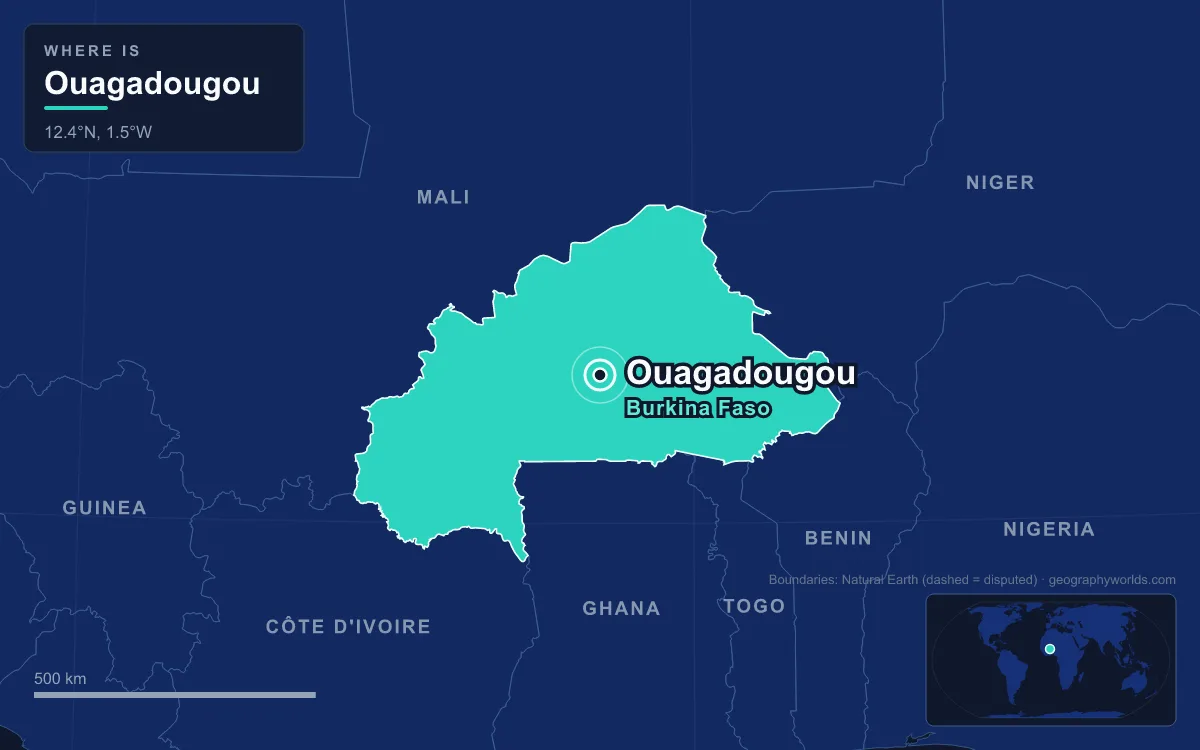
Ouaga has older roots than most African capitals. According to Wikipedia's account of its origins, Soninke traders of the Wangara diaspora may have founded a settlement here as early as 1050. They came from the Ghana Empire, also called Wagadu, and the name Wagadugu means "home of the Wagu", the Soninke subgroup that ruled Ghana. "Ouagadougou" is simply the French spelling of that name. Mossi horsemen moving north took the town in the 14th century. By around 1495 the kingdom of Wagadugu had become the leading power among the Mossi states. When French troops arrived on 5 September 1896 they burned it to the ground. The city you see today was rebuilt in stages after that: first as a colonial capital, then as the capital of independent Upper Volta, and from 1984 as the capital of Burkina Faso.
The Moro-Naba Palace and Its Friday Ceremony
The best place to start is the compound of the Mogho Naaba, often written Moro-Naba. His title is usually translated as "king of all the world". The largest Mossi kingdom was Ouagadougou's, and its ruler stood at the head of all the Mossi. Oral tradition traces the royal line to Princess Yennenga and her son Ouédraogo, and Mossi chronicles number each king in turn. Nyadfo, the 10th Moro-Naba, was the first to live at Ouagadougou, in the middle of the 17th century. About a century later the 21st, Zombre, made it the permanent royal capital.
The kingship survived colonial conquest. The French conquered the kingdom in 1896 and for decades governed the region largely through the Mossi administrative structure. The monarchy has no sovereign power today, but it still carries weight in politics and culture, and Naba Baongo II is the current Mogho Naaba. Visitors come for the Moro-Naba Ceremony, held every Friday at about 07:00. Mossi chiefs sit in order of rank. The king appears dressed in red with a saddled horse, as if about to ride to war. A cannon fires and the senior chiefs pledge their loyalty. The king then withdraws and comes back in white, the colour of peace. Doolo (the local beer) and kola-nut drinks are handed round, and the king holds court. The ritual is usually explained as a re-enactment of ministers persuading their king not to go to war.
The Cathedral of the Immaculate Conception, 1936
The French made Ouagadougou the capital of the Upper Volta territory in 1919 and rebuilt much of the town. Christian missions arrived with the administration. The best-known building they left behind is the Cathedral of the Immaculate Conception, seat of the Roman Catholic Archdiocese of Ouagadougou. Joanny Thévenoud, the apostolic vicar from the White Fathers missionary society, built it during the period of French West Africa. It took two years to complete and was dedicated on 19 January 1936. Its red-brown walls, twin square towers and rows of narrow arched windows give it a fortress-like look. Behind the cathedral, near the car park, an altar dedicated to Mary holds a statue of the Virgin inside a carved stone arch.
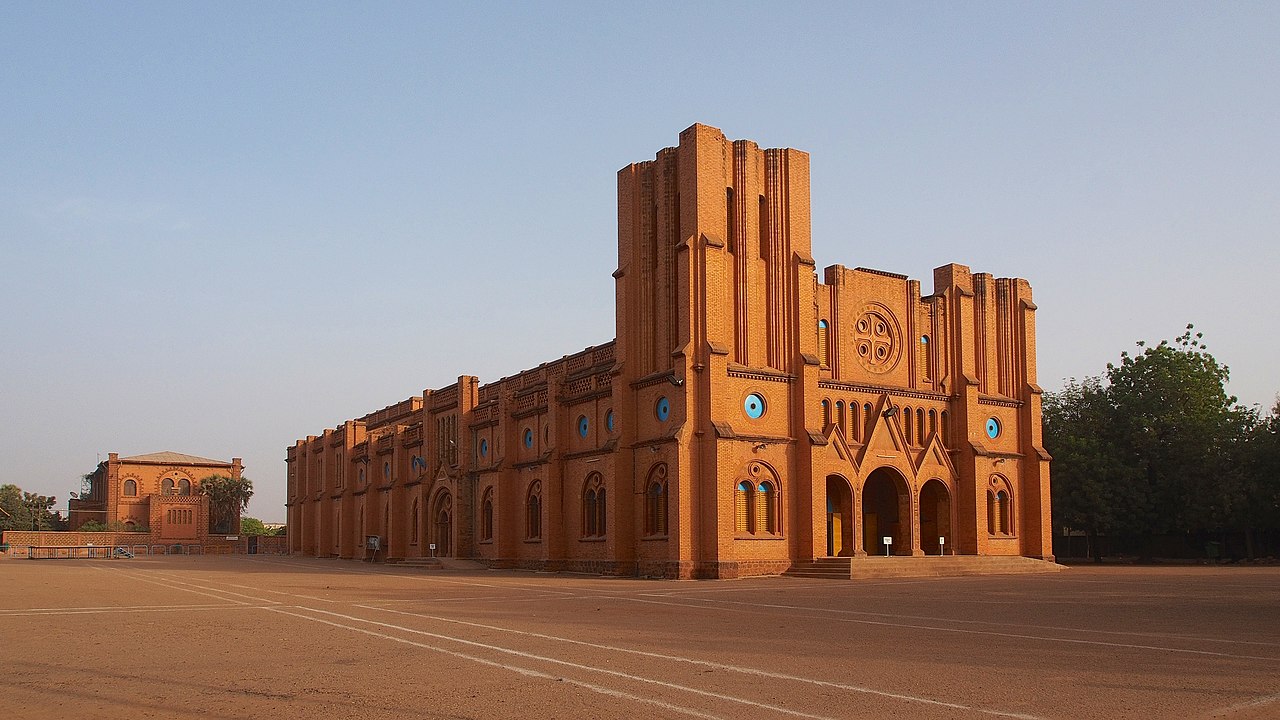
The cathedral stands for one strand of the city's religious life, but it is not the largest one. Mosques are the most common places of worship in Ouagadougou. There are also many churches, including Reformed congregations, the Assemblies of God and the Deeper Life Bible Church. The city's official language is French, but on the street you will mostly hear Mooré, Dyula and Fulfulde. Since 1994 bilingual schools have taught in French alongside one of those local languages.
The Grand Mosque Rebuilt by Oumarou Kanazoé
Islam came to Ouagadougou through the royal court as well as through trade. The 24th Moro-Naba, Doulougou, built the city's first mosque early in the 19th century. The present Grand Mosque stands on a site first set aside in 1952. Local Muslims had campaigned for land for a Friday mosque, the Moro-Naba supported their request and the colonial administration gave its approval.
As the city grew, the first building became too small. Between 1973 and 1979 it was rebuilt under Oumarou Kanazoé, a businessman and Muslim community leader. Reports at the time said he paid for the whole project himself, at a cost of roughly 320 million West African CFA francs. President Sangoulé Lamizana opened the new mosque in April 1979. Its main prayer hall covers about 1,925 square metres, with two annexes for women and a paved courtyard of around 7,000 square metres. Four minarets and a central dome make it one of the easiest landmarks to pick out in the centre. It remains a main venue for Friday prayers.

The Railway Station and the Naba Koom Statue
The single biggest change to modern Ouagadougou arrived by train. In 1954 the railway from Côte d'Ivoire reached the city, giving landlocked Upper Volta a link to the port of Abidjan, and the population began to grow very quickly. The line still defines the city's trade. In June 2014 the operator Sitarail was running a passenger train three times a week between Ouagadougou and Abidjan, with passenger services also reaching Bobo-Dioulasso and Koudougou. Freight trains continue north to Kaya.
Arriving passengers are greeted by Naba Koom. This 6-metre statue of a woman pouring water from a calabash faces the station, and the spot bears the name of an important chief in Burkina Faso's history. The trade that the railway brought is easy to see nearby. Ouagadougou has one of West Africa's largest markets. It burned down in 2003 and reopened with better facilities and fire protection. Most of the economy is informal: petty trade around markets, along the main roads and in neighbourhood stalls. Factories are concentrated in the Kossodo and Gounghin industrial zones, and some plants have moved here from Bobo-Dioulasso, the country's second city. Jobs in food processing, textiles and other workshops keep drawing people in from the countryside. That migration helps explain the growth from a colonial town to a city of more than two million. The comparison with Burkina Faso's other urban centres appears in our guide to the largest cities in Burkina Faso.
Stade du 4-Août, Sankara's Stadium
The national stadium's name marks a coup. On 4 August 1983 a group of revolutionaries seized power and made Thomas Sankara president of Upper Volta. Construction of the stadium had begun in 1981 as part of a national sports programme built with Chinese cooperation. Sankara inaugurated it on 18 July 1984. In August 1984, on the first anniversary of the coup, his government renamed the country Burkina Faso, "land of the upright people", and Sankara wrote the new national anthem himself. His programme of vaccination, literacy and tree-planting made him a pan-African icon. It ended when he was assassinated on 15 October 1987 by troops led by Blaise Compaoré, who then ruled until the 2014 uprising. The capital's airport, which lies only about 1.5 kilometres southeast of the main commercial area, now carries Sankara's name.
The stadium holds 29,800 spectators and is home to Étoile Filante de Ouagadougou. It also hosts the opening night of FESPACO, the Panafrican Film and Television Festival of Ouagadougou. FESPACO accepts only films by African film-makers for competition. It started in 1969 with 23 films and five African countries taking part, and was formally made an institution by decree on 7 January 1972. That same year it created its top prize, the Étalon de Yennenga, named after the Mossi princess of the founding legend. Held every second year in March, FESPACO is widely regarded as the leading event in African cinema. Around it the city hosts other festivals, including SIAO (the International Arts and Crafts Fair) and FESPAM (the Pan-African Music Festival). The stadium had a difficult spell. On 2 March 2021 the Confederation of African Football banned it for poor pitch, drainage and security standards, and the national team had to play home matches abroad. After renovation it received CAF approval on 1 July 2025 and reopened on 4 August 2025, the anniversary it is named for.
Bangr-Weoogo, the Sacred Forest Turned Urban Park
The last stop is the city's green lung. Bangr-Weoogo urban park covers 2.63 square kilometres. Before colonial rule it belonged to the Mossi chiefs, who treated it as a sacred forest used for initiations and as a place of refuge. In the 1930s the French turned it into a park, ignoring its local meaning. It was renovated in 1985 and renamed in January 2001 as Parc Urbain Bangr-Weoogo, "the urban park of the forest of knowledge". In the same spirit the Jardin de l'amitié Ouaga-Loudun, a garden near the United Nations crossroads renovated in 1996, marks the city's twinning with Loudun in France.
Shade matters here. Ouagadougou has a hot semi-arid climate, close to tropical wet-and-dry, and gets about 800 millimetres of rain a year, almost all of it between May and September. March and April are the hottest months, with highs that can reach 43 °C. From October to February the harmattan blows dry, dusty air south from the Sahara, and night-time averages fall to about 16 °C. The city lies in the Sudano-Sahelian zone, which explains the pattern of rains and harmattan. Our explainer what is the Sahel covers that belt in more detail.
Rapid growth is putting pressure on every one of these places. The city is divided into five arrondissements made up of 30 sectors, with districts such as Gounghin, Paspanga and Koulouba. The airport, which was on the southern edge of town when it was built in the 1960s, is now surrounded by housing, so a replacement airport, on which construction started in 2021, is going up near Donsin, roughly 35 kilometres to the northeast. The state University of Ouagadougou, founded in 1974, had about 40,000 students in 2010, some 83 percent of all the country's university students. A satellite town called Yennenga, planned for about 80,000 residents on 678 hectares some 15 kilometres from the capital, was under construction in early 2026. Its name comes from the same princess who gave FESPACO its trophy. For the wider picture, from the Mossi plateau to the country's borders, see our Burkina Faso country guide.
Quick Facts About Ouagadougou
- Country: Burkina Faso
- Continent: Africa (West Africa)
- Country population: approximately 24.6 million
- Capital city status: Ouagadougou is the capital of Burkina Faso, the seat of national government, and the location of foreign embassies, parliament, and the head of state's official residence.
Frequently Asked Questions
What is the capital of Burkina Faso?
The capital of Burkina Faso is Ouagadougou. Ouagadougou is the seat of national government, hosts most foreign embassies and consulates, and is typically where the head of state and parliament are located.
What continent is Ouagadougou in?
Ouagadougou, the capital of Burkina Faso, is located in Africa, in the West Africa region. As Burkina Faso's capital, Ouagadougou serves as the country's primary connection to the broader African political, economic, and cultural sphere.
Why is Ouagadougou the capital of Burkina Faso?
Ouagadougou was chosen as the capital of Burkina Faso for reasons that typically combine geography, history, and politics. Capital city selections often reflect a desire for centrality (being accessible from across the country), historical importance (being a longstanding seat of government or culture), or neutrality (being acceptable to multiple regions or ethnic groups within the country). The specific reasons for Ouagadougou's designation are detailed in the city's history above.
What is Ouagadougou known for?
As the capital of Burkina Faso, Ouagadougou is best known for housing the country's central government institutions — parliament, presidential or royal residences, supreme court, and key ministries. It is also typically a major cultural and economic center within Burkina Faso, hosting national museums, embassies, and signature monuments. The introduction and history sections above provide detailed coverage of the city's specific notable institutions and landmarks.
Related Pages
- Burkina Faso Country Guide — full geography, climate, economy, and culture overview
- Flag of Burkina Faso — meaning, history, and design of Burkina Faso's national flag