

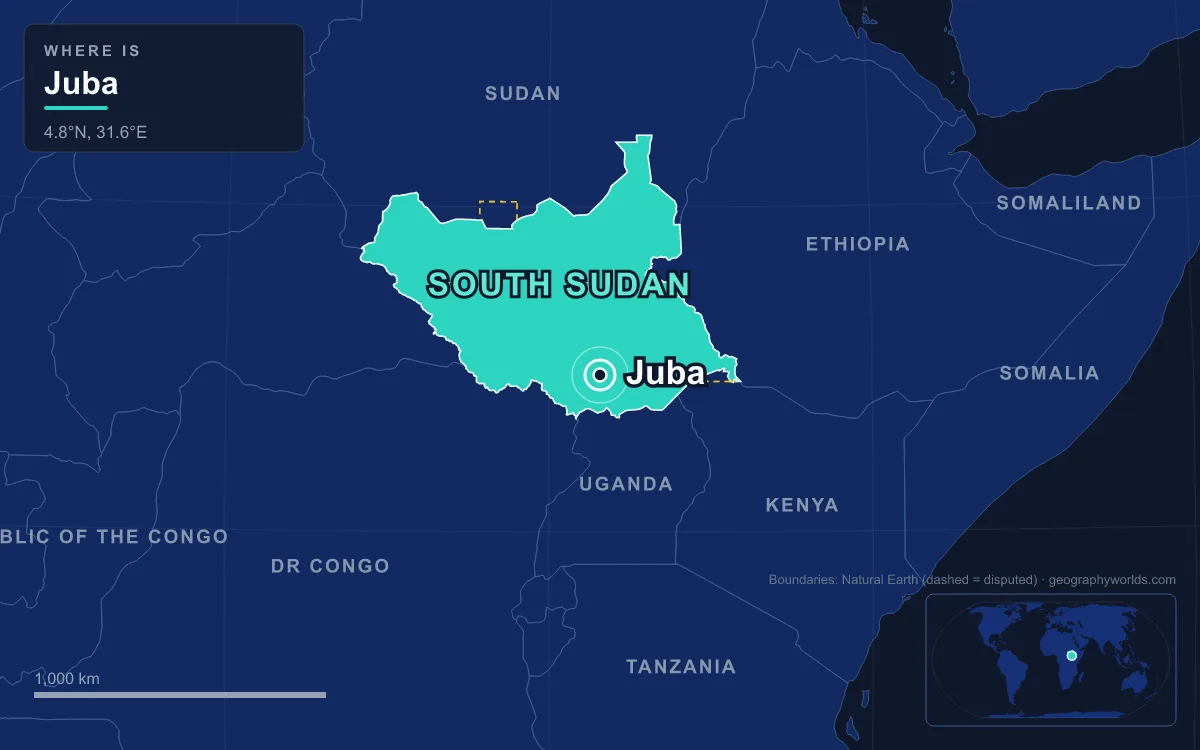
Juba is the capital and largest city of South Sudan, and it is named after the small Bari village on whose land it was built a century ago. The city stands on the White Nile in the far south of the country, in Central Equatoria State, of which it is also the capital. A 2017 estimate put its population at 525,953, within a city area of about 52 square kilometres and a metropolitan area of about 336. Since South Sudan declared independence on 9 July 2011, Juba has been the world's most recently declared national capital. Almost everything about it, from the language on its streets to the shape of its neighbourhoods, comes from the peoples who have arrived there in waves: Bari farmers, Egyptian garrison soldiers, missionaries, Greek merchants, returning refugees, East African traders and, most recently, people fleeing war in Sudan.
The Bari Villages Between Gondokoro and Rejaf
The land Juba occupies belongs to the Bari, a Nilotic people who are today the fourth-largest ethnic group in South Sudan, after the Dinka, Nuer and Azande. The Bari of the Nile are settled agropastoralists who farm the savanna up to about 40 miles east and west of the river and keep cattle as much for marriage gifts, ceremonies and savings as for food. Their historic riverside villages include Mongalla, Lado, Gondokoro and Rejaf. Juba lies about ten miles south of Gondokoro and seven miles north of Rejaf.
Those two neighbours explain why the capital ended up here. Gondokoro, a trading station on the east bank of the Nile about 1,200 kilometres south of Khartoum, sat near the upstream limit of navigation from the north, which made it the gateway to the lands beyond. It was there, on 13 February 1863, that the explorers John Hanning Speke and James Augustus Grant, exhausted after walking from Zanzibar, were greeted by Samuel and Florence Baker, and there in 1874 that Charles George Gordon secured the region for the Khedive of Egypt. Under the Khedivate, the Juba area was the Egyptian army's southernmost garrison, quartering only a handful of soldiers who suffered badly from malaria, meningitis and blackwater fever. The Bari paid for this traffic: they were devastated by slave raiders, and the raids spread the tsetse fly that shrank their herds.
The town itself began with a school. In 1920 and 1921 the Church Missionary Society set up a mission and the Nugent Memorial Intermediate School in the Bari village called Juba. In the late 1920s Anglo-Egyptian officials chose the site for the new capital of Mongalla Province, partly because the school was there and partly because of the river. They ordered the Bari residents to move, and major construction was under way by 1927. Traders from Rejaf relocated in 1929 and the governor's office followed in 1930. Around 1922 Juba had also replaced Gondokoro as the furthest navigable point on the Nile. The displacement left a long shadow: during the rapid growth of the 2000s, Bari communities kept their distance from newcomers, and that tension shaped how land in the city was handed out.
Greek Merchants and the Hai Jalaba Quarter
The early commercial town was built to a surprising degree by Greeks. Greek merchants supplying the British Army arrived in the early 1920s. They never numbered more than about 2,000, but they had good relations with the Bari and received a great deal of local help, and they put up many of the buildings around the downtown Juba Market and in what British soldiers called the Greek Quarter, today the small suburb of Hai Jalaba.
A number of those buildings still stand. Greeks built the Juba Hotel in the mid-1930s and the Central Bank building in the mid-1940s, as well as the premises later occupied by the Ivory Bank, the Nile Commercial Bank and the Buffalo Commercial Bank, the old Sudan Airways building, the Paradise Hotel and the Notos Lounge. The three banks, all South Sudanese-owned, still keep their headquarters in the city.
Juba was then part of Anglo-Egyptian Sudan, and the British had long run the south separately from the north. When the administration switched in 1946 to a policy of uniting the two, without consulting southern opinion, it convened the Juba Conference as a gesture towards southerners. Sudan became independent in 1956; a year earlier a mutiny of southern soldiers at Torit had started the First Sudanese Civil War, which lasted until 1972. The University of Juba was founded in 1975, after the 1972 Addis Ababa Agreement gave the south autonomy, as the first institution of higher education in southern Sudan; it admitted its first students in 1977. During the Second Sudanese Civil War the university moved to Khartoum for safety, and it only fully returned after independence in 2011. Today it has about 40,000 students.
Juba Arabic, the Language Named After the City
The everyday language of Juba's streets and markets is Juba Arabic, known since 2011 as South Sudanese Arabic. It grew up in the nineteenth century as a pidgin among the descendants of Sudanese soldiers, many of whom had been recruited in the south, and it takes its vocabulary from Sudanese Arabic but has a much simpler grammar shaped by local languages such as Dinka, Bari, Pojulu and Shilluk.
Juba Arabic is the lingua franca of Equatoria, and it is reportedly the most widely spoken language in South Sudan, ahead of English, the official language, even though governments have discouraged it because of its association with past Arab rule. It is a regional rather than national speech: in Malakal and Wau, the other large towns, people tend to use Arabic closer to Sudanese Arabic alongside their own languages. Juba's dinner tables are similarly mixed. Kisra is a fermented sorghum flatbread and asida a sorghum porridge; bamia is an okra and meat stew; ful medames is a breakfast of mashed fava beans; malakwang is a stew of greens and peanuts; and ugali is the maize porridge eaten in many African countries.
Religion is less mixed. Places of worship in Juba are mostly Christian, fitting for a town that began as a mission station, with the Roman Catholic Archdiocese of Juba, the Episcopal Church of South Sudan, Baptist and Presbyterian churches all based here.
Returnees, Cattle Keepers and Traders from Kampala and Nairobi
For most of the second civil war, Juba was a garrison town held by the Khartoum government and cut off from much of its hinterland, and many of its original inhabitants fled south to Uganda. The Comprehensive Peace Agreement of 2005 turned it into the capital of the Autonomous Government of Southern Sudan, and people poured in. The United Nations moved its southern operations from Kenya into a base known as OCHA Camp, aid agencies followed, and refugees and returnees built new neighbourhoods that often reproduced the village life they had left.
The official figures in the chart are almost certainly low. The 2008 Sudan census counted 372,413 people in Juba County, a result the southern government rejected, and one account has the population rising from 250,000 to a million between 2006 and 2011. The city council's chief executive has claimed more than a million residents, with up to a million more in the suburbs. Growth was running at about 4.23 percent a year in 2013.
The boom drew traders from northern Sudan and from East Africa. The Kenya Commercial Bank and the Commercial Bank of Ethiopia set up South Sudanese headquarters in Juba, and Uganda's National Insurance Corporation opened an office. Research by the Overseas Development Institute found many traders treated Juba as a place for quick profit, not investing in storage or shops. The road to Uganda was the first to be rebuilt, and it mattered especially because so many of Juba's original inhabitants had fled to Uganda during the war. Rural life came too. Cattle are a common sight on Juba's roads, and the capital sits close to cattle-keeping country: the lands of the Mundari, part of the same Karo family as the Bari, begin about 75 kilometres to the north around Terekeka.

The peace did not hold. In December 2013 fighting between forces loyal to President Salva Kiir and to former vice-president Riek Machar left about 300 dead in the suburbs, and clashes returned in July 2016. After the former army chief of staff Paul Malong Awan was removed from the city in November 2017, Juba became a fortified stronghold of the president, with armed groups a constant presence in its governance.
Ramciel, the Nile Bridges and the Newest Arrivals of 2023
Juba's position as capital has never been settled. On 5 September 2011, two months after independence, the government announced that the capital would move about 250 kilometres to Ramciel, a planned site near the geographic centre of the country in Lakes State. As of January 2026 the move had not happened.
Meanwhile the city has had to be stitched together across the river. For hundreds of miles the only way over the Nile was once an irregular ferry, until a bridge built by the Dutch firm De Groot International from Second World War Bailey bridge parts opened on 15 March 1974. After one span collapsed during the fighting, two replacement 252-metre spans were installed in 2006, and a new crossing, the Freedom Bridge, costing more than $92 million, opened a little upstream in 2022.

The newest wave of people came the other way along the Nile. Since war broke out in Sudan in 2023, about 6,000 refugees have arrived in Juba, many settling in Gorom near the city with little aid. They join a city that sits in a tropical wet and dry climate, with almost 1,000 mm of rain a year falling mainly from April to October and dry-season highs of 37.8 °C in February. The river that links all these arrivals has its own profile in our White Nile guide; the rest of the country's peoples and regions are covered in the South Sudan country guide; and the capital of the country the newest arrivals fled is profiled in our article on Khartoum.
Quick Facts About Juba
- Country: South Sudan
- Continent: Africa (East Africa)
- Country population: approximately 12.4 million
- Capital city status: Juba is the capital of South Sudan, the seat of national government, and the location of foreign embassies, parliament, and the head of state's official residence.
Frequently Asked Questions
What is the capital of South Sudan?
The capital of South Sudan is Juba. Juba is the seat of national government, hosts most foreign embassies and consulates, and is typically where the head of state and parliament are located.
What continent is Juba in?
Juba, the capital of South Sudan, is located in Africa, in the East Africa region. As South Sudan's capital, Juba serves as the country's primary connection to the broader African political, economic, and cultural sphere.
Why is Juba the capital of South Sudan?
Juba was chosen as the capital of South Sudan for reasons that typically combine geography, history, and politics. Capital city selections often reflect a desire for centrality (being accessible from across the country), historical importance (being a longstanding seat of government or culture), or neutrality (being acceptable to multiple regions or ethnic groups within the country). The specific reasons for Juba's designation are detailed in the city's history above.
What is Juba known for?
As the capital of South Sudan, Juba is best known for housing the country's central government institutions — parliament, presidential or royal residences, supreme court, and key ministries. It is also typically a major cultural and economic center within South Sudan, hosting national museums, embassies, and signature monuments. The introduction and history sections above provide detailed coverage of the city's specific notable institutions and landmarks.
Related Pages
- South Sudan Country Guide — full geography, climate, economy, and culture overview
- Flag of South Sudan — meaning, history, and design of South Sudan's national flag