

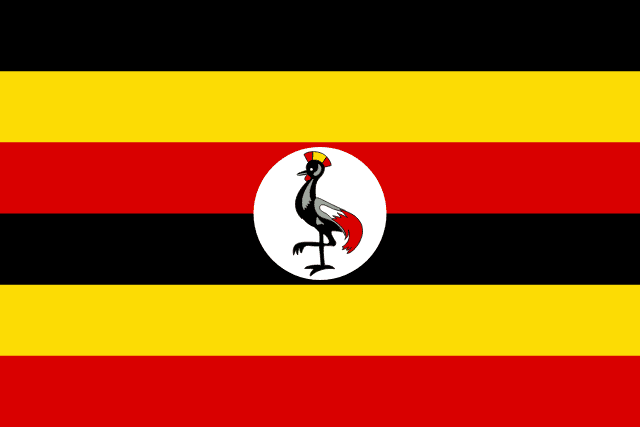
Few national flags wear their geography quite as proudly as Uganda's. Six bold horizontal stripes in black, yellow, and red carry a white circle at the center, and inside that circle stands a grey crowned crane lifting one leg as though caught mid-step. It is one of the rare flags on Earth to feature a living creature rendered in such detail, and that bird ties the flag to the savannahs, wetlands, and people of a country sitting astride the equator in East Africa. Adopted in 1962, the design has remained constant ever since, an unusual stability for a flag born in a year of enormous political change.
What the Colors Mean
The three colors repeat down the flag in a deliberate sequence, each pairing of stripes carrying its own message. Black stands for the African people, an affirmation of identity at a moment when the nation was claiming control of its own story. Yellow represents the sun, fitting for a land that straddles the equator and bathes in steady tropical light year-round. Red signals African brotherhood, the bond of shared blood and common cause among the peoples of the continent.
Read together, the colors form a compact statement about who Ugandans are, where they live, and what unites them with neighbors. There is nothing accidental about the repetition; the doubled rhythm gives the flag a drumbeat quality, and by repeating the trio Uganda created a banner impossible to mistake for a simpler tricolor.
Design and Layout
The flag is divided into six equal horizontal bands running black, yellow, red, black, yellow, red, so the full trio of colors appears twice. Overlaid at the exact center is a white disc, and within it sits the grey crowned crane facing toward the hoist, the side nearest the pole. The bird is shown in profile with its distinctive spray of golden feathers fanning out behind its head.
The official proportions place the flag at a ratio of two units high to three units wide, the same shape used by many Commonwealth nations and a legacy of British conventions that shaped flag-making across the former empire. This combination of strict geometric stripes and a finely detailed emblem is what makes Uganda's flag instantly recognizable. Many flags rely on abstract shapes alone; here the precision of the crane gives the eye something specific to settle on, and the surrounding white circle isolates the figure so it reads clearly even on a flag rippling in the wind.
How the Flag Came to Be
The crowned crane was not invented for the flag. Long before independence, the bird had served as a military badge under British colonial rule, appearing on the insignia of Ugandan troops and on the colonial-era ensign of the protectorate. When the country approached self-government, the crane was already a familiar emblem with local resonance, and it carried forward rather than being discarded as a colonial relic.
The story of the design is also a story of politics. An early proposal, drawn up by the party that had expected to lead the country, used vertical stripes with a yellow crane and would have looked very different. When a different coalition won the pre-independence elections, the design was reworked, and the new scheme drew on the colors of the victorious Uganda People's Congress. The partisan palette of one moment became the enduring national palette.
The 1962 flag replaced earlier colonial standards as the Union Jack came down at independence on the ninth of October that year. Keeping the crane while wrapping it in the new palette was a clever act of continuity: it preserved a recognizable image while reframing it under colors chosen to speak for the African people, the equatorial sun, and continental solidarity. The design has not been altered since, surviving coups, the turbulent years of dictatorship, and several changes of government, so the flag flying today is essentially the same one raised at independence.
The Crane and National Identity
The grey crowned crane is Uganda's national bird, and its place at the heart of the flag elevates it from wildlife to emblem. The species is native to the wetlands and grasslands of the region, an elegant, long-legged bird whose courtship dances have long fascinated those who watch them. By raising one leg, the crane is often read as a country moving forward rather than standing still.
That symbolism resonates well beyond the cloth. The crane appears on the national coat of arms and lends its name and image to sports teams, institutions, and currency. For travelers curious about the landscapes and culture behind the symbol, our uganda country guide explores the country in greater depth. There is a poignant note, too: the grey crowned crane is now classified as endangered, its numbers falling across East Africa, which has made the flag a quiet rallying point for conservationists.
How It Compares to Other Flags
Uganda's black, yellow, and red belong to the broad family of pan-African colors echoed on flags from Kenya to Ghana to Malawi. At a glance the kinship is clear, yet Uganda stands apart. Kenya's flag, also black, red, and green, centers a Maasai shield and crossed spears rather than an animal, while Ghana and others lean on a five-pointed star or an arrangement borrowed from Ethiopia, the continent's symbolic mother flag. What truly sets Uganda apart is the realism of the crane. Where most flags abstract their meaning into geometry, Uganda renders a recognizable creature in profile, an approach shared by only a small club of flags worldwide. The six-stripe rhythm is distinctive too; very few flags repeat their full color set twice in stacked horizontal bands.
The Flag in Modern Life
Today the flag turns up wherever Ugandans gather to mark their nationhood. It is raised on Independence Day each October, flown at government buildings and schools, and waved at sporting events, where the national football side is nicknamed the Cranes in its honor. The banner also accompanies Ugandans abroad, a portable piece of home that hangs in diaspora community halls. It drapes the shoulders of medalists at athletics meets and turns up in classrooms where children learn to draw the crane long before they can name the year of independence.
Because the design has stayed fixed since 1962, generations of Ugandans have grown up with the same flag their grandparents first saluted. In a region where borders and governments have shifted, the unchanging stripes and steadfast crane offer a sense of permanence, a visual anchor for national memory.
Interesting Facts at a Glance
- Uganda's flag is one of relatively few national flags to depict a real animal in detailed form rather than a stylized symbol.
- The grey crowned crane is positioned facing the hoist, the side closest to the flagpole.
- The six stripes show the three national colors twice, in the order black, yellow, red.
- The crane began as a military badge during the British colonial period before becoming the centerpiece of the national flag.
- Uganda lies on the equator, which gives extra meaning to the yellow stripe representing the sun.
- The flag has remained unchanged since its adoption in 1962.
- The black, yellow, and red colors trace back to the political party that led the country into independence.
Frequently Asked Questions
When was the flag of Uganda adopted?
The flag was adopted in 1962, the year Uganda gained its independence, and has flown unchanged ever since, making it one of the more enduring African national flags of the post-colonial era.
What do the colors of the Ugandan flag mean?
Black represents the African people, yellow stands for the sun, and red symbolizes African brotherhood. The three colors repeat across six horizontal stripes, appearing twice in the same black-yellow-red order.
Why is there a bird on the Uganda flag?
The bird is the grey crowned crane, Uganda's national bird. It had served as a military badge under British colonial rule, so it carried established meaning into the independence-era flag, where it now sits inside a white circle at the center.
What continent is Uganda on, and which flags resemble it?
Uganda is in East Africa, sitting right on the equator. Its black, yellow, and red palette echoes the pan-African colors found on many flags across the continent, but the central crowned crane on a white disc makes Uganda's design unmistakably its own.
Why does the crane stand on one leg?
The raised leg is widely interpreted as a symbol of a nation moving forward into the future rather than standing still. It echoes the natural posture of the living bird and gives the emblem a sense of motion and progress that suits a country celebrating its independence.