
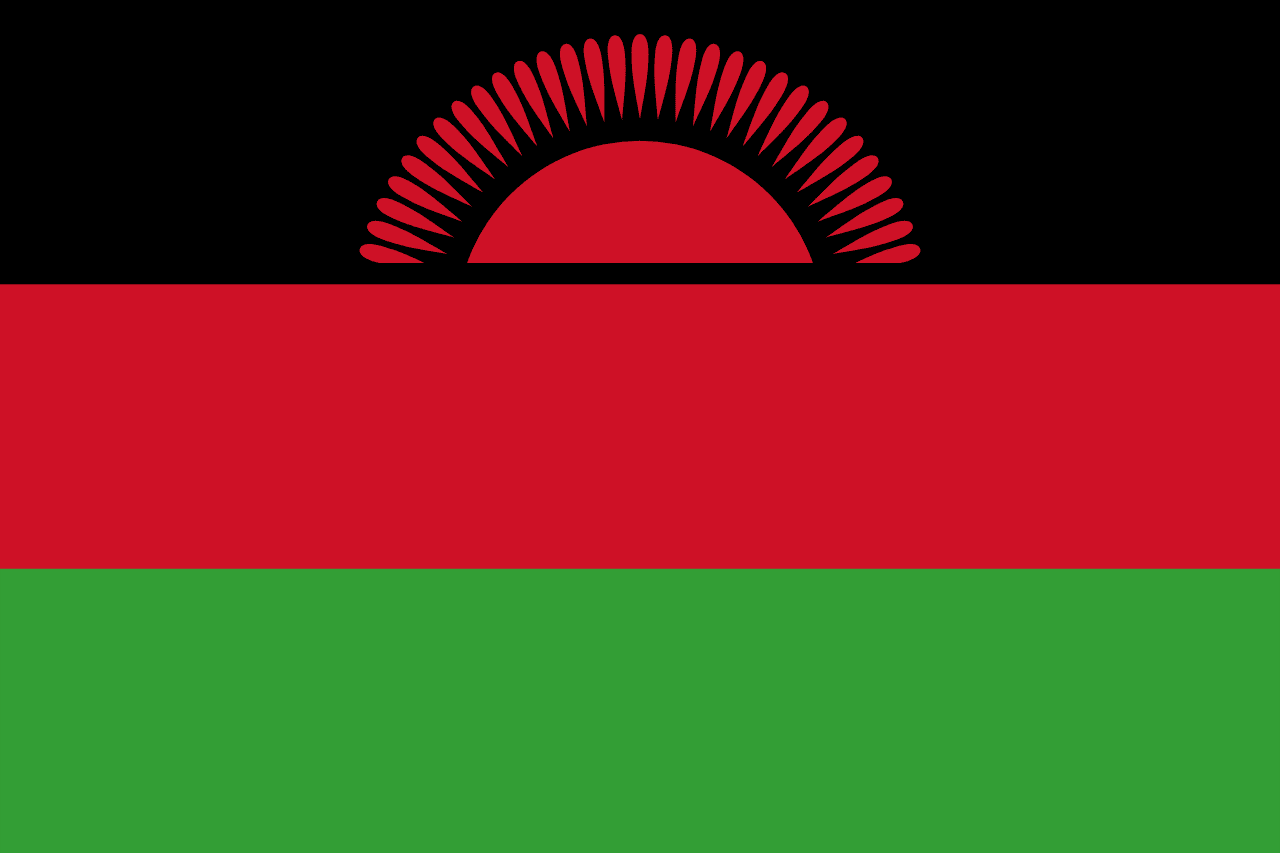
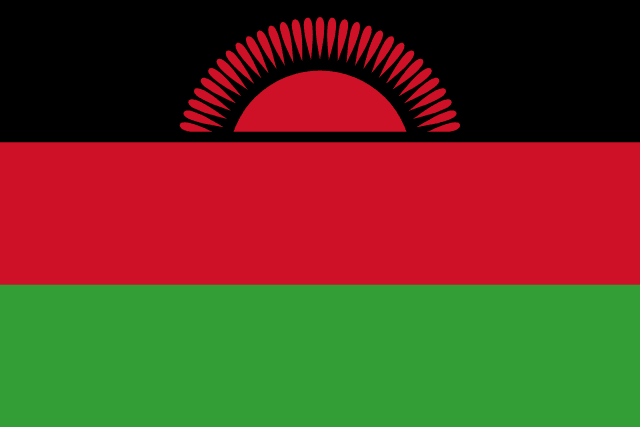
Few flags in Africa pack as much narrative into three simple bands as the flag of Malawi. At a glance it is a tidy horizontal triband of black, red, and green, but resting on the topmost stripe is a glowing disc that turns the whole design into a small story about dawn breaking over a young nation. This is a flag built around a single, hopeful idea: a sun rising over the African horizon, marking the arrival of a new era for a people who had long lived under colonial rule. Whether you encounter it fluttering above Lilongwe, stitched onto a football jersey, or printed in a classroom atlas, the banner is instantly recognizable and quietly distinctive among its continental neighbors.
A First Look at the Banner
The flag is composed of three equal horizontal stripes. The top band is black, the middle band is red, and the bottom band is green, with a circular sun centered on the black stripe at the very top of the field. The arrangement is deliberate and symmetrical, so that the eye travels from the dark band at the top down through the warm red and into the cool green at the base. The sun is the element that lifts this flag out of the crowd of African tricolors; without it, the color scheme alone would be far more ambiguous. With it, the design reads clearly as Malawian and nothing else. Simplicity is part of the point here, because a flag that can be drawn from memory by a schoolchild is a flag that genuinely belongs to its people.
What the Colors and the Sun Mean
Every component of the Malawian flag carries a defined meaning, and the symbolism is refreshingly direct. The black stripe represents the people of Malawi and, more broadly, the indigenous peoples of Africa. The red band stands for the blood shed in the struggle for freedom and independence, a sober acknowledgement that liberty was hard-won. The green stripe speaks to the nature and fertile land of the country, from the rolling highlands to the lush shores of its great lake. Crowning the design, the sun symbolizes the dawn of hope and a new beginning for the continent and for Malawi in particular.
What makes the symbolism so cohesive is the way the elements stack from bottom to top. The green earth supports the people, the red records the cost of independence, and above it all the sun announces a fresh start. It is a vertical journey from struggle toward optimism, which is exactly the message a newly self-governing nation wants its emblem to broadcast to its citizens and to the wider world.
The Story Behind the Sun
The most interesting chapter in this flag's biography concerns the disc at its top. In the original design the sun appeared as a partial, rising sun, with rays fanning upward to suggest daybreak over the continent. Then, in 2012, the country adopted a revised version in which the rising sun was replaced by a full sun, a complete circle of rays. The change was championed by then-president Bingu wa Mutharika, who argued that Malawi had matured since independence and that a fully risen sun better captured a country that had moved beyond its dawn into the full light of day.
The decision was, predictably, a subject of lively national debate. A flag is an emotional object, and altering one that citizens have grown up saluting is rarely a quiet affair. Some embraced the redesign as a confident statement of progress, while others felt deeply attached to the original rising-sun motif and its connection to the country's founding moment. The episode is a useful reminder that flags are living symbols, capable of being reinterpreted as a nation's sense of itself evolves over time.
How It Compares to Other African Flags
The black-red-green palette is one of the most resonant in Africa, echoing the Pan-African colors associated with liberation movements across the continent. Because of this shared vocabulary, the Malawian flag invites comparison with several neighbors and look-alikes. Kenya, for instance, uses a similar stacking of black, red, and green, but separates the bands with thin white fimbriations and places a Maasai shield and spears at the center rather than a sun. Several other nations draw on the same three hues in different arrangements, so the colors alone are not enough to tell them apart.
This is precisely why the sun is so important. The radiant disc on the black stripe is Malawi's signature, the detail that prevents any confusion with flags that happen to share its colors. Where Kenya answers with weaponry and white edging, Malawi answers with light. The contrast is telling: one emblem leans on the imagery of defense, the other on the imagery of a new dawn. For a quick refresher on the country itself, its geography, and its place in the region, the malawi country guide offers helpful background that complements the flag's story.
The Flag in National Identity
For Malawians, the flag is far more than a decorative arrangement of stripes. It is the visual shorthand for a shared identity that crosses the country's many ethnic groups and languages. The black band's reference to the people is not abstract; it is a daily affirmation that the nation belongs to its citizens. Children encounter the flag at school, raised during assemblies and explained in lessons on the country's path to independence. Government buildings, official documents, and civic ceremonies all lean on the banner to signal the authority and continuity of the state.
The flag also functions as a bridge between past and future. The red stripe keeps the memory of struggle alive, ensuring that the cost of freedom is not forgotten, while the sun fixes the national gaze forward. That balance between remembrance and aspiration is what gives the design its emotional weight and helps explain why debates over its details can become so heated.
The Flag in Modern Life
In everyday Malawi, the banner shows up wherever national pride is on display. It flies on public holidays, most prominently on the country's independence celebrations, when streets, stadiums, and homes bloom with black, red, and green. Sports are another natural arena: supporters of the national football team, nicknamed the Flames, wave the colors and paint their faces to match, turning the flag into a rallying point for collective hope and friendly rivalry.
The flag travels well beyond the country's borders, too. It marks Malawian embassies abroad, identifies the nation at international summits and athletic competitions, and accompanies the diaspora to community gatherings far from home. In each setting it performs the same quiet work, telling anyone who sees it that this is Malawi, the land of the rising sun and the warm heart of Africa.
Interesting Facts at a Glance
- The flag is a horizontal triband of black over red over green, with a sun resting on the top stripe.
- Black stands for the people, red for the blood of the independence struggle, and green for the nation's nature and land.
- The sun represents the dawn of hope and a fresh start for Malawi and for Africa.
- In 2012, the design was changed so the original rising sun became a full sun, a complete circle of rays.
- The full-sun redesign was driven by then-president Bingu wa Mutharika, who saw it as a symbol of national maturity.
- The black-red-green color scheme places Malawi within the broader family of Pan-African flags.
- The radiant disc is the key feature that distinguishes Malawi's flag from similarly colored neighbors.
Frequently Asked Questions
When was the current version of the Malawi flag adopted?
The version featuring a full sun was adopted in 2012. This update replaced the earlier rising-sun emblem with a complete circular sun, a change introduced under then-president Bingu wa Mutharika as a statement of the nation's progress and maturity.
What do the colors of the Malawi flag mean?
Each color carries a specific meaning. Black represents the people of Malawi and Africa, red symbolizes the blood shed during the struggle for independence, and green stands for the country's nature and fertile land. The sun on top signifies a new dawn and the hope of a fresh beginning.
Who was responsible for changing the flag's sun?
The shift from a rising sun to a full sun was championed by then-president Bingu wa Mutharika. He argued that a fully risen sun better reflected a country that had matured since gaining independence, moving from its symbolic dawn into the full light of day.
What continent is Malawi on, and how does its flag compare to similar ones?
Malawi is a landlocked country in southeastern Africa. Its flag shares the black, red, and green Pan-African palette used by several other African nations, such as Kenya. The distinguishing feature is the sun on the top stripe, which sets Malawi's banner apart from look-alikes that rely on different central emblems like shields or stars.
