
Few national flags carry a weapon at their center, and fewer still wear it as a badge of pride rather than aggression. The flag of Kenya does exactly that. Stretched across its middle is a traditional Maasai shield flanked by two crossed spears, resting on bold horizontal bands of black, red, and green. Raised for the first time at independence in 1963, it announces who the Kenyan people are, what their freedom cost, and the land they call home.
A First Look at the Design
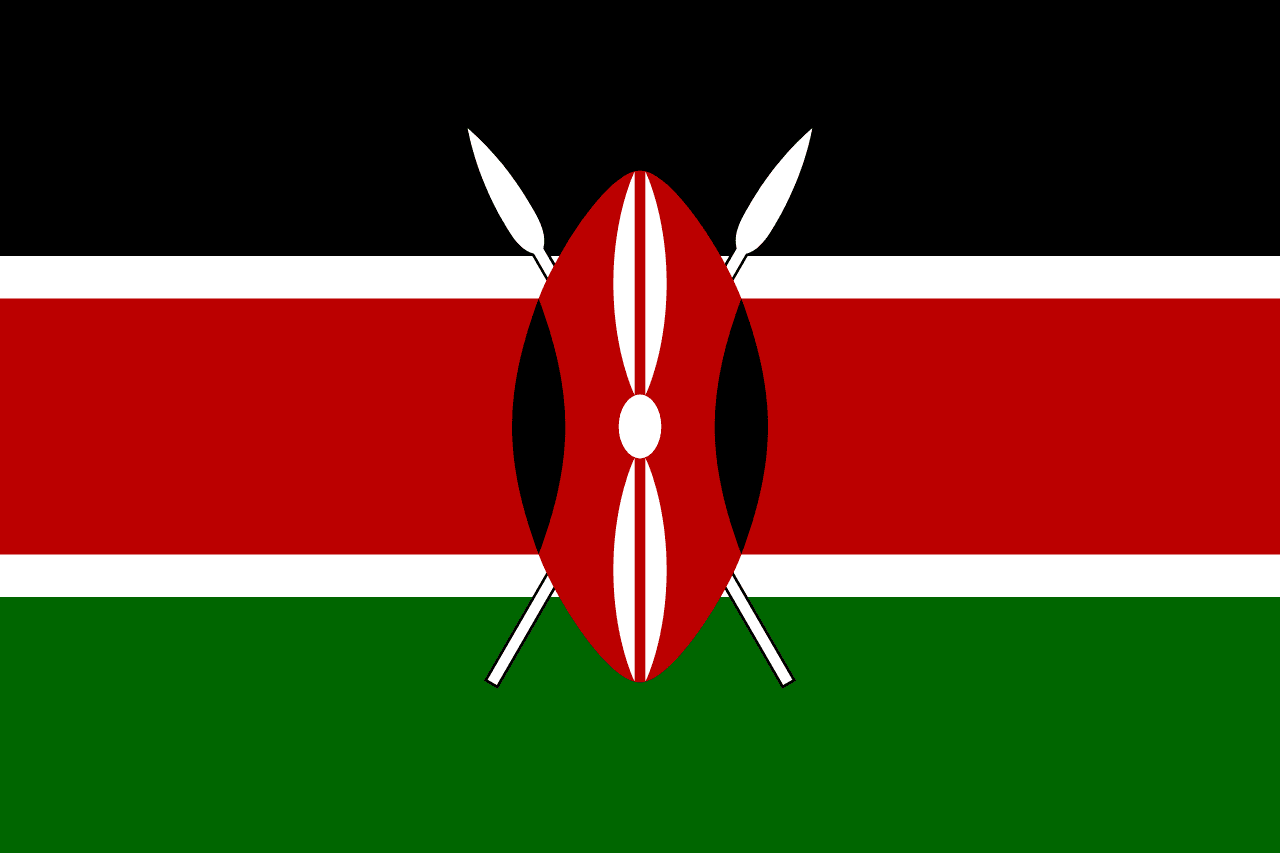
Kenya's flag is built on a horizontal triband: black across the top, red through the middle, and green along the bottom. Thin white fimbriations separate these bands, giving the colors crisp edges and adding a fourth shade to the palette. Centered over all three stripes is the flag's most distinctive element, a Maasai warrior's shield with two spears crossed behind it. The shield is decorated in red, black, and white, echoing the bands themselves so that the emblem feels woven into the whole rather than pasted on top.
This combination of a clean European-style triband with an unmistakably African symbol is what makes the flag instantly recognizable. The official proportions are set at two to three, a ratio shared by many national flags and one that keeps the shield comfortably centered without crowding the stripes.
What the Colors Mean
Each band of color speaks to a different part of Kenya's story. The meanings are direct and deeply felt:
- Black stands for the people of Kenya, the majority population whose nation this is.
- Red represents the blood shed in the struggle for freedom, a remembrance of the lives lost on the road to independence.
- Green celebrates the landscape, the fertile land, forests, and natural wealth that sustain the country.
- White, carried in the thin dividing stripes, is generally read as a symbol of peace and unity binding the nation together.
Read from top to bottom, the colors tell a small narrative on their own: a people, the price of their liberty, and the green country they defended. The white was not part of the original party palette and was added specifically for the national flag. In a country emerging from a bruising colonial conflict, that thin white line was a quiet but pointed statement about a future built on reconciliation as well as struggle.
The Shield and Spears
The Maasai shield and crossed spears are the soul of the flag. Far more than decoration, they represent the defense of everything the colors describe. The shield speaks to protection, the spears to readiness, and together they declare that Kenyans stand guard over their freedom and the land they fought to claim. Choosing a Maasai shield rather than a generic emblem rooted the new nation's identity in indigenous tradition.
It is a quietly powerful choice. Where many flags lean on stars, crosses, or abstract geometry, Kenya placed a real object from its own heritage at the center. The painted geometry of a Maasai shield traditionally carried information about the warrior who held it, his age set, and his clan.
From Colonial Banner to Independent Symbol
Kenya spent decades under British colonial rule, flying British ensigns rather than a flag of its own. From 1895 the region was administered as the East Africa Protectorate, and from 1920 as the Crown Colony of Kenya, both of which used a British Blue Ensign defaced with a colonial badge featuring a red lion. For ordinary Kenyans this was never their flag; it was the emblem of a distant authority. That grievance sharpened through the 1950s as the independence movement gathered force, including the Mau Mau uprising, whose suppression left deep scars that the flag's red band would later memorialize.
The modern flag grew directly out of the banner of the Kenya African National Union, or KANU, the political party that led the country into independence under Jomo Kenyatta. KANU's colors of black, red, and green provided the foundation, and the design was refined for national use by adding the white fimbriations and placing the Maasai shield and spears at the center. When Kenya became independent on the twelfth of December 1963, this was the flag that rose as the Union Jack came down, carrying the memory of the independence struggle in its very fabric.
How Kenya's Flag Compares to Others
Kenya's flag belongs to a wider family that draws on the Pan-African colors of black, red, and green, a palette popularized in the early twentieth century by Marcus Garvey as a symbol of Black liberation and unity. That shared heritage links Kenya visually to the flag of Malawi and to many liberation movements across the diaspora, even though each gives the colors its own meaning and arrangement.
Yet Kenya is rarely mistaken for any of them, and the reason is the central emblem. Kenya's Maasai shield is unique among national flags. The closest visual cousins are flags that also place a defensive emblem at their heart, such as Eswatini with its shield and spears. While Kenya shares its colors with a continent, it shares its full design with no one.
A Symbol of National Identity
For Kenyans, the flag is shorthand for a shared identity that crosses the country's many ethnic and regional lines. The colors and the shield appear far beyond official buildings, turning up in artwork, on clothing, in murals, and across everyday objects. The combination has also become a wider emblem of African pride, so the flag resonates beyond Kenya's borders.
To see how the flag fits into the larger picture of the country, its people, and its geography, explore the kenya country guide, which puts these symbols in fuller context.
The Flag in Modern Life
Today the flag is woven into the rhythm of Kenyan public life. It flies over government offices, schools, and embassies, and it takes center stage during celebrations such as Jamhuri Day on the twelfth of December, which marks independence and the founding of the republic, and Madaraka Day on the first of June, which commemorates internal self-rule. On these holidays streets and stadiums fill with its colors, and it is lowered to half-mast in moments of national mourning.
Kenyan athletes have given the flag some of its most visible global moments. The country's long-distance runners are among the most celebrated in the world, and the sight of a victorious Kenyan draped in black, red, and green on a marathon route has become a familiar image of national achievement. Schoolchildren learn the flag's meaning early, and laws govern its respectful display. In all these moments the flag does what it was designed to do: gather millions behind a single, instantly recognizable symbol.
Interesting Facts
- The flag was adopted in 1963, the year Kenya gained its independence.
- Its design is based on the flag of KANU, the ruling party at the time of independence.
- The central emblem is a traditional Maasai shield with two crossed spears.
- The shield and spears specifically symbolize the defense of freedom.
- Counting the white fimbriations, the flag uses four colors: black, red, green, and white.
- The flag's black, red, and green echo the Pan-African colors linked to Marcus Garvey's liberation movement.
- Kenya is located on the continent of Africa, along its eastern coast.
Frequently Asked Questions
When was the flag of Kenya adopted?
Kenya's national flag was adopted in 1963, the same year the country achieved independence from British colonial rule. It has remained the official flag ever since.
What do the colors of the Kenyan flag mean?
Black represents the people of Kenya, red stands for the blood shed in the struggle for freedom, and green symbolizes the country's landscape and natural wealth. The thin white stripes are widely understood to represent peace and unity.
What is the shield in the middle of the flag?
It is a traditional Maasai shield, shown with two spears crossed behind it. Together they symbolize the defense of freedom, expressing the nation's readiness to protect its hard-won independence and its land.
What continent is Kenya on, and where did the flag's design come from?
Kenya is in East Africa. The flag's design was based on the banner of the Kenya African National Union (KANU), the party that led the country to independence, with the Maasai shield, crossed spears, and white fimbriations added.
Why does Kenya's flag use black, red, and green?
These are the Pan-African colors, a palette associated with Black liberation and unity that many African nations adopted in the twentieth century. Kenya inherited them through the KANU banner and gave each a national meaning, while the Maasai shield keeps the flag distinct from every other flag that shares the same colors.