
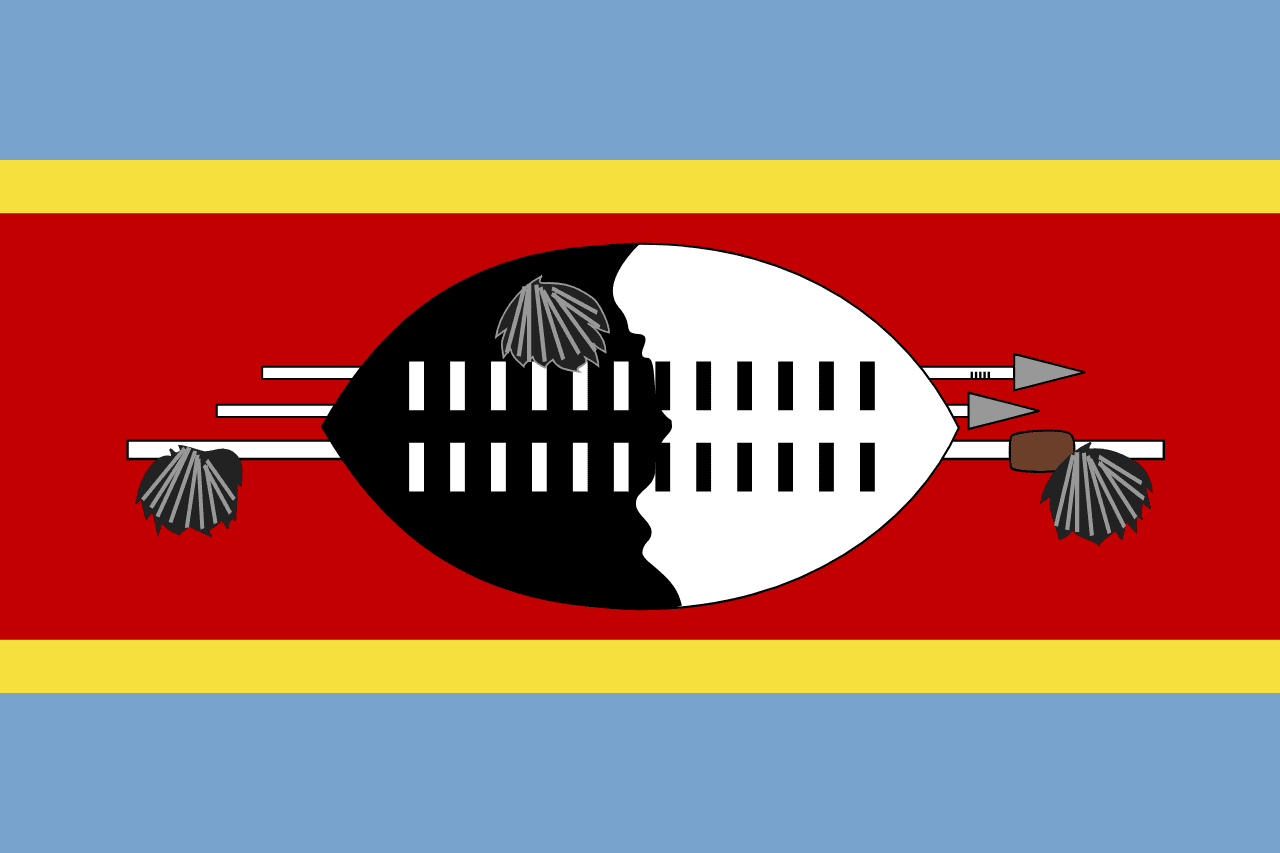
Few national flags carry their meaning quite as literally as the flag of Eswatini. Where many countries lean on abstract symbols or geometric arrangements, this small southern African kingdom puts a warrior's shield and a bundle of weapons right at the centre of its banner — one of the most distinctive flags on the continent, a horizontal tricolour interrupted by an emblem that speaks directly to the Swazi tradition of defence, dignity, and self-reliance.
Adopted in 1968, the flag has remained a steady fixture through one of the more remarkable identity shifts in recent African history. In 2018 the country was renamed from Swaziland to Eswatini, yet the flag did not change a thread — continuity that tells you how deeply the design is woven into national feeling.
A Banner Built Around a Shield
The composition is a horizontal arrangement of stripes in blue, yellow, and red. A broad red band runs across the middle, bordered above and below by thin yellow lines, and then framed top and bottom by blue. The red stripe is wider than the others, giving the flag a clear centre of gravity and a natural backdrop for the emblem it carries. The flag flies in a 2:3 ratio, and the central red field sits roughly three times the height of either blue stripe so the emblem never feels crowded.
That emblem is a large black-and-white Nguni shield laid horizontally, with two spears and a fighting staff behind it. The shield is the type traditionally used by Swazi warriors, and tassels known as injobo — tufts made from feathers and animal tails — hang from the staff. Placing this cluster of objects across the central band gives the flag a sculptural, almost three-dimensional quality that few other national flags attempt, an arrangement that reads clearly even at a distance.
What the Colours Stand For
Each colour on the flag of Eswatini was chosen to carry a specific idea, and the palette covers five hues once you include the black and white of the shield.
- Red — recalls past battles and the struggles endured on the way to nationhood.
- Yellow — points to the mineral resources of the land and the wealth it can provide.
- Blue — stands for peace and stability, the settled calm the kingdom hopes to maintain.
- Black and white — the colours of the shield, taken to represent that the country's black and white peoples live together in harmony.
The shield and spears add a layer of meaning on top of the colours: they signal protection and the readiness to defend the nation — a martial image, but one framed as guardianship rather than aggression. The balance of blue against red is telling, too. Many newly independent states of the 1960s used red heavily to mark revolution, but Eswatini bookends its red with calm blue, so the flag reads as a statement that peace tempers the memory of conflict.
From a Wartime Gift to a National Emblem
The flag's roots reach back further than 1968. Its design is based on a flag presented to the Swazi Pioneer Corps during the Second World War, a unit of Swazi men who served within the wider war effort. The visual language of that military banner — the shield, the weapons, the bold horizontal bands — was later adapted into the design that would represent the independent kingdom.
Before that wartime banner, the territory had no single indigenous flag in the modern sense; through the colonial period it was administered under British arrangements, and the everyday symbols of authority were imperial rather than Swazi. That makes the Pioneer Corps standard a genuine turning point — an emblem rooted in Swazi material culture carried with official sanction for the first time.
When the country gained independence from British administration in 1968, it formally adopted the flag we recognise today, drawing on an emblem that already carried emotional weight and a sense of shared service. For a broader picture of how the kingdom developed, the eswatini country guide traces its journey from independence to the present day.
How It Compares to Other Flags
Set the flag of Eswatini beside others and one thing stands out: very few flags place a literal weapon at their heart. The closest cousin is the flag of Kenya, which also features a traditional shield and crossed spears over horizontal stripes, drawing on the same idea that a warrior's shield can stand for the defence of a young nation. But Kenya's Maasai shield is oval and richly decorated on a black-white-red-green palette, while Eswatini's Nguni shield is narrower, paired with a feathered staff, and rests on a calmer blue-yellow-red field.
Eswatini also largely sidesteps the Pan-African palette of red, green, gold, and black that so many continental flags share. The combination of blue, yellow, and red, with the emblem doing the heavy symbolic lifting, gives it a look closer to certain Commonwealth flags than to its regional peers. There is no risk of confusing it with the flags of South Africa, Mozambique, or Zimbabwe that surround it; the busy central emblem is a fingerprint no other sovereign flag duplicates.
A Symbol of a Living Monarchy
Eswatini is one of the world's few remaining absolute monarchies, and the flag reflects a national identity in which tradition and kingship sit at the centre of public life. The shield and spears are not antique decorations; regalia of this kind still appear in major cultural ceremonies, connecting the modern state directly to those living customs.
This is part of why the renaming of 2018 left the flag untouched. The change from Swaziland to Eswatini — a name meaning roughly "land of the Swazi" in siSwati — was about reclaiming an indigenous name and shedding a colonial-era label. The flag had never been a colonial creation, so there was nothing to undo; it already pointed inward, toward Swazi heritage.
The Flag in Everyday Life
Within Eswatini the flag flies over government buildings and schools and during the national festivals that punctuate the calendar. It is especially visible during the Incwala ceremony, the kingdom's most sacred annual ritual of kingship and first fruits, and during the Umhlanga or Reed Dance, when the shield and staff on the banner echo the regalia carried by participants. On the international stage it represents the kingdom at the United Nations, at African Union gatherings, and behind the national football side, Sihlangu Semnikati — a name that itself refers to the shield.
Citizens also encounter it in quieter ways: on the national coat of arms, where lion-and-elephant supporters flank a version of the same shield, and on the badges of schoolchildren who learn to name its parts early. Because the emblem is so detailed, the flag rewards a close look that a plain tricolour never could.
Interesting Facts About the Flag
- The design descends from a flag given to the Swazi Pioneer Corps during the Second World War.
- It uses five colours in total once the black and white of the shield are counted alongside blue, yellow, and red.
- The injobo tassels hanging from the staff are made from feathers and animal tails.
- The flag survived the 2018 renaming of the country completely unchanged.
- It is one of only a handful of national flags worldwide to depict actual weapons.
- Eswatini sits in southern Africa, landlocked between South Africa and Mozambique.
Frequently Asked Questions
When was the flag of Eswatini adopted?
The flag was adopted in 1968, the same year the country became independent. Although the nation was renamed from Swaziland to Eswatini in 2018, the flag itself was not altered and has remained in continuous use since 1968.
What do the colours of the Eswatini flag mean?
Red represents past struggles and battles, yellow stands for the country's mineral resources, and blue signifies peace and stability. The black and white of the central shield are read as a symbol of the country's peoples living together in harmony.
What is the emblem on the flag?
The centrepiece is a traditional Nguni warrior's shield laid horizontally, with two spears and a fighting staff behind it and decorative tassels called injobo hanging from the staff. Together they represent protection and the defence of the nation.
Why didn't the flag change when Swaziland became Eswatini?
The 2018 renaming was about replacing a colonial-era label with an indigenous siSwati name, not about reinventing national identity. Because the flag was already built entirely from Swazi symbols and traced its origins to a Swazi military unit rather than to colonial heraldry, there was nothing colonial to remove, and it was kept exactly as it was.
What continent is Eswatini on?
Eswatini is in southern Africa. It is a small, landlocked kingdom bordered mostly by South Africa, with a shorter boundary shared with Mozambique to the east.