
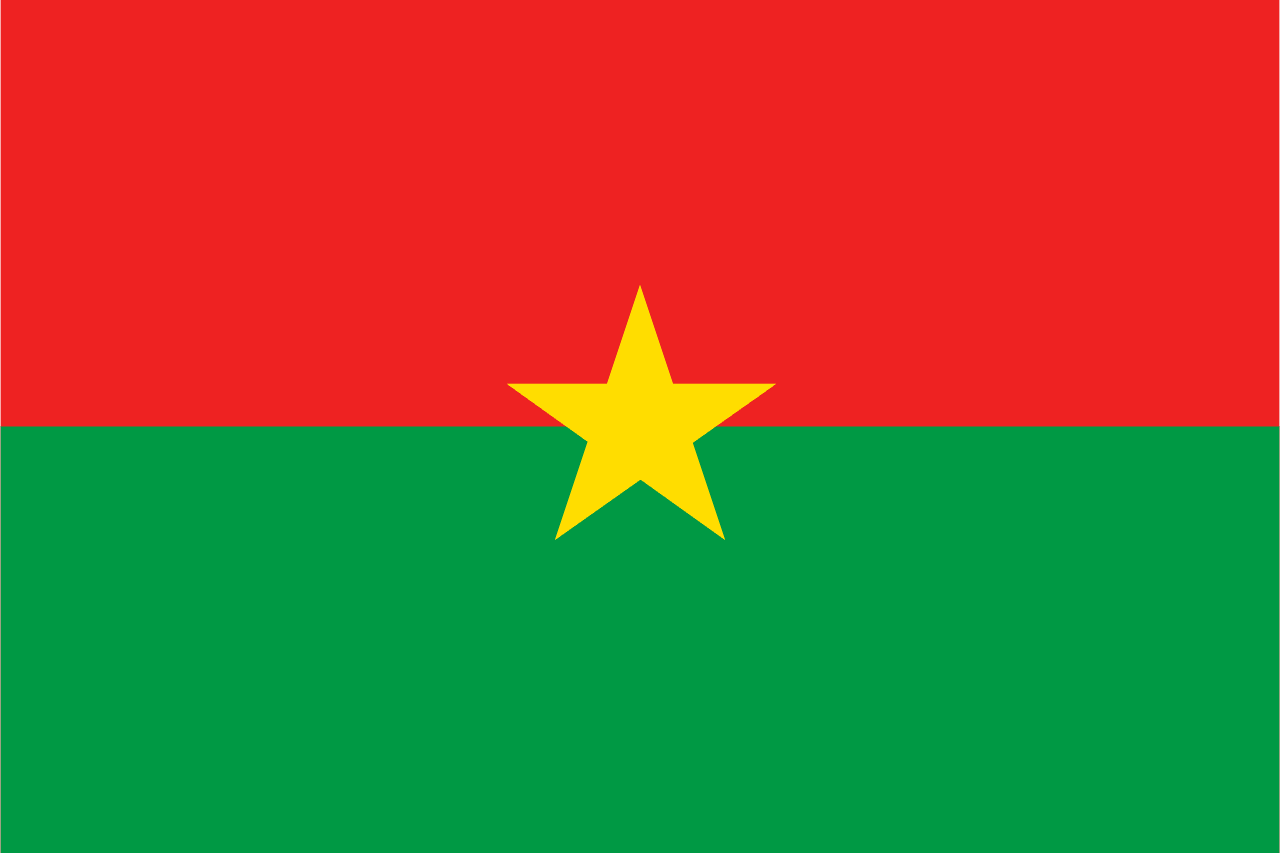
Few flags wear their politics as openly as the banner of Burkina Faso. Two broad stripes of red and green, split by a single golden star, the design was born in the heat of a revolution that also gave the country its name. Before 1984 this West African nation was known as Upper Volta. When a new government swept that name away, it swept away the old flag too, replacing colonial-era geography with the language of liberation. The result is one of the more legible national emblems on the African continent, a flag that practically explains itself.
What the Colors Mean
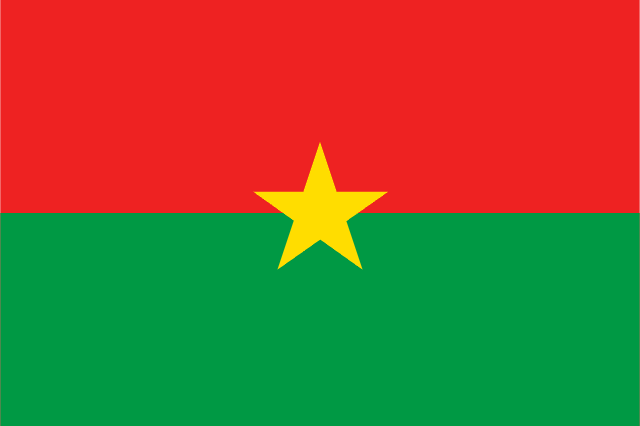
The flag uses three colors, and each one carries a specific charge. Red fills the upper half and stands for the revolution itself, the upheaval that reshaped the country in the early 1980s. Green occupies the lower half and represents agriculture, the fertile land and farming life that sustain a largely rural population. Resting where the two stripes meet is a five-pointed yellow star, understood as the guiding light of the revolution, the mineral wealth of the country, and the brightness of the people's hopes for the future.
Together these three colors place Burkina Faso firmly within the family of Pan-African flags. Red, green, and gold appear again and again across the continent, echoing the colors first popularized by Ethiopia and later adopted as symbols of African independence and solidarity. By choosing them, the designers signaled where the young nation saw itself: among the freed and self-governing peoples of Africa rather than the territories still bearing names handed down by European mapmakers.
The order in which the colors are stacked matters too. Red sits above green, putting the revolution at the top of the composition and the land beneath it, while the yellow star bridges the two. Read top to bottom, the flag tells a small story: revolution, its guiding light, and the soil that work is meant to nourish.
The Design and Layout
Structurally, the flag could hardly be simpler. It is a horizontal bicolor, red over green, divided into two equal stripes of identical width. Centered across the dividing line sits the golden star, large enough to read from a distance but small enough not to crowd the field. There is no fly-side device, no canton, no coat of arms, only the two bands and the star. It flies at a width-to-length ratio of two to three, shared by many national flags.
That restraint is part of the flag's strength. A child can sketch it from memory, and it reproduces cleanly at any scale, from a lapel pin to a stadium-sized banner. The star's placement at the exact junction of red and green is deliberate too: the revolution and the land meet at the point of the guiding light, a small piece of visual storytelling built into an otherwise plain composition. Because the star is the only ornament, it stays recognizable even when a flag is faded or seen rippling at a distance.
From Upper Volta to the Land of Honest People
The flag's history is inseparable from the country's renaming. In 1984, the territory then called Upper Volta was renamed Burkina Faso, a phrase drawn from two of the nation's languages that together translate roughly as the Land of Honest People or Land of Upright People. The new name rejected the colonial label "Upper Volta," which had merely described the country's position along the upper Volta River system.
With a new name came a new flag, adopted that same year. The previous Upper Volta flag had used three horizontal stripes of black, white, and red to represent the Black, White, and Red Volta rivers, a tidy piece of symbolism tying the country's identity to its waterways. That earlier banner had flown since independence from France in 1960, serving as the face of the republic for nearly a quarter of a century. The 1984 redesign discarded that symbolism entirely in favor of the red-green-star scheme, trading a description of the landscape for a statement of ideals. The change marked a clean break, announcing that the country meant to define itself by its people and principles rather than by features drawn on someone else's map. If you want the broader story of the nation behind the flag, this burkina faso country guide fills in the geography and culture.
How It Compares to Similar Flags
Set Burkina Faso's flag beside its neighbors and the family resemblance is immediate. The red, green, and gold trio runs through the flags of Ghana, Senegal, Mali, Guinea, Cameroon, and many others, a shared palette that turns a wall of African flags into a single conversation about independence. Yet Burkina Faso's design keeps a clear accent of its own.
The closest visual cousins are flags that pair a horizontal split with a central star. Ghana, for instance, also uses a single star, but it floats on three horizontal stripes rather than two. Burkina Faso is unusual in giving the star pride of place on the seam between just two bold stripes, with no third color and no extra emblem. Where many regional flags reach for three stripes or a coat of arms, this one trusts a single star.
Cultural Significance and National Identity
For Burkinabè citizens, the flag is a compact summary of national values. The emphasis on revolution and agriculture reflects a country proud of its self-reliance and its working land, while the star speaks to ambition and shared direction. Because the design emerged from a moment of deliberate self-redefinition, it carries an unusually direct sense of authorship: this is not a flag inherited from an empire but one chosen to express what the people wanted to become. Standing among other African flags, its red and green read instantly as part of a shared visual vocabulary of independence, even as the single centered star keeps it distinct and recognizable.
The Flag in Modern Life
Today the flag flies over government buildings, schools, and public squares, and it appears at national celebrations and civic ceremonies throughout the year. It travels onto the international stage as well, raised at sporting events and worn by supporters of the national football team, the Stallions, whose fans turn the stands into fields of red and green. At the Africa Cup of Nations the flag becomes a wearable identity, painted on cheeks and draped over shoulders. Citizens display it during national holidays, and it marks embassies and official delegations abroad. Wherever it appears, the flag does the same quiet work it has done since 1984: marking out a space as belonging to the Land of Honest People.
Interesting Facts
- The name Burkina Faso means "Land of Honest People," and the flag was adopted in the very year the country took that name.
- The red, green, and yellow combination is part of the Pan-African color tradition shared by many flags across the continent.
- The flag replaced the black-white-red banner of Upper Volta, which had represented the three Volta rivers and flown since independence in 1960.
- The golden star sits precisely on the line between the two stripes, where revolution and agriculture meet.
- Its simple two-stripe-and-star design makes it one of the easiest African flags to draw from memory.
Frequently Asked Questions
When was the flag of Burkina Faso adopted?
The current flag was adopted in 1984, the same year the country changed its name from Upper Volta to Burkina Faso, as part of a broader effort to redefine the nation's identity on its own terms.
What do the colors of the Burkina Faso flag mean?
Red represents the revolution, green stands for agriculture and fertile land, and the yellow star symbolizes the guiding light of the revolution. The three colors also belong to the Pan-African tradition of red, green, and gold.
What continent is Burkina Faso on?
Burkina Faso is a landlocked country in West Africa, and its flag's Pan-African colors connect it visually to the wider community of independent African nations.
How does the flag compare to similar flags?
Many African flags share the red, green, and gold palette, so Burkina Faso's banner sits within a recognizable continental family. What sets it apart is its specific arrangement: a clean horizontal split of red over green with a single five-pointed yellow star centered on the dividing line, rather than the multiple stripes or emblems seen on many neighboring flags.
What flag did Burkina Faso use before 1984?
Before 1984 the country was called Upper Volta and flew a flag of three horizontal stripes, black over white over red, representing the Black, White, and Red Volta rivers. That flag dated to independence in 1960 and was replaced when the nation took its new name.