
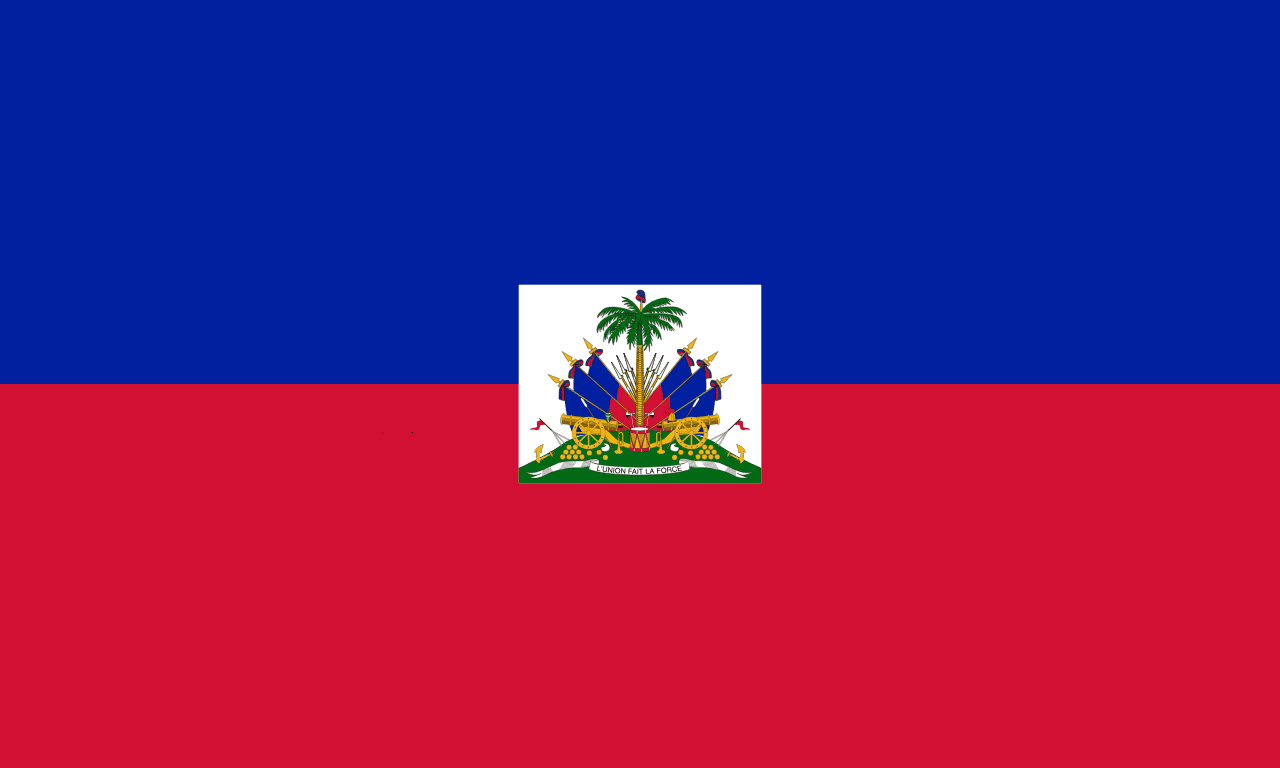

Few flags carry their origin story as openly as the banner of Haiti. According to a tradition retold across generations, the flag was born from an act of defiance: revolutionaries took the French tricolor, tore out the white center, and stitched the remaining blue and red panels back together. The gesture said everything that needed saying. A nation built by formerly enslaved people would keep the colors of the colonizer but discard the color associated with white rule. From that bold edit grew one of the Caribbean's most recognizable national symbols, a horizontal bicolor crowned with a richly detailed coat of arms.
This article walks through what those colors mean, how the design is arranged, how the flag evolved across two turbulent centuries, and why it still stirs strong feelings among Haitians at home and across a vast diaspora. Along the way it untangles a few common mix-ups with look-alike flags and answers the questions people most often type into search bars.
A Banner Cut From the French Tricolor
The most famous fact about Haiti's flag is also the simplest to grasp. The design descends directly from the French tricolor of blue, white, and red. During the revolution that turned the colony of Saint-Domingue into the independent nation of Haiti, the white stripe was removed and the two remaining bands were brought together. What had been three vertical stripes became two horizontal ones, and a flag of empire became a flag of liberation.
That act of removal is not just a quirky anecdote; it is the conceptual heart of the whole design. Where many flags add elements to assert identity, Haiti's announced itself by subtracting. The missing white stripe is, in a sense, still part of the story, because its absence is what gives the colors their meaning. It is hard to think of another national flag whose origin is so closely tied to something taken away.
What the Blue and Red Stand For
The two horizontal bands are blue on top and red on the bottom, and the traditional reading of them is deeply tied to the people who founded the country. Blue is understood to represent Haiti's formerly enslaved citizens, while red represents those of mixed-race heritage. Bringing the two colors together on a single cloth expressed an idea of alliance: that a free Haiti would be built by uniting these communities against a common oppressor.
The white that was discarded, by contrast, had stood for the colonial French population. So the color scheme is not decorative but political, a visual statement about who the new republic belonged to. That symbolism is reinforced by the national motto carried on the central emblem, L'Union Fait La Force, which translates as "Unity Makes Strength." The colors and the words point in the same direction: a country whose strength comes from joining its people together.
How the Design Is Arranged
Today's official flag is a horizontal bicolor with the national coat of arms set in a white panel at the center. The arms are unusually detailed for a flag. They depict a royal palm topped by a cap of liberty, flanked by an array of flags, cannons, and weapons arranged on a green field, with the motto inscribed on a white ribbon below.
That military hardware is not random. Cannons, drums, anchors, and stacked muskets evoke the armed struggle for independence and the readiness to defend it. The palm crowned with the liberty cap, a symbol with deep roots in revolutionary iconography, ties the young nation to the broader age of revolutions. Because the emblem sits on a white rectangle against the blue and red, the central white reappears in a new role, no longer the discarded colonial stripe but the backdrop for a proudly Haitian crest. The everyday civil version of the flag is sometimes flown as a plain blue-and-red bicolor without the arms, while the state flag carries the full emblem.
Two Centuries of Change
Haiti's flag has not stayed perfectly fixed since independence. Over the course of the nineteenth and twentieth centuries the country experimented with different arrangements that mirrored its shifting politics. When Haiti was governed as an empire or a kingdom at various moments, its standards changed accordingly, and at several points authorities favored black-and-red color schemes rather than the blue-and-red familiar today.
The most significant modern shift came in the twentieth century. During an era of authoritarian rule, the flag was altered to a black-and-red vertical design, a version that many Haitians associated with repression. With the political changes that followed, the historic blue-and-red bicolor with the coat of arms was restored as the official flag in 1986. That restoration was about more than aesthetics; reclaiming the older design was a way of reconnecting with the revolutionary ideals of unity and independence rather than the symbols of a discredited regime.
Telling It Apart From Look-Alikes
Because the world has only so many color combinations, Haiti's flag invites comparison with a handful of others, and a few details keep it distinct. The flag of Liechtenstein, for example, is also a horizontal blue-over-red bicolor, and the resemblance was famously noticed at the 1936 Olympics when the two nations realized their flags were nearly identical. Liechtenstein responded by adding a gold crown to its flag; Haiti's distinguishing feature, the elaborate central coat of arms, was already in place.
The flag's heritage also links it to the wider family of tricolor-derived banners. Its parent, the French tricolor, gave the world a template that countless flags borrowed. Haiti's twist on that template was unique because it kept only two of the three stripes and turned them sideways. So while the blue-and-red palette has cousins around the globe, the combination of a horizontal bicolor, a white central panel, and a weapon-laden palm-and-liberty-cap emblem makes Haiti's flag unmistakable once you know what to look for. To understand how the flag fits into the country's broader story, the haiti country guide offers a fuller picture.
A Living Symbol of National Identity
For Haitians, the flag is woven into civic life and is honored each year with its own observance, Flag Day, which commemorates the moment the banner was first created during the revolutionary period. The day is marked with ceremonies, music, and displays of the colors in schools and public squares, and it is observed enthusiastically not only on the island but throughout the Haitian diaspora in cities far from the Caribbean.
Geographically, Haiti sits in the Caribbean region of North America, sharing the island of Hispaniola with the Dominican Republic. The flag travels well beyond those shores, though. You will see it draped at international football matches, waved at cultural festivals, and worn as a badge of pride by people whose families left Haiti generations ago. As the first nation in the world to be founded by a successful revolt of enslaved people, Haiti carries a history that resonates widely, and its flag is the most immediate emblem of that achievement.
Quick Facts at a Glance
- The flag is a horizontal bicolor of blue over red with the national coat of arms centered on a white panel.
- It is said to have been made by removing the white stripe from the French tricolor and joining the remaining colors.
- Blue traditionally represents formerly enslaved Haitians; red represents people of mixed-race heritage.
- The motto on the emblem reads L'Union Fait La Force, "Unity Makes Strength."
- The current blue-and-red design with the coat of arms was restored as the official flag in 1986.
- The coat of arms features a royal palm topped by a liberty cap, surrounded by flags, cannons, and other arms.
- The flag closely resembles Liechtenstein's, a similarity that surfaced at the 1936 Olympic Games.
Frequently Asked Questions
When was the Haitian flag adopted?
The blue-and-red bicolor traces its origins to the revolutionary era of the early nineteenth century, but the modern flag in its current official form, complete with the coat of arms, was restored in 1986 after a period when a black-and-red design had been in use. That restoration reconnected the country with its historic revolutionary symbolism.
What do the colors of Haiti's flag mean?
Blue is traditionally said to represent Haiti's formerly enslaved population, while red represents people of mixed-race heritage. Together they symbolize unity among the communities that fought for independence. The white originally found in the parent French flag, associated with the colonial population, was deliberately removed.
Who created the Haitian flag?
Tradition holds that the flag was created during the independence struggle by tearing the white stripe out of the French tricolor and stitching the blue and red together. The story is closely tied to the leaders of the Haitian Revolution, and the act of removing the white is remembered as a defining symbolic moment of the nation's founding.
What continent is Haiti on, and which flags look similar?
Haiti is located in the Caribbean, part of North America, on the island of Hispaniola alongside the Dominican Republic. Its closest visual twin is the flag of Liechtenstein, also a blue-over-red horizontal bicolor; Haiti's distinguishing central coat of arms sets the two apart at a glance.
