
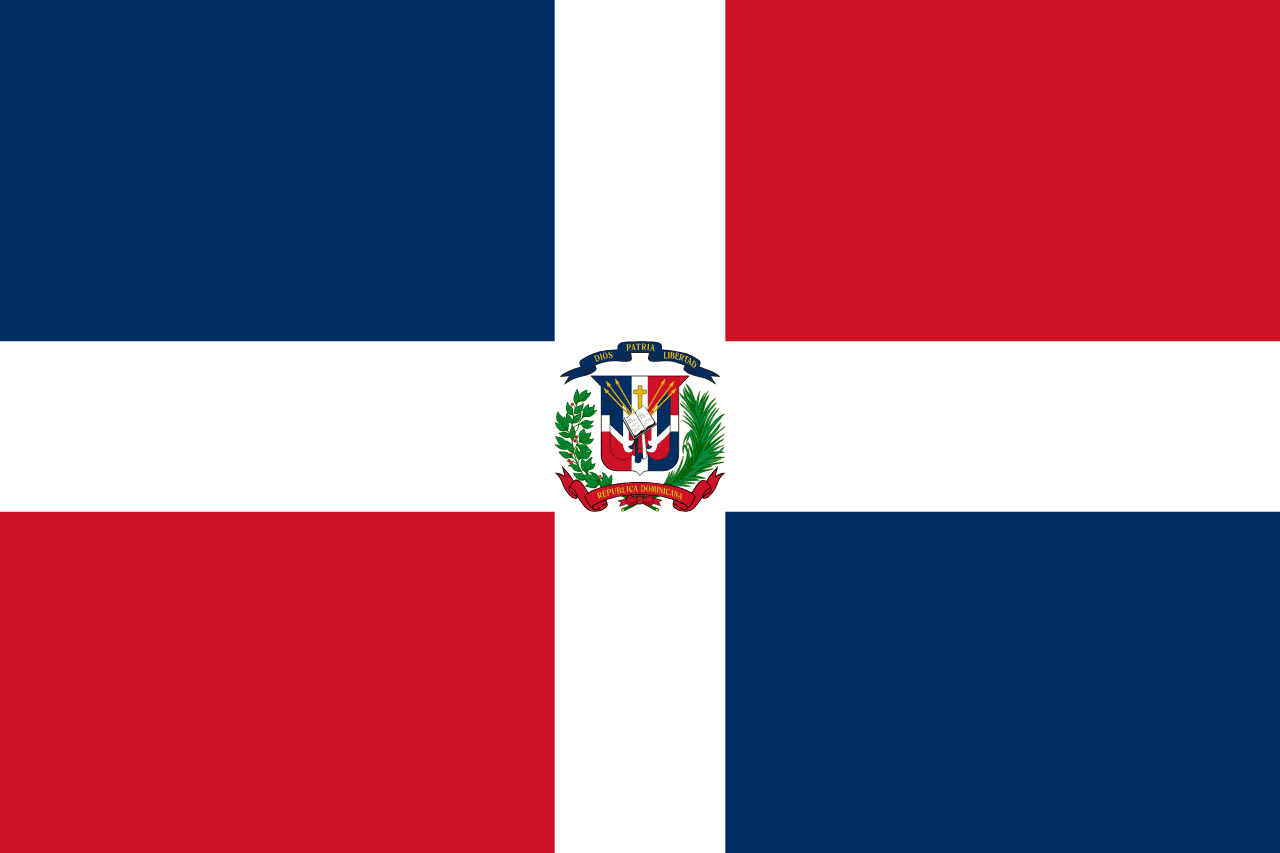
Among the world's national banners, the flag of the Dominican Republic holds a quiet distinction that is easy to miss from a distance: it is the only one that carries an open Bible turned to a specific passage. That detail sits at the heart of the country's emblem, and it tells you something immediately about how this Caribbean nation thinks of itself. Born in the dramatic independence year of 1844, the flag is woven from the story of a young republic breaking free, and every quarter, color, and symbol was placed there with deliberate intent.
This is not a simple tricolor or a single bold field. It is a quartered design, split by a white cross into four rectangles of alternating blue and red, with the national coat of arms anchored at the very center. To understand it fully, you have to read it the way its creators intended: as a layered statement of faith, sacrifice, and the longing for liberty.
A Cross at the Center of the Design
The defining feature of the Dominican flag is the broad white cross that runs the full height and width of the banner, dividing it into four equal quarters. This is the structural backbone of the whole design. The cross itself stands for salvation and the deep Catholic faith that runs through Dominican culture, while its geometry organizes everything else on the cloth.
The four resulting rectangles alternate in color in a way that gives the flag its characteristic checkerboard rhythm. The upper hoist quarter and the lower fly quarter are colored differently from their neighbors, producing the diagonal pairing of blue and red that distinguishes this flag from the many other crossed banners around the world. At the intersection of the cross, dead center, sits the coat of arms, making the emblem the literal and symbolic heart of the design.
What the Blue, Red, and White Mean
The three colors of the flag each carry a clear and specific meaning, and they are not interchangeable decoration. Blue represents liberty, the freedom that the founders fought to secure. Red stands for the blood shed by those who gave their lives in the struggle for independence. White, expressed through the cross, signifies salvation and the peace that faith was meant to bring to the new nation.
Read together, these colors compress an entire national philosophy into three tones: a people who wanted to be free, who paid for that freedom in blood, and who placed their hope in salvation. It is worth noting how directly the symbolism maps onto the country's founding moment rather than relying on vague abstractions. There is no guesswork here about what the designers intended each color to convey.
The Coat of Arms at the Heart of the Flag
If the cross is the flag's frame, the coat of arms is its soul. Set in the central white field, the emblem is what truly sets this flag apart from every other in the world. At its core lies an open Bible, and unlike the generic religious imagery found on some flags, this Bible is shown turned to a particular passage, traditionally identified with the Gospel of John and the verse declaring that the truth shall make you free. A small cross rises above the open book.
Surrounding the central shield are details drawn from the nation's identity: branches of laurel and palm, flags of the republic arranged around the shield, and a ribbon bearing the national motto. The phrase Dios, Patria, Libertad — God, Homeland, Liberty — appears with the country's name, summarizing in three words the values the entire banner was built to express. Because of this richly detailed emblem, the Dominican flag is sometimes described as carrying more meaning per square inch than almost any other.
From Independence to the Flag We Know
The flag's story is inseparable from the man credited with its conception, the independence leader Juan Pablo Duarte. Duarte founded the secret society dedicated to liberating the eastern part of the island of Hispaniola, and the design that emerged took an earlier banner and reworked it for a new and distinctly Dominican purpose. The decisive moment arrived in 1844, when independence was proclaimed and the new flag was raised over the republic.
The version with the cross dividing the field came to embody the break from prior rule, transforming a borrowed palette into something the Dominican people could call entirely their own. Over the following decades the coat of arms was refined and standardized, but the essential idea — quartered fields, a unifying cross, a central emblem with the open Bible — has remained remarkably stable since the founding era. To learn more about the nation that flies it, see our dominican republic country guide.
How It Compares to Look-Alike Flags
At a casual glance, the Dominican flag can be confused with several others that share its blue, red, and white palette or its crossed structure. It is most often grouped in the mind with the flag of neighboring Haiti, with which it shares the island of Hispaniola, though the two designs are in fact quite different — Haiti's flag uses horizontal bands rather than a quartered cross.
What truly separates the Dominican banner from any potential look-alike is twofold. First, the white cross that splits the field into four alternating panels is an unusual structure for a national flag, more reminiscent of crossed designs in northern Europe than of the typical Latin American tricolor. Second, and decisively, no other national flag in the world places an open Bible at its center. Even flags that feature religious symbolism do not specify a passage. That single feature makes the Dominican flag instantly identifiable once you know what to look for, and it ends any confusion with similarly colored banners.
The Flag in National Life Today
Within the Dominican Republic, the flag is far more than a design on a pole. It appears on Independence Day each February, when the nation marks the 1844 proclamation, and it flies over government buildings, schools, and public squares throughout the year. Dominican athletes carry it into international competition, and it is a familiar sight wherever the large Dominican diaspora has settled, draped from balconies and worn at parades and festivals.
The flag also enjoys a level of legal and ceremonial respect that reflects its founding symbolism. Its colors and emblem turn up in everything from currency and official seals to baseball celebrations, the sport most beloved by the nation. Across all these settings, the same message that Duarte and the founders encoded in 1844 — liberty paid for in sacrifice and anchored in faith — continues to do its work.
Interesting Facts About the Dominican Flag
- It is the only national flag in the world to display an open Bible, and that Bible is shown turned to a specific passage.
- The white cross divides the flag into four quarters, alternating blue and red, an unusual layout among the world's banners.
- The flag dates to 1844, the year the Dominican Republic declared its independence.
- Independence leader Juan Pablo Duarte is credited with conceiving the design.
- The national motto on the emblem, Dios, Patria, Libertad, translates to God, Homeland, Liberty.
- Blue stands for liberty, red for the blood of those who fought, and white for salvation.
Frequently Asked Questions
When was the flag of the Dominican Republic adopted?
The flag dates to 1844, the year the Dominican Republic proclaimed its independence. The quartered design with its central cross and coat of arms emerged from that founding moment and has remained the basis of the national flag ever since, with later refinements made mainly to the details of the coat of arms.
What do the colors of the flag mean?
Each color carries a defined meaning. Blue represents liberty, red represents the blood shed by those who fought for independence, and white — shown through the cross — represents salvation. Together they express a nation that sought freedom, paid for it in sacrifice, and grounded its hope in faith.
Who designed the Dominican Republic's flag?
The design is credited to Juan Pablo Duarte, the independence leader who founded the movement to free the country. He is regarded as one of the founding fathers of the republic, and the flag is closely tied to his vision of an independent Dominican nation.
What continent is the Dominican Republic on, and how does its flag compare to similar ones?
The Dominican Republic is a Caribbean nation in North America, occupying the eastern part of the island of Hispaniola. Its flag is sometimes confused with that of neighboring Haiti, but Haiti uses horizontal bands while the Dominican flag uses a quartered cross. The open Bible at its center makes it unique among all national flags.