
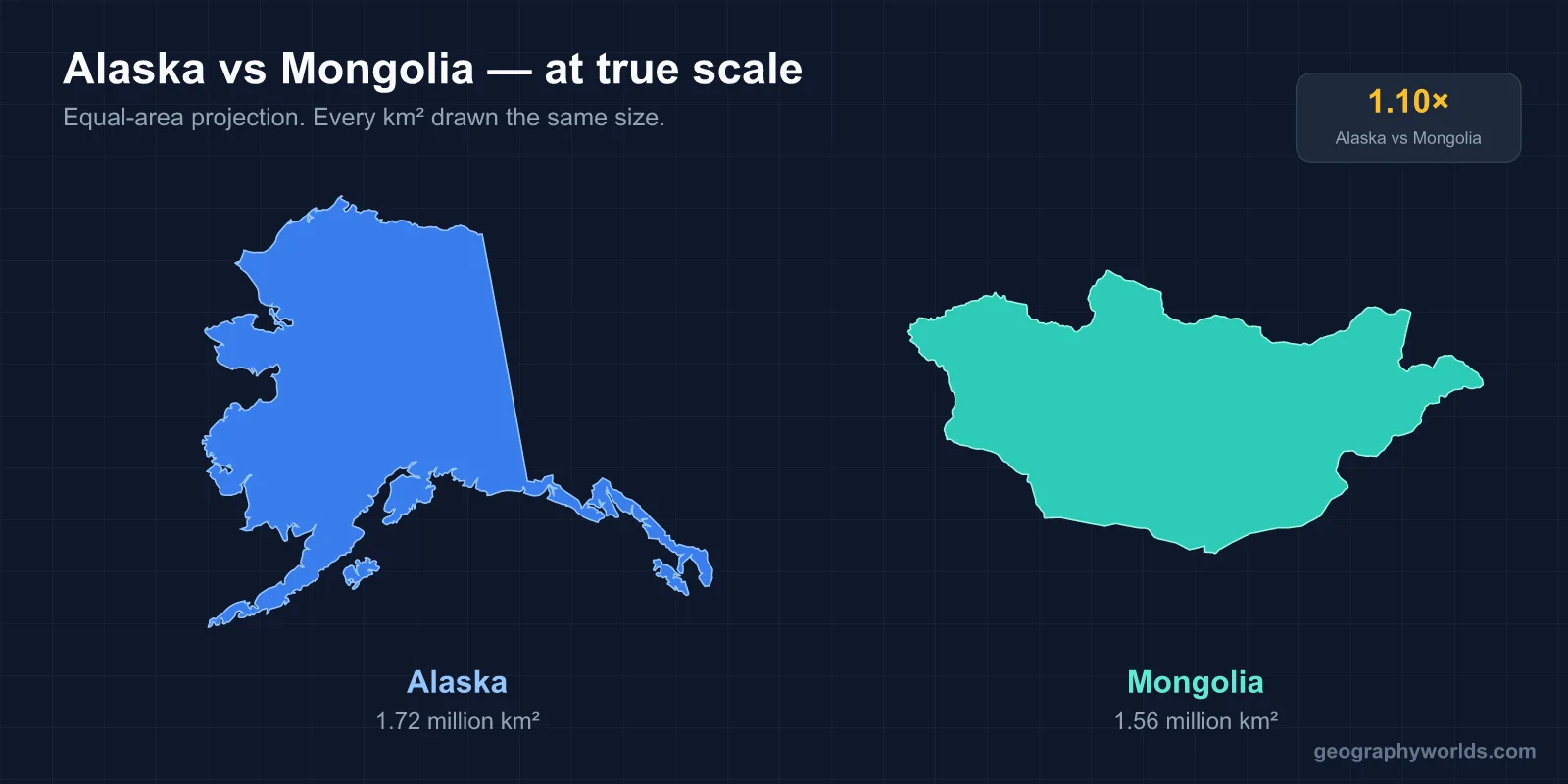
Mongolia and Alaska share a lot of geographic DNA — both are vast, sparsely populated, harsh in climate, and famous for wilderness. They're often compared because they're among the most thinly populated large regions on Earth. But which one is actually bigger? The answer is closer than most people guess.
The Short Answer
No, Alaska is bigger than Mongolia. Alaska covers 1,717,856 km². Mongolia covers 1,564,116 km². Alaska is about 10% larger. But it's remarkable that a single US state is larger than one of Asia's biggest countries.
Side-by-Side Numbers
- Mongolia area: 1,564,116 km² (603,909 sq mi)
- Alaska area: 1,717,856 km² (663,267 sq mi)
- Difference: Alaska is ~154,000 km² larger
- Ratio: Alaska is ~1.10× the size of Mongolia
- Mongolia population: ~3.4 million
- Alaska population: ~736,000
Mongolia
Mongolia is a landlocked country in East/Central Asia, sandwiched between Russia to the north and China to the south. It is the 18th largest country in the world by area and the most sparsely populated sovereign state — about 2 people per km². The capital, Ulaanbaatar, holds nearly half of the country's population (1.6 million people).
Geography is dominated by the Gobi Desert in the south, vast steppe grasslands in the center and east, and the Altai and Khangai mountain ranges in the west. Average elevation is high (1,580 m), making Mongolia one of the highest countries by mean elevation. The country was historically the heart of the Mongol Empire (1206–1368), which under Genghis Khan and his successors became the largest contiguous land empire in human history.
Alaska
Alaska is the largest US state, separated from the contiguous United States by Canada. It was purchased from Russia in 1867 for $7.2 million (about 2 cents per acre) — a deal mocked at the time as "Seward's Folly" but later considered one of the best real estate deals in history after the discovery of gold, oil, and natural gas. Alaska became the 49th state in 1959.
Geography is wildly varied. The state contains 17 of the 20 highest peaks in the United States, including Denali (6,190 m), North America's tallest mountain. Major features include the Alaska Range, the Brooks Range in the far north, the Yukon and Kuskokwim river basins, the Aleutian Islands stretching nearly to Russia, and Prince William Sound. Alaska's coastline (over 10,000 km if you include all islands) is longer than that of all other US states combined.
Population Density
Both regions are dramatically empty by global standards. Mongolia's population density of about 2 people per km² is the lowest of any sovereign country on Earth. Alaska's density of about 0.5 people per km² is the lowest of any US state — roughly equivalent to having one person in every 2 km². Most of Alaska's population lives in Anchorage (around 290,000), the Matanuska-Susitna Valley, and Fairbanks. Mongolia's population is even more concentrated — Ulaanbaatar alone holds nearly 50% of the country.
Climate
Mongolia has an extreme continental climate. Winters are bitterly cold — average January temperatures in Ulaanbaatar are −20°C, and the capital is sometimes called the coldest national capital on Earth. Summers can be hot (up to 30°C). The country has very low precipitation (200–350 mm annually) and over 250 sunny days per year, earning it the nickname "Land of the Eternal Blue Sky."
Alaska's climate varies by region. The far north has Arctic climate with permafrost and brief, cool summers. The interior has subarctic continental climate — Fairbanks regularly sees winter lows below −40°C and summer highs above 30°C. The southern coast (Anchorage, Juneau) is much milder due to maritime influence and the warm North Pacific currents. Annual snowfall in some Alaskan areas exceeds 10 meters.
Wildlife
Mongolia is home to iconic wildlife including the snow leopard, Pallas's cat, gray wolf, Siberian ibex, Argali sheep, saiga antelope, Mongolian wild ass, Bactrian camel, and the takhi (Przewalski's horse — the only truly wild horse species, reintroduced after extinction in the wild). Bird life is rich, with cinereous vultures, golden eagles, and over 470 recorded species.
Alaska's wildlife is similarly iconic but very different. The state hosts roughly 30,000 brown/grizzly bears, 100,000 black bears, polar bears in the Arctic, 175,000 moose, hundreds of thousands of caribou, gray wolves, lynx, wolverines, and the largest concentration of bald eagles on Earth. Alaska's waters host massive populations of salmon (five species), halibut, king crab, humpback whales, orcas, and sea otters.
Economy
Mongolia's economy depends heavily on mining (copper, gold, coal, uranium) and herding. About 25–30% of Mongolians still live a semi-nomadic pastoral lifestyle, raising sheep, goats, horses, cattle, and Bactrian camels. The country has vast mineral wealth, including the Oyu Tolgoi copper-gold mine, one of the world's largest. GDP per capita is about $5,000.
Alaska's economy is dominated by oil and gas (the Prudhoe Bay field on the North Slope is North America's largest), commercial fishing (the largest seafood industry in the US), tourism, and federal government spending. The Alaska Permanent Fund pays a yearly dividend to every Alaska resident from oil royalties — usually $1,000–$2,000 per person. GDP per capita is around $75,000, dramatically higher than Mongolia.
Historical Connections
Mongolia and Alaska share an indirect deep history. Indigenous peoples of Alaska — Inupiaq, Yupik, Aleut, Athabascan, Tlingit, Haida — descended from migrations across the Bering Land Bridge from northeast Asia, including ancestral populations that also peopled parts of present-day Mongolia and Siberia. Genetic studies show Mongolians and Indigenous Alaskans share ancient ancestry from common Siberian source populations.
Transportation and Connectivity
Both places are notoriously difficult to traverse. Mongolia has only about 50,000 km of road, much of it unpaved. Long-distance travel often happens on the Trans-Mongolian Railway (a branch of the Trans-Siberian) or by air; outside cities, off-road driving across the steppe is still routine for nomadic herders. Alaska is even more cut off in some ways: the state has fewer paved roads than Rhode Island despite being over 500 times larger. Many communities — including the capital, Juneau — cannot be reached by road from the rest of the state and depend on ferries or small planes. Alaska has the highest per-capita use of small aircraft in the United States.
Tourism and Recreation
Mongolia has been opening up to tourism since the early 2000s. Visitors come for the Gobi Desert, the Naadam Festival (held each July with wrestling, horse racing, and archery competitions), eagle hunting in the Altai Mountains, and the experience of staying in a traditional ger camp with nomadic families. About 600,000 international tourists visit annually. Alaska's tourism is much larger and more developed: about 2.7 million visitors per year, drawn by Denali, the Inside Passage cruises, brown bear viewing at Katmai, the northern lights in Fairbanks, and salmon fishing throughout the state.
Environmental Challenges
Mongolia's biggest environmental challenge is desertification. Around 76% of the country is already affected by some degree of land degradation, driven by overgrazing, mining expansion, and climate change. The country has warmed at more than twice the global average over the past 70 years, leading to drying lakes, shrinking glaciers in the Altai, and increasingly severe "dzud" winters — extreme cold spells that can wipe out millions of livestock in a single season. Alaska, meanwhile, is at the front line of Arctic climate change. Permafrost is thawing across vast areas of the interior, destabilizing roads, buildings, and pipelines. Glaciers are retreating rapidly — the state has lost an estimated 75 gigatons of ice per year over the past two decades. Coastal erosion is forcing entire villages, like Newtok and Kivalina, to relocate.
Key Facts
- Alaska is about 10% larger than Mongolia.
- Mongolia is the most sparsely populated sovereign country; Alaska is the most sparsely populated US state.
- Both have extreme continental climates with brutal winters.
- Mongolia was the heart of the Mongol Empire, the largest contiguous empire in history.
- Alaska was bought from Russia for $7.2 million in 1867.
Fun Facts
- Ulaanbaatar is often cited as the coldest national capital on Earth.
- Alaska has more coastline than all other US states combined.
- Mongolia has more horses than humans.
- Alaska's Denali is the tallest mountain in North America at 6,190 m.
- Mongolia has about 30 million livestock — roughly 9 animals per person.
The Bottom Line
Alaska is bigger than Mongolia — by about 10%. The fact that a single US state out-sizes one of Asia's largest countries is itself a memorable factoid worth knowing. Both regions are dramatic in their emptiness, brutal in their climate, rich in their wildlife, and home to indigenous cultures shaped by harsh landscapes. They look very similar from space — vast, sparsely lit, dominated by wilderness — and they represent two of the planet's most striking examples of land that resists dense human settlement.
Quiz Vast Places!
Test your knowledge of Mongolia, Alaska, and the world's biggest landscapes.
Play Geography Games →