

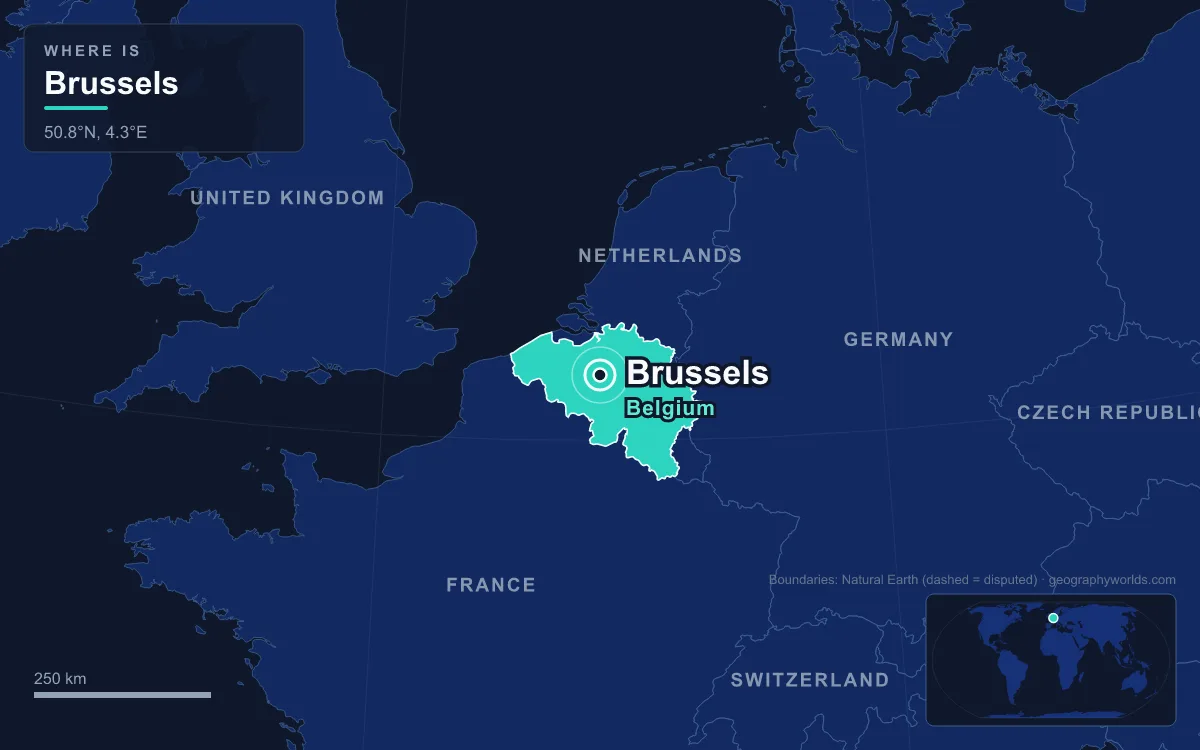
Brussels is the capital of Belgium. Strictly, Article 194 of the Belgian Constitution names the City of Brussels, a single municipality of about 33 square kilometres, as the capital, but most people mean the wider Brussels-Capital Region: 19 municipalities covering 162 square kilometres in the centre of the country, home to 1,255,795 people in 2025. The region is a bilingual French and Dutch enclave inside Flanders, and what sets it apart from every other national capital is that it has two jobs. Besides running Belgium, it hosts the European Commission, the Council of the European Union and the headquarters of NATO, which makes it the de facto capital of the EU.
Bruocsella on the Senne, 695–1183
The name gives away the original site. Brussels most likely comes from the Old Dutch Bruocsella, "settlement in the marsh", and the earliest written reference, to a hamlet called Brosella, was made by Saint Vindicianus, Bishop of Cambrai, in 695. Local legend credits Saint Gaugericus with building a chapel on an island in the river Senne around 580. The official founding date usually given is 979, when Charles, Duke of Lower Lorraine, moved the relics of Saint Gudula from Moorsel to that chapel. Charles, appointed duke by Emperor Otto II in 977, also built the settlement's first permanent fortification on the same island, the furthest point inland at which the Senne was still navigable.
Around 1000, Lambert I, Count of Louvain, gained the County of Brussels by marrying Charles's daughter. The town sat on the trade route linking the Flemish cloth cities of Bruges and Ghent with Cologne, and it grew on textiles. By the end of the 11th century an open-air market had been laid out on a drained marsh near the fort, the ground that became the Grand-Place. The town spread up the slope to the Treurenberg, the Coudenberg and the Sablon, above the reach of the Senne's floods, and as the population approached 30,000 the surrounding marshes were drained. In 1183 the Counts of Leuven became Dukes of Brabant, a duchy that, unlike neighbouring Flanders, belonged to the Holy Roman Empire rather than owing allegiance to the King of France.
Walled Town of the Dukes of Brabant, 1183–1477
Brussels was one of four capitals of Brabant, alongside Leuven, Antwerp and 's-Hertogenbosch, and like them it spoke Dutch. Latin gave way to Middle Dutch in city orders from the late 13th century, and before 1500 there were almost no French documents in the city archives. The first walls went up in the early 13th century; work on the Gothic church that is now the Cathedral of St Michael and St Gudula began in 1225, replacing a Romanesque predecessor. A second, much longer circuit of walls followed between 1356 and 1383. Only traces of the walls survive, but the Small Ring of boulevards that frames the historic centre still traces their line, which is why the old core is known as the Pentagon.
After Joanna, Duchess of Brabant, died in 1406, the duchy passed to the House of Burgundy, and French began its slow advance at court. When Duke Charles the Bold was killed at the Battle of Nancy in 1477, his heiress, the Brussels-born Mary of Burgundy, married the future Emperor Maximilian I, and the Low Countries passed to the Habsburgs.
Habsburg Seat, 1477–1713: Charles V to the French Bombardment
Under the Habsburgs Brussels became the princely capital of the Seventeen Provinces. Charles V, whose empire stretched to the Americas, was declared of age in the Coudenberg Palace in 1515, and in the same palace in 1555 he abdicated, handing the Netherlands to his son Philip II of Spain. The palace, famous across Europe, burned down in 1731. The 16th and 17th centuries were the age of Brussels lace and of Brussels tapestries, which hung in palaces across Europe.
The worst day in the city's history came in August 1695, during the Nine Years' War, when Louis XIV's artillery bombarded Brussels. The shells and the fires that followed destroyed about 4,000 buildings, a third of the city, including almost all of the Grand-Place. Only the Town Hall's façade and tower, which the French artillery had used as a target, and some stone walls withstood the fire. The guild houses were rebuilt in the years that followed in the ornate Baroque style that now makes the square, 68 by 110 metres, a UNESCO World Heritage Site since 1998.
Austrian, French and Dutch Brussels, 1713–1830
Allied troops took Brussels after the Battle of Ramillies in 1706, and the Treaty of Utrecht in 1713 transferred the Southern Netherlands from Spain to the Austrian Habsburgs. France held the city from 1746 to 1749 during the War of the Austrian Succession, then returned it. In 1795 revolutionary France annexed the whole region, and Brussels was demoted to the chief town of the département of the Dyle. Napoleon's defeat at Waterloo in 1815, south of today's regional boundary, ended French rule, and the Congress of Vienna joined the south to the north in a United Kingdom of the Netherlands under William I of Orange. The former Dyle département became the province of South Brabant, with Brussels as its capital.
Capital of the New Belgium, 1830–1914
The city made the country. On 25 August 1830, the audience leaving a performance of Auber's patriotic opera La Muette de Portici at La Monnaie joined rioters in the streets, and uprisings spread across the south. On 27 September a provisional government in Brussels declared independence, and on 21 July 1831 Leopold I took the oath as the first King of the Belgians. Brussels became the capital and seat of government of the new state, and the medieval walls were torn down.
Growth followed quickly. The Brussels–Charleroi Canal opened in 1832, the Free University of Brussels was founded in 1834, and in 1835 a line from Molenbeek to Mechelen became the first passenger railway built outside England. Over the century the population of the city and its surroundings rose from about 80,000 to more than 625,000. The Senne, by then an open sewer that flooded the working-class lower town, was vaulted over between 1867 and 1871 under mayor Jules Anspach, and grand boulevards were laid on top of it. The Bourse (1873), the Palace of Justice (1883) and Saint Mary's Royal Church (1885) date from this building boom, and Victor Horta, Paul Hankar and Henry van de Velde made Brussels a centre of Art Nouveau around 1900.

The capital also changed language in this era. French was the only language of the courts, the army, the administration and higher education, and after 1880 Dutch-speaking families increasingly brought up their children in French. From 1910 the number of French monolinguals grew steadily, turning a historically Dutch-speaking city into one where French became the majority language, a shift that still shapes Belgian politics and is covered in our guide to the languages spoken in Belgium.
Occupations, Expo 58 and Brusselisation, 1914–1989
German troops occupied Brussels in both world wars. The city escaped large-scale destruction in the first, though explosives left by retreating German forces in November 1918 damaged about 2,300 houses. In the second, an American raid aimed at the SABCA aircraft works in Haren on 7 September 1943 hit Ixelles instead and killed 282 civilians. The British Guards Armoured Division liberated the city on 3 September 1944.
The post-war decades remade the centre. The North–South rail connection linking the main stations was finished in 1952, the first premetro tram tunnel opened in 1969 and the first metro line in 1976. The 1958 World's Fair left the Atomium, a 102-metre model of an iron crystal with nine steel-clad spheres, on the Heysel Plateau. Europe arrived at the same time. The Treaty of Brussels, signed in the city on 17 March 1948 by Belgium, France, Luxembourg, the Netherlands and the United Kingdom, was a forerunner of NATO, and from 1957 Brussels, Luxembourg and Strasbourg began hosting the institutions of the new European Communities. Office blocks went up with so little regard for what they replaced that the city's name became a planning term for it: Brusselisation.
Region, Europe and NATO Since 18 June 1989
Belgium's gradual federalisation gave the capital its present form. The Brussels Agglomeration, created in 1971, held its only council election that November. After the constitutional reform of 1988, the Brussels-Capital Region was established on 18 June 1989 as one of three federal regions, officially bilingual, with a yellow iris as its emblem. When the old province of Brabant was split in 1995, the region was left outside any province. Its parliament has 89 members, 72 elected on French-speaking lists and 17 on Dutch-speaking ones. The City of Brussels also serves as capital of both the French Community and the Flemish Community, so the Flemish Parliament sits in a city whose majority speaks French. How these layers of federal, regional and community power fit together is set out in our explainer on the government of Belgium.
The European role has kept growing. The Treaty of Amsterdam formally gives Brussels the seats of the European Commission and the Council of the European Union, and although the European Parliament's official seat is in Strasbourg, about three quarters of its sessions now take place in its Brussels hemicycle. The Commission alone occupies some 865,000 square metres in the European Quarter, around a quarter of all office space in the city, with the Berlaymont building at its centre. NATO's headquarters stands on the Boulevard Léopold III in Haren, at the north-eastern edge of the City of Brussels, in a new €750 million building completed in 2017.

The international role has had a cost as well as rewards. On 22 March 2016, ISIL suicide bombers attacked Brussels Airport in Zaventem and Maalbeek metro station, killing 32 people in the deadliest terrorist attack in Belgian history.
The population reflects all of this. By 2024 residents held 186 different nationalities and spoke 104 languages, up from 72 in 2001. Of the region's 1,255,795 inhabitants in 2025, 62.8 percent held Belgian citizenship and 37.2 percent did not; citizens of other EU states formed the largest foreign group. In Ixelles, Etterbeek and Saint-Gilles, roughly half of all residents are foreign nationals.
That mix is the city's answer to its own history: a Dutch-speaking market town on a marsh, rebuilt after 1695, turned French-speaking after 1830 and international after 1957. Today it governs a federal kingdom and hosts much of the machinery of a 27-member union, whose institutions are explained in our guide to what the European Union is and how it works.
Quick Facts About Brussels
- Country: Belgium
- Continent: Europe (Western Europe)
- Country population: approximately 11.8 million
- Capital city status: Brussels is the capital of Belgium, the seat of national government, and the location of foreign embassies, parliament, and the head of state's official residence.
Frequently Asked Questions
What is the capital of Belgium?
The capital of Belgium is Brussels. Brussels is the seat of national government, hosts most foreign embassies and consulates, and is typically where the head of state and parliament are located.
What continent is Brussels in?
Brussels, the capital of Belgium, is located in Europe, in the Western Europe region. As Belgium's capital, Brussels serves as the country's primary connection to the broader Europen political, economic, and cultural sphere.
Why is Brussels the capital of Belgium?
Brussels was chosen as the capital of Belgium for reasons that typically combine geography, history, and politics. Capital city selections often reflect a desire for centrality (being accessible from across the country), historical importance (being a longstanding seat of government or culture), or neutrality (being acceptable to multiple regions or ethnic groups within the country). The specific reasons for Brussels's designation are detailed in the city's history above.
What is Brussels known for?
As the capital of Belgium, Brussels is best known for housing the country's central government institutions — parliament, presidential or royal residences, supreme court, and key ministries. It is also typically a major cultural and economic center within Belgium, hosting national museums, embassies, and signature monuments. The introduction and history sections above provide detailed coverage of the city's specific notable institutions and landmarks.
Related Pages
- Belgium Country Guide — full geography, climate, economy, and culture overview
- Flag of Belgium — meaning, history, and design of Belgium's national flag