

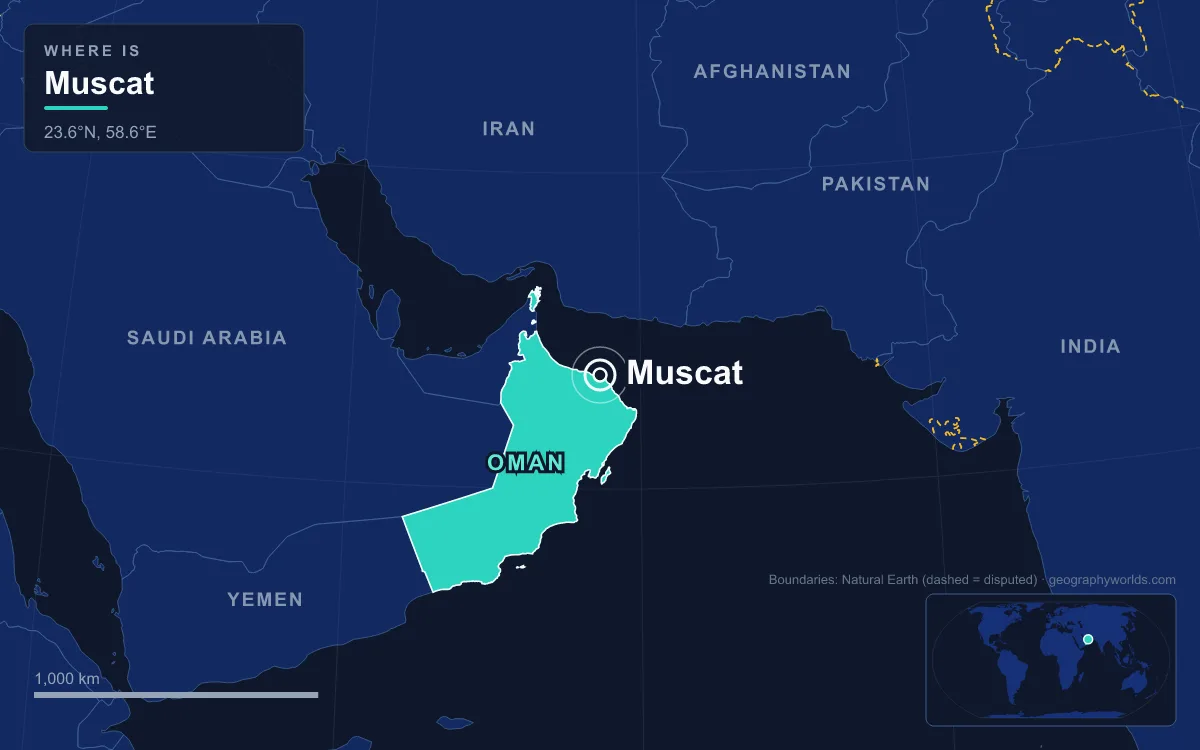
The capital of Oman is Muscat, a port city on the Gulf of Oman in the northeast of the country, not far from the Strait of Hormuz. The Muscat Governorate had about 1.72 million people in 2022, according to Oman’s National Centre for Statistics and Information, spread across six wilayat (provinces) and roughly 6,500 square kilometres. What sets it apart is its shape: rather than a single centre, Muscat is a chain of low, mostly white districts strung for dozens of kilometres along a narrow coastal strip, squeezed between the sea and the bare rock of the Hajar Mountains. The best way to understand it is to walk it from east to west, from the walled old town where the sultans have their palace to the airport at Seeb.
Inside the 1625 Walls of Old Muscat
Start in Old Muscat, the original town, which is cut off from the rest of the city by coastal hills. You enter through the Muscat Gate, now a museum. The town is closed on its western and southern sides by a wall with round towers, built in 1625, and on the other two sides by the sea and the mountains. Until the middle of the 20th century the gates were shut three hours after dusk, anyone out on the streets after that had to carry a lantern, smoking was banned on the main streets, and music could not be played in public.
At the water’s edge stands Al Alam Palace, the “Palace of the Flag”, the ceremonial seat of the Sultan of Oman, used to receive heads of state. Sultan Said bin Sultan built an earlier palace here in the early 1800s on the foundations of an old sea wall. It was damaged by tribal insurgents in 1895, left unrepaired, and demolished in 1971. The present building, designed by the Indian firm Shapoorji Pallonji and completed in 1972, has a façade of gold and blue columns. Visitors cannot go inside the grounds but may photograph it from the gates.

The palace sits between two forts that frame the harbour and tell the story of Muscat’s most violent century. The Portuguese admiral Afonso de Albuquerque arrived in 1507, was fired on as he approached, took the town and burned most of it. Portugal held Muscat for more than a century, though Ottoman fleets bombarded it in 1546 and captured it in 1552 and again in the 1580s. Fort Al-Mirani existed before the Portuguese came, was rebuilt by them in 1587, and became the first fort in Oman to use cannon. Al Jalali, also called the eastern fort, was built in the 1580s under Philip I of Portugal on an earlier Omani fortress, to guard the harbour after the two Ottoman sackings; the Portuguese called it Forte de São João. Omani forces under the Ya’ariba imams ended Portuguese rule: an attack on 16 August 1648 destroyed the high towers, and after a night assault the Portuguese surrendered on 23 January 1650. Al Jalali later served as Oman’s main prison for much of the 20th century and has been a museum for visiting dignitaries since its restoration in 1983.
Old Muscat became the national capital in 1793, when it replaced the inland town of Rustaq. Under Said bin Sultan in the 19th century it was the heart of a maritime state reaching Zanzibar, and on 21 September 1833 he signed a treaty here with Edmund Roberts, envoy of US President Andrew Jackson. In 1840 Said moved his own seat to Stone Town on Zanzibar, and after his death in 1856 Zanzibar and Oman went to different sons.
Along the Muttrah Corniche to Souq Al Dhalam
Follow the coast road northwest over the hills and you reach Muttrah, which before oil was the commercial centre of the whole country. Its corniche runs along one of the two deep natural harbours, at Muttrah and at Old Muscat, that made the city a port. Ptolemy’s map of Arabia marks two harbours on this coast, Cryptus Portus and Moscha Portus, and scholars still disagree over which of them was Muscat. When Edmund Roberts visited in the early 1830s, Muttrah had about 8,000 inhabitants. Today it is the most densely populated wilayat in Oman.
Behind the corniche lies the Muttrah Souq, known locally as Al Dhalam, “Darkness”, because its stalls and lanes are so tightly packed that sunlight barely reaches the ground. It is one of the oldest markets in Oman, about two centuries old, and the densest part runs from the Al Lawatiya Mosque to Khour Bimba. The souq still sells the city’s traditional exports, dates, mother-of-pearl and fish among them, alongside Omani craft goods.
Next to the souq, behind its own wall, is Sur Al Lawatia, a small enclosed quarter that belongs to the Lawatiya community. They arrived from Sindh in waves between 1780 and 1880, brought an Indo-Aryan language, Luwati, which they still speak, and traded in incense, jewellery and cloth. In predominantly Ibadi Oman, they make up most of the local Shia population. They were not the first South Asian merchants here. Hindu traders from Sindh and later Kutch had dominated Muscat’s commerce by the 19th century, trading with Thatta and Kutch, and four Hindu temples stood in the city around 1760. Arabic is the city’s main language, but Balochi, Sindhi, Swahili, Gujarati, Malayalam, Urdu and a dozen other languages are also heard on its streets.
Ruwi and Mina Qaboos: The Port and Business District Built After 1970
At the western end of the corniche is Port Sultan Qaboos, formerly Mina Qaboos. It was first conceived by Sultan Said bin Taimur, an increasingly isolated ruler who had moved his residence to Salalah in the far south. On 23 July 1970 his son Qaboos bin Said removed him in a bloodless coup, renamed the country from Muscat and Oman to the Sultanate of Oman, and completed the port in the 1970s. At its peak it handled about 1.6 million tons of cargo a year, modest next to the roughly 44 million tons passing through Jebel Ali in neighbouring Dubai. In August 2014 the government announced it would end commercial operations here, citing traffic congestion; cargo moved to Sohar, and the harbour is being turned into a cruise-ship port.
Inland from Muttrah is Ruwi, an old village turned into the city’s central business district by a new complex of offices, warehouses, shops and homes. The first five-year development plan, launched in 1976, poured money into Muscat’s infrastructure, and migrants from across the region followed. Ruwi is the hub of the city’s bus network, and the Muscat Securities Market, founded in 1988, is in the business district. The cheapest way around is still the “baiza bus”, a shared minibus named after the smallest coin of the Omani rial, whose name comes from the Indian paisa. By the 2003 census, immigrants made up about 40 percent of the governorate’s population, and Muttrah had more than 100,000 expatriates, the highest number of any wilayat.
West Along Sultan Qaboos Street to Qurum, the Opera House and Bawshar
From Ruwi, Sultan Qaboos Street, the city’s main artery, runs west for kilometres. Along the coast it passes Darsait and Mina Al Fahal, whose hills of serpentinite and other volcanic rock, rich in iron but almost bare of plants, are typical of the southeastern Arabian Peninsula. Oil is never far away: Petroleum Development Oman, central to the city’s economy since at least 1962, is the country’s second-largest employer after the government. Next comes Qurum, with its nature reserve of salt-tolerant sabkha plants and a freshwater estuary full of glassfish, and the main shopping district.
In Shati Al-Qurum stands the Royal Opera House Muscat. Sultan Qaboos, a lover of classical music, ordered it in 2001, and it opened in October 2011 with Puccini’s Turandot conducted by Plácido Domingo. It seats up to 1,100 people and stages opera, ballet and orchestral music. A little further west, Al Khuwair Square gained a 126-metre flagpole on 22 May 2025, now the tallest man-made structure in the country.
The walk ends at the country’s largest mosque. The Sultan Qaboos Grand Mosque in Bawshar was ordered in 1992, begun in December 1994 and completed in 2001. It holds up to 20,000 worshippers. Its main minaret rises 90 metres, flanked by four of 45.5 metres, and about 270,000 tonnes of Indian sandstone went into it. Inside, a hand-woven carpet of 1.7 million knots, weighing 21 tonnes and made by some 600 weavers over four years, covers the prayer hall under a 14-metre chandelier with 600,000 crystals. Both were once the largest of their kind in the world.

Seeb, the Airport and the Heat of a Muscat Summer
The western end of the city is Seeb, which at the 2003 census was already the most populous wilayat, with more than 220,000 residents. Here the mountains fall back and the coast opens into the plains of Al Batinah. Muscat International Airport, formerly Seeb International Airport, lies about 25 kilometres from Ruwi and houses the head office of Oman Air. Muscat has a hot desert climate, with about 10 centimetres of rain a year, falling mostly between December and April.
May and June are the hottest months, with average highs near 39.5°C, and the airport has recorded 49.2°C in August. The rare storms that do arrive can be severe: Cyclone Gonu struck on 6 June 2007 and Cyclone Phet in June 2010, each dropping more than 100 millimetres of rain on the city in a single day. Between the sea, the mountains and the heat, the city has grown in a long line along the coast. To see how the capital fits into the rest of the sultanate, read this Oman country guide, look up the countries that border Oman, or read about the strategic channel to the north in this guide to the Strait of Hormuz.
Quick Facts About Muscat
- Country: Oman
- Continent: Asia (Middle East)
- Country population: approximately 5.7 million
- Capital city status: Muscat is the capital of Oman, the seat of national government, and the location of foreign embassies, parliament, and the head of state's official residence.
Frequently Asked Questions
What is the capital of Oman?
The capital of Oman is Muscat. Muscat is the seat of national government, hosts most foreign embassies and consulates, and is typically where the head of state and parliament are located.
What continent is Muscat in?
Muscat, the capital of Oman, is located in Asia, in the Middle East region. As Oman's capital, Muscat serves as the country's primary connection to the broader Asian political, economic, and cultural sphere.
Why is Muscat the capital of Oman?
Muscat was chosen as the capital of Oman for reasons that typically combine geography, history, and politics. Capital city selections often reflect a desire for centrality (being accessible from across the country), historical importance (being a longstanding seat of government or culture), or neutrality (being acceptable to multiple regions or ethnic groups within the country). The specific reasons for Muscat's designation are detailed in the city's history above.
What is Muscat known for?
As the capital of Oman, Muscat is best known for housing the country's central government institutions — parliament, presidential or royal residences, supreme court, and key ministries. It is also typically a major cultural and economic center within Oman, hosting national museums, embassies, and signature monuments. The introduction and history sections above provide detailed coverage of the city's specific notable institutions and landmarks.
Related Pages
- Oman Country Guide — full geography, climate, economy, and culture overview
- Flag of Oman — meaning, history, and design of Oman's national flag