

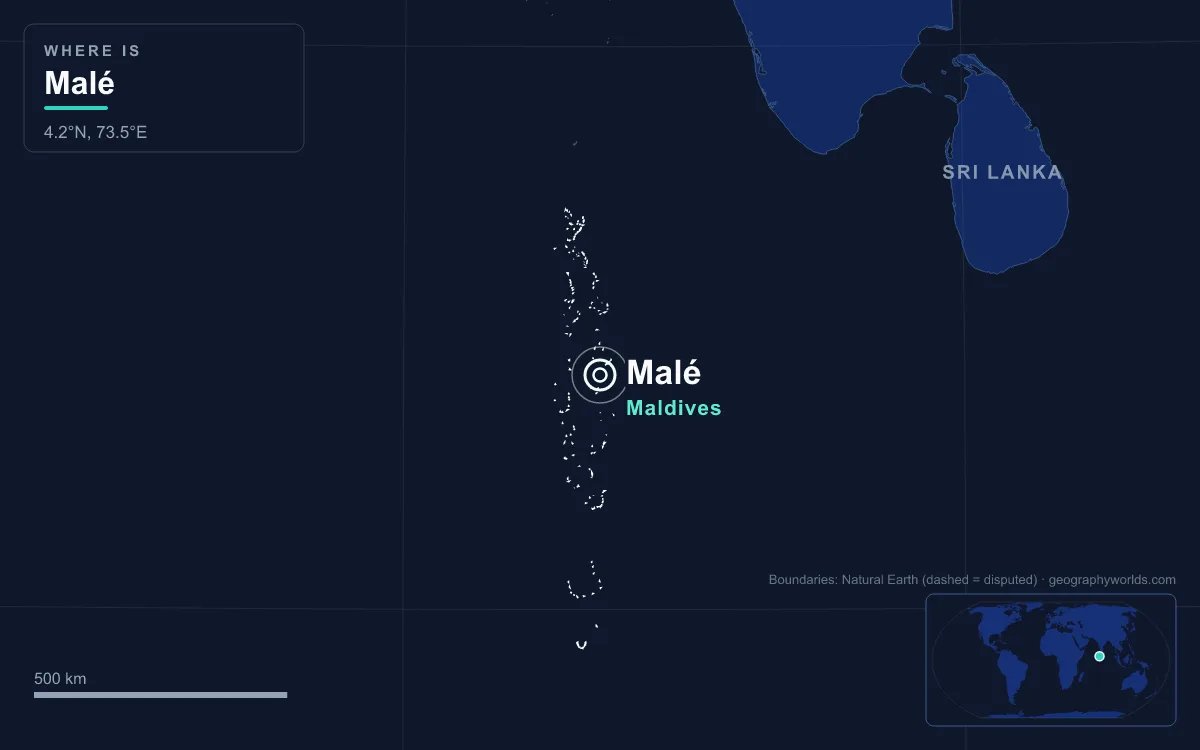
Medieval travellers named the whole archipelago after its capital: Ibn Battuta called the islands Maḥal Dībīyāt, after Malé, and that name is still inscribed on the Maldives state emblem. Malé is the capital and most populous city of the Maldives, sitting on the southern edge of North Malé Atoll (Kaafu Atoll) in the Indian Ocean. The 2022 census counted 211,908 people in its administrative area, which includes the central island, the airport island of Hulhulé and the reclaimed island of Hulhumalé, making it one of the most densely populated cities on Earth. About 41 percent of everyone in the Maldives now lives in the capital, up from 27 percent in 2000. The city is best explained through the people who made it, from Tamil-speaking fishermen and a northern prince to coral masons, a Moroccan judge, Gujarati merchants and today’s Bangladeshi construction crews.
The Giraavaru Fishermen and the Sandbank of Blood
Malé’s founding story begins with the Giraavaru, regarded as the oldest island community in the Maldives. They spoke an early form of Tamil, probably descended from settlers from the Malabar Coast and the northwest shores of Sri Lanka, and lived on the island of Giraavaru in the same atoll. They had no kings, only local headmen. According to local lore, their fishermen regularly took tuna to a large sandbank at the southern end of the atoll to clean the catch. So much offal and blood went into the water that it looked like a great pool of blood, “maa ley” in the old language, and that phrase is said to have given the island its name.
The Giraavaru also named the island’s four traditional wards, which survive as administrative divisions today: Maafannu (a big place where a village path meets the sea), Henveiru (where fishermen went out for bait), Galolhu (a stone groove) and Macchangolhi (a windward fork in the path). The Giraavaru themselves were strictly monogamous, prohibited divorce and kept a music tradition distinct from other islanders. Their own island was eroding, and its name is thought to mean “eroding islanders”. It was eventually abandoned, in 1968 according to some sources and 1972 according to others. Its last families were ferried to Hulhulé and, when the airport there was extended, moved on to Malé, where they were absorbed into the wider population.
Koimala’s Palace and the Sultans of Fura Malé
The same legend says a prince from the subcontinent named Koimala sailed into the atoll from the north. The Giraavaru welcomed him and let him settle on the blood-stained sandbank. Trees were planted, a palace was built, and the island was formally called Maa-le, while its neighbour became Hulhu-le, today’s airport island. Koimala ruled as King Mahaabarana, of the Lunar dynasty, and until 1968 the formal titles of Maldivian kings still claimed descent from both the Moon and the Sun.
From then on Malé was the King’s Island. Maldivians called it Fura Malé, “Malé the Pre-Eminent”, while early foreign writers called it Ambria or Mahl. The royal dynasties ruled from a palace compound in the centre of the island, and in the 17th century Sultan Muhammad Imaduddin enclosed it with walls on the north, east and west sides. In 1888 the walled town held just 2,148 people. The fortifications were dismantled and rebuilt on a smaller scale in 1925–1927 under Muhammad Shamsuddeen III, and after the monarchy was abolished in 1968, President Ibrahim Nasir’s remodelling of the city destroyed the Royal Palace, the forts and the bastions. Only the Malé Friday Mosque and the last sultan’s residence, now the National Museum, survived.
Abu al-Barakat, Ibn Battuta and the Converts of 1153
The people who most changed Malé arrived by sea from the Muslim world. Arab traders dominated the Indian Ocean in the 12th century, and in 1153, according to the usual date, the last Buddhist king, Dhovemi, converted to Islam and took the name Sultan Muhammad al Adil. Six dynasties comprising 84 sultans and sultanas followed him. The Medhu Ziyaaraiy, the most revered site in Malé, is the tomb of Abu al-Barakat Yusuf al-Barbari, the visitor traditionally credited with the conversion. Where he came from is disputed. The account told to Ibn Battuta made him a North African, while the local chronicles, the Raadavalhi and the Taarikh, identify him as Yusuf Shams ud-Din of Tabriz in Persia; in the Arabic script of the time, al-Barbari and al-Tabrizi looked almost identical.
The best outside witness is the Moroccan traveller Ibn Battuta, who reached Malé in 1343. He found a queen, Rehendhi Khadeeja, living in a palace whose compound contained pits full of cowrie shells ready for export, and mosques built of wood. The islands were then one of the world’s great sources of cowrie money, which circulated across Africa, South Asia and East Asia; the Chinese character for money, 貝, began as a drawing of a Maldivian cowrie. Ibn Battuta stayed on as chief qadi, or judge, ordered public whippings for men who skipped Friday prayer, took four wives and clashed with the island’s rulers until he resigned.

Coral Masons of the 1658 Hukuru Miskiy
The wooden mosques Ibn Battuta described have gone, but the craftsmen who replaced them left Malé its finest building. By the 1650s the mosque built on the site in 1153 had become too small, and Sultan Ibrahim Iskandar I ordered a new one. Work began in 1656 and finished in 1658. The builders used blocks of Porites coral, which is soft and easy to cut while wet but hardens into sturdy stone once dry, and they fitted the pieces together by interlocking assembly. The master carpenters, Ali Maavadi Kaleyfaanu and Mahmud Maavadi Kaleyfaanu, came from Kondey on Huvadhu Atoll in the far south, and the calligraphy was carved by the chief justice of the day. The Hukuru Miskiy stands opposite the Medhu Ziyaaraiy and was placed on UNESCO’s tentative World Heritage list in 2008 as an example of coral-stone architecture.
Not every newcomer was welcome. In 1558 the Portuguese set up a colony in the Maldives, governed from Goa, and tried to impose Christianity. In 1573 three brothers from Utheemu in the northern atolls, led by Muhammad Thakurufaanu, fought their way island by island to Malé, killed the Portuguese commander and drove out the garrison. Thakurufaanu became sultan, and the day of the victory is still marked as National Day. Three centuries later a different outside community shaped the city’s politics: disturbances in the 1860s aimed at Bora merchants from India, who were British subjects, drew Britain into Maldivian affairs, and an 1887 agreement recorded the islands as a British protectorate. Independence came on 26 July 1965.
Dhivehi, Thaana and the Speech of the Capital
Malé also sets the national language. Dhivehi is an Indo-Aryan language, closely related to Sinhala but not mutually intelligible with it, and it carries traces of every group that passed through: Tamil, Malayalam, Arabic, Persian, Hindustani, Portuguese and English. The dialect of Malé is the standard form. The southern atolls of Huvadhu, Addu and Fuvahmulah speak dialects so different that northern speakers cannot understand them.
Dhivehi is written in Thaana, one of the world’s more unusual scripts. It first appeared in the early 15th century, in the reign of Sultan Nasir al-Din (1409–1411). Its consonant letters were derived from numerals, both Arabic and local, and its vowel marks from the diacritics of Arabic script, and like Arabic it is written right to left. Social rank in the Maldives was never a rigid caste system, but the old distinction between nobles (bēfulhu) and commoners survives in one respect: the country’s social elite is concentrated in Malé.
132,493 Foreign Residents and the Move to Hulhumalé
Modern Malé grew at a speed few cities have matched. From 11,453 people in 1967 it reached 29,522 by 1977, and by 1986 the shallow lagoon around the island had been filled in to make room. The 2022 census counted 211,908 in the city. With no countryside, everything is squeezed into the islands: water comes from brackish wells 50 to 60 metres deep and is desalinated by reverse osmosis, electricity comes from diesel generators, and solid waste has been used to fill lagoons on nearby islands such as Thilafushi. Most families live in small houses or shared apartments.
Much of the newest population is foreign. The 2022 census counted 515,132 people in the Maldives, of whom 382,639 were resident Maldivians and 132,493 were resident foreigners, about 26 percent of the total. Bangladeshis made up 56.4 percent of the migrants, Indians 24.9 percent, Sri Lankans 8.6 percent and Nepalis 3.9 percent, with smaller Indonesian and Filipino groups. Many work as skilled and unskilled labourers on the city’s building sites, and the Indian community of around 27,000 also supplies many of the country’s doctors, nurses and teachers. Tourism, the country’s largest industry at about 28 percent of GDP, underpins much of that demand for labour.

The answer to the crowding has been to build new land and move people onto it. Reclamation of Hulhumalé began on 16 October 1997 on a lagoon northeast of the airport, pumping sand from the sea floor, partly as a hedge against rising seas. President Maumoon Abdul Gayoom inaugurated the settlement on 12 May 2004. Reclamation has since raised its area to about 4 square kilometres, making it the fourth-largest island in the country, and it passed 50,000 residents by December 2019, with plans for as many as 240,000. The Sinamalé Bridge, opened in October 2018, links Malé to Hulhulé, and a causeway continues to Hulhumalé, joining the three islands by road for the first time. The city now has an elected council, created in 2011, whose first directly elected mayor, Mohamed Muizzu, went on to win the presidency.
A fisherman from Giraavaru would not recognise the place, though the tuna still comes in by boat. To see how Malé fits into a nation of 1,192 coral islands grouped in 26 atolls, read this guide to the geography of the Maldives’ islands, find the archipelago on the map with where the Maldives is, or compare the capital’s nearest large neighbour in Sri Lanka versus the Maldives.
Quick Facts About Male
- Country: Maldives
- Continent: Asia (South Asia)
- Country population: approximately 532 thousand
- Capital city status: Male is the capital of Maldives, the seat of national government, and the location of foreign embassies, parliament, and the head of state's official residence.
Frequently Asked Questions
What is the capital of Maldives?
The capital of Maldives is Male. Male is the seat of national government, hosts most foreign embassies and consulates, and is typically where the head of state and parliament are located.
What continent is Male in?
Male, the capital of Maldives, is located in Asia, in the South Asia region. As Maldives's capital, Male serves as the country's primary connection to the broader Asian political, economic, and cultural sphere.
Why is Male the capital of Maldives?
Male was chosen as the capital of Maldives for reasons that typically combine geography, history, and politics. Capital city selections often reflect a desire for centrality (being accessible from across the country), historical importance (being a longstanding seat of government or culture), or neutrality (being acceptable to multiple regions or ethnic groups within the country). The specific reasons for Male's designation are detailed in the city's history above.
What is Male known for?
As the capital of Maldives, Male is best known for housing the country's central government institutions — parliament, presidential or royal residences, supreme court, and key ministries. It is also typically a major cultural and economic center within Maldives, hosting national museums, embassies, and signature monuments. The introduction and history sections above provide detailed coverage of the city's specific notable institutions and landmarks.
Related Pages
- Maldives Country Guide — full geography, climate, economy, and culture overview
- Flag of Maldives — meaning, history, and design of Maldives's national flag