

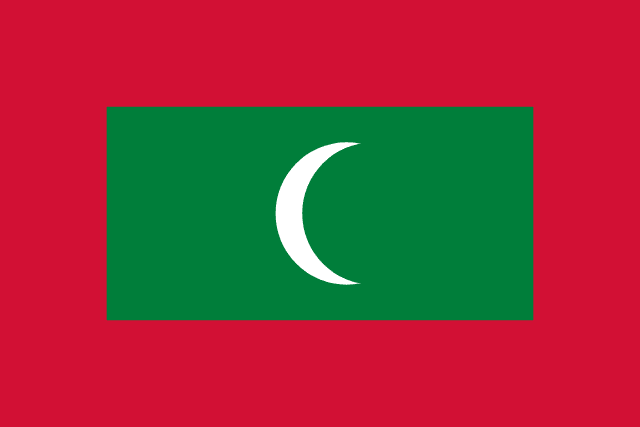
Among the flags of the Indian Ocean's island nations, the banner of the Maldives stands out for its bold simplicity and the quiet precision of its meaning. A field of deep red surrounds a vivid green rectangle, and floating at the heart of that green panel is a white crescent. There is no star alongside the crescent, no inscription, no elaborate emblem, just three colors arranged with such clarity that the flag reads instantly at a distance. For a country spread across roughly twenty-six coral atolls and more than a thousand islands, this compact design carries a surprising amount of history, faith, and national feeling.
A First Look at the Design
The flag follows a layered structure. The outermost layer is a solid red field that borders the flag on all four sides. Inside that red border sits a large green rectangle, and centered within the green is a white crescent moon. The crescent is the only ornament on the entire flag, which gives it a striking, almost graphic quality. Because the green panel is framed evenly by red on every edge, the composition feels balanced and deliberate rather than divided into stripes or quarters as many other national flags are.
One detail rewards a closer look. On the Maldivian flag, the open side of the crescent does not face the hoist (the edge nearest the flagpole) as it does on the majority of crescent-bearing flags around the world. Instead, the crescent opens toward the fly side, the free edge that flutters in the wind. This small orientation choice is one of the most distinctive features of the design and a favorite piece of trivia among flag enthusiasts.
What the Colors Stand For
Each element of the flag carries its own meaning, and together they summarize the values the nation wishes to project. The red field honors the blood of the heroes who defended the country and its independence, a color of sacrifice and courage. The green rectangle represents peace and prosperity, and it also evokes the palm trees that line the islands' shores, a natural emblem of life in an ocean-bound nation. The white crescent is the symbol of Islam, the faith that shapes daily life and national identity across the Maldives.
This reading, where red speaks of struggle, green of peace, and the crescent of faith, is the symbolism the country itself recognizes. It is worth noting how economically the meaning is delivered: three colors, three ideas, and nothing extra to dilute the message.
How the Flag Came to Be
The flag in its current form was adopted in 1965, the same period in which the Maldives moved toward full independence. The design did not appear from nowhere, however. It is a refined version of earlier Maldivian flags, building on banners that had been used in previous decades. The most significant change in the modern era was the addition of the green panel and the white crescent to what had once been a plainer red ensign.
Older Maldivian flags leaned heavily on red, sometimes with a black-and-white striped panel near the hoist that marked them as part of the wider family of regional maritime flags. As national consciousness grew, the green rectangle and crescent were introduced, and earlier decorative stripes were eventually dropped. By 1965 the flag had settled into the clean three-color arrangement recognized today, a design that captured both the country's Islamic heritage and its emergence as a sovereign state. Readers curious about the broader story of the islands can explore our maldives country guide for more context on how the nation took shape.
Comparing It to Similar Flags
The crescent is one of the most widely shared symbols in world vexillology, appearing on the flags of many predominantly Muslim countries, so it is natural to ask how the Maldivian flag differs from its relatives. The flags of Pakistan, Turkey, Tunisia, and others also feature a white crescent, but each pairs it with distinct companions. Pakistan adds a five-pointed star and a broad white hoist stripe on a green field; Turkey places its star-and-crescent on a fully red ground; Tunisia centers its crescent and star inside a white disc.
The Maldives takes a different route entirely. It omits the star, keeps the crescent alone, and frames the whole emblem inside a green rectangle that itself floats on red, rather than letting the crescent sit directly on a single-color field. The result is a layered, picture-frame look that very few national flags share. Add the fly-facing crescent, and the Maldivian flag becomes genuinely difficult to confuse with any other once you know what to look for. Where many crescent flags read as a symbol on a background, this one reads as a symbol within a panel within a field.
A Banner of Faith and Nationhood
For Maldivians, the flag is inseparable from the country's identity as an Islamic republic. The crescent ties the nation visually to the wider Muslim world while the red and green ground it in a specifically Maldivian story of sacrifice and peace. Because the population is concentrated on small, scattered islands, shared national symbols carry real weight in binding the atolls together as a single people, and the flag is among the most visible of those symbols.
It appears on government buildings, at official ceremonies, and in the hands of citizens during moments of national pride. Its design is simple enough that schoolchildren can draw it from memory, which is part of what makes it such an effective emblem: it belongs to everyone, easily reproduced and instantly recognized.
The Flag in Modern Life
Today the flag is woven into the rhythm of Maldivian public life. It flies prominently on Independence Day and Republic Day, when streets and buildings are decorated and parades fill the capital. International sporting events bring the colors out in force, with fans waving the red, green, and white whenever national teams compete. The flag also represents the country abroad, flying at embassies and at gatherings of international bodies where the Maldives takes its seat among the world's nations.
Because the Maldives sits within Asia, in the Indian Ocean southwest of the Indian subcontinent, its flag is also a familiar sight in the tourism imagery that draws visitors to its famous reefs and resorts. For many travelers, the crescent on green is the first symbol they associate with the islands.
Interesting Facts at a Glance
- The crescent opens toward the fly side rather than the hoist, the reverse of most crescent flags worldwide.
- The flag carries no star, unlike many other flags that pair a crescent with a star.
- It was adopted in its modern form in 1965, around the time of independence.
- The design is a refinement of earlier Maldivian banners that were largely red.
- Its three colors map neatly to three ideas: red for sacrifice, green for peace, and the white crescent for Islam.
- The green panel is framed evenly by red on all sides, giving the flag a distinctive picture-frame layout.
Frequently Asked Questions
When was the flag of the Maldives adopted?
The current flag was adopted in 1965, during the period when the Maldives was moving toward full independence. It replaced and refined earlier national banners, most notably by featuring the green rectangle and white crescent in their modern arrangement.
What do the colors of the Maldivian flag mean?
The red field represents the blood of the heroes who defended the nation, the green rectangle stands for peace and prosperity, and the white crescent symbolizes Islam, the faith of the Maldivian people.
What continent is the Maldives on?
The Maldives is part of Asia. It is an island nation in the Indian Ocean, located southwest of the Indian subcontinent and spread across a chain of coral atolls.
How is the Maldivian flag different from other crescent flags?
Unlike many crescent flags such as those of Turkey or Pakistan, the Maldivian flag has no star and places its crescent inside a green rectangle that sits on a red field, creating a layered, framed look. Its crescent also opens toward the fly side rather than the hoist, making it easy to tell apart once you know the detail.